
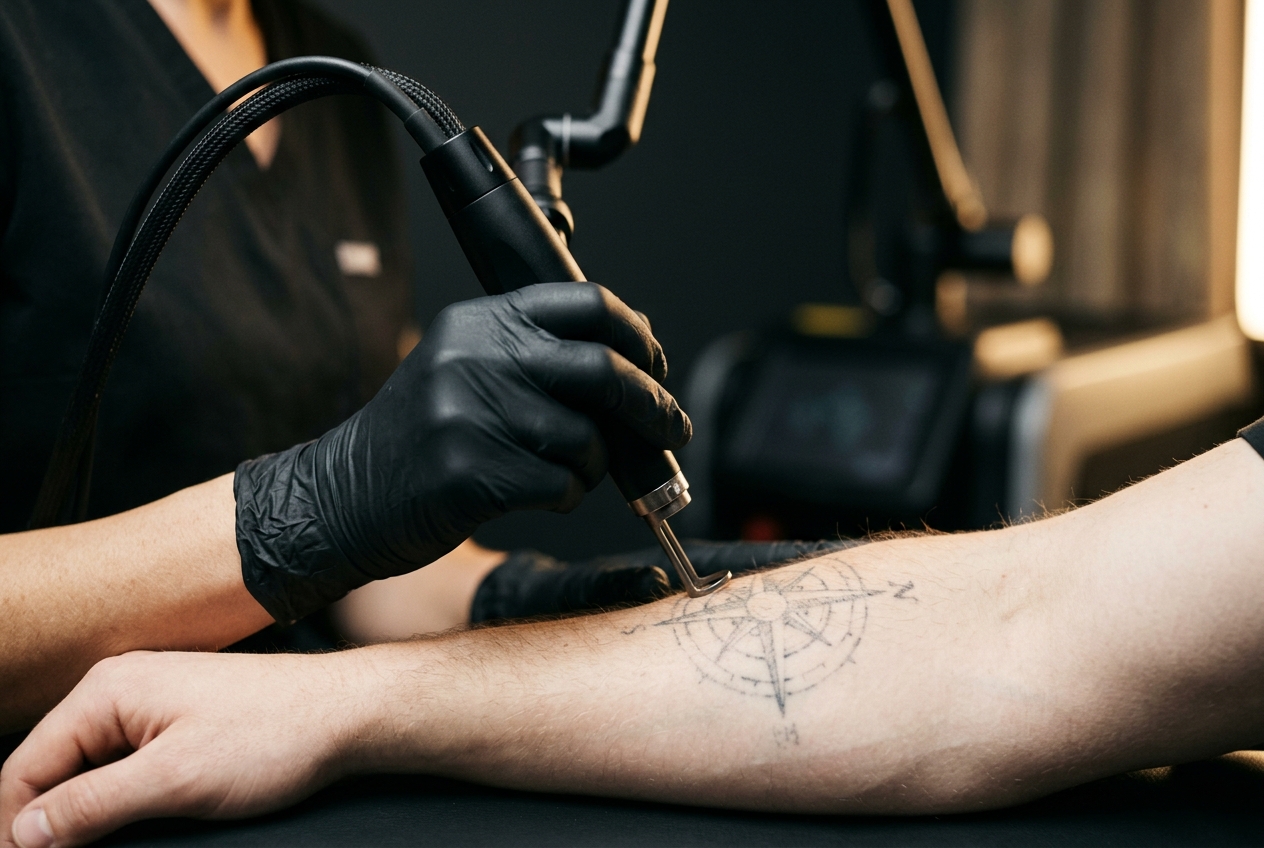
Tattoo removal: science, safety and evidence
What science really knows about tattoo inks, their safety and their laser removal. Rigorous medical information — no scaremongering, no easy promises.
Scientific review: Doctor Florian A. Vallecillo Cabrera · Last reviewed: 2026-06
Would you like an assessment of your tattoo?
Answer a short questionnaire and send us photos of your tattoo: our medical team reviews it and contacts you with guidance and a personalised quote. It is not a diagnosis.
We do not push anyone to erase their story. Our goal is to inform rigorously: what inks contain, what research shows and, for those who wish to remove a tattoo, how to do it safely, with realistic expectations and under medical supervision.
This page is educational. It does not make diagnoses nor replace a medical consultation.
What inks contain and what research shows
Tattoo inks are complex mixtures of pigments and additives. Several scientific studies have analysed their composition and behaviour in the body.
Ink composition
They contain organic pigments (often azo) and inorganic ones, together with solvents, preservatives and trace impurities. The composition does not always match the labelling — which prompted regulatory controls.
Migration to lymph nodes
A synchrotron study (Schreiver et al., Scientific Reports, 2017) showed that pigment particles — especially nano-sized ones — and elements such as titanium, chromium, nickel or copper migrate from the skin to regional lymph nodes, where they can persist long-term.
Heavy metals and impurities
Market analyses have detected metals such as nickel, chromium, lead, cadmium, arsenic, mercury or cobalt, sometimes above recommended limits. Some are sensitisers or toxic.
Azo pigments and aromatic amines
Under UV light, heat or the laser itself, some azo pigments can break down and release aromatic amines, some classified as carcinogenic. This is one reason for the EU regulation.
Do they cause cancer? What we know and don't
The strongest evidence concerns particle migration and deposition and the presence of potentially hazardous substances. However, a direct causal link with cancer in humans is not proven: the data are suggestive, not conclusive. The WHO (IARC) maintains a dedicated research project.
Migration of ink particles
Particles, especially nano-sized, migrate from the skin to regional lymph nodes, where they can persist. Source: Schreiver et al., Scientific Reports, 2017.
The European regulation (REACH)
Since 4 January 2022, Regulation (EU) 2020/2081 — introducing entry 75 of REACH Annex XVII — restricts more than 4,000 hazardous substances in tattoo inks and permanent make-up. Important: it does not ban tattoos nor "recommend removing them"; it regulates which hazardous substances inks may contain and at what concentrations.
- Applicable since 4 January 2022 (EU).
- Pigment Blue 15:3 and Pigment Green 7: restricted since 4 January 2023.
- Covers CMR substances, sensitisers, certain azo dyes, aromatic amines, PAHs, metals and methanol.
- Goal: reduce risk, not remove the tattoo.
How laser removal works
The laser emits ultra-short pulses that fragment ink particles through a photoacoustic effect. The smaller fragments are gradually cleared by the immune system. Picosecond lasers deliver shorter pulses than Q-switched nanosecond systems and, in many cases, clear the tattoo in fewer sessions, especially for difficult colours.
How many sessions will I need?
The number of sessions (often between 4 and more than 15) is an individual estimate. It depends on several factors, summarised in clinical tools such as the Kirby-Desai scale:
- Ink colour (black/blue easier; green, yellow, white harder).
- Ink density and depth.
- Tattoo age (older ones often clear faster).
- Body location (better circulation = better clearance).
- Skin phototype (parameters adjusted to skin colour).
- Professional or amateur, layered tattoos and prior scarring.
Ink colour and laser response
General reference — each case is individual:
- Black
- Dark blue
- Red
- Brown
- Green
- Light blue
- Yellow
- White
Clearance also depends on the laser wavelength, density and depth. It does not guarantee complete removal.
Medical assessment of skin and tattoo
Medical history, phototype and background
Realistic expectations and session plan
Tailored laser parameters
Spaced sessions with follow-up
Aftercare and sun protection
This is what a real laser removal session looks like. We do not show patient results: these are freely licensed documentary images of the procedure.
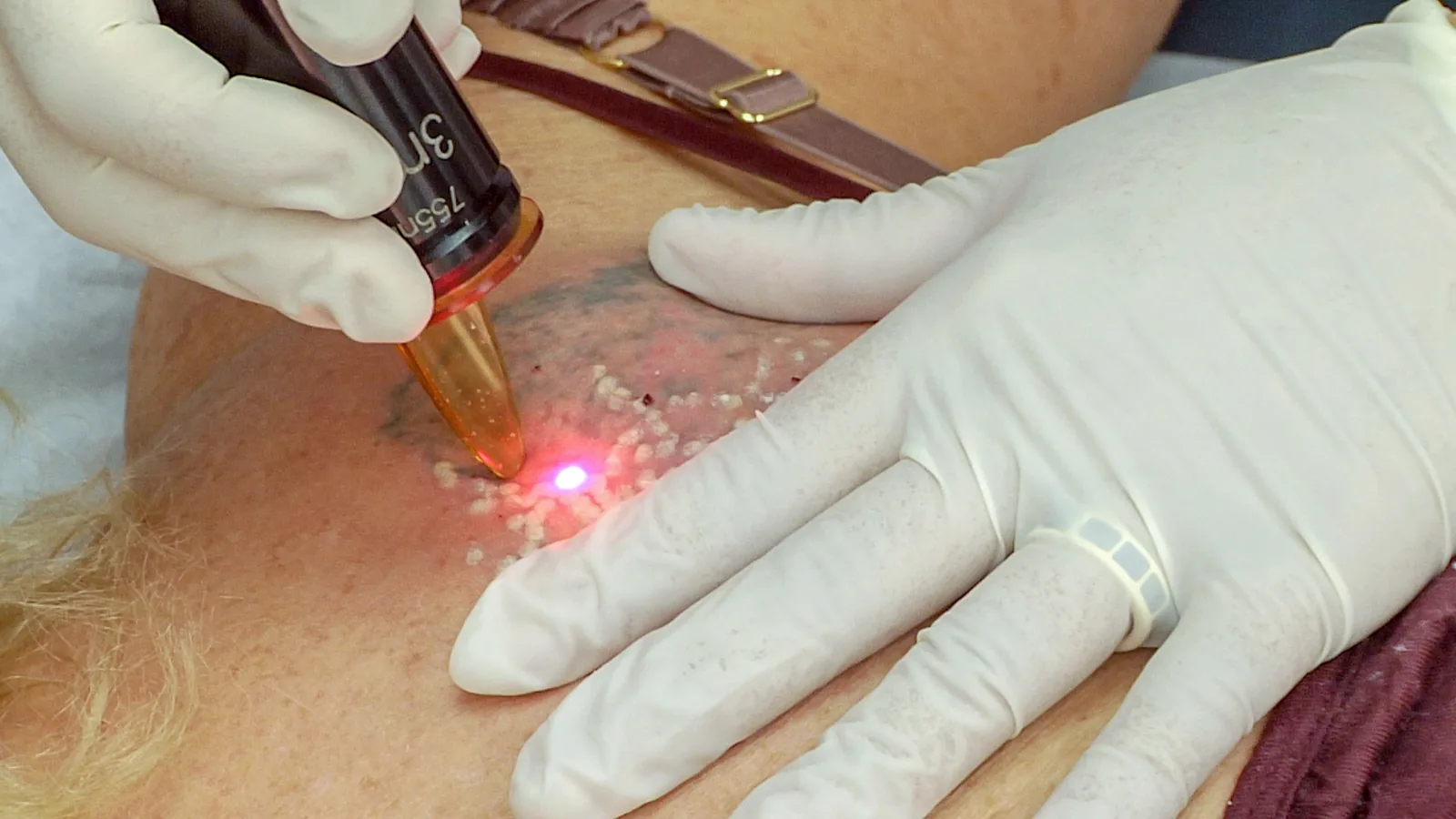
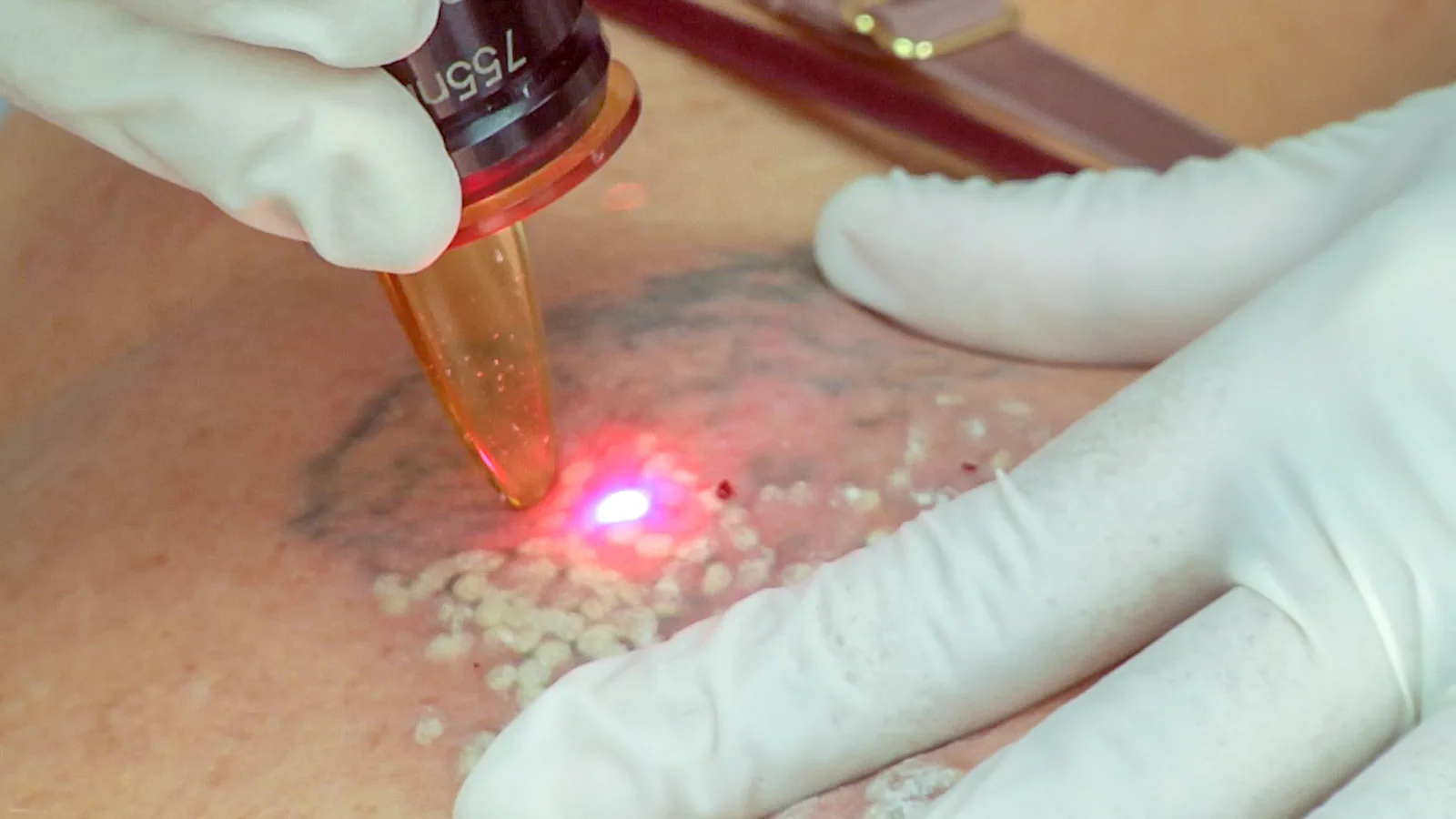
Documentary images under a free license (Wikimedia Commons). They are not results or patients of Clínica Valorian.
Safety and expectations
Laser removal is a medical procedure. It can cause transient effects (redness, blisters, crusting) and, less often, pigment changes or, rarely, scarring. Not all tattoos are fully removed and some colours resist. Certain situations (pregnancy, some skin conditions, a history of abnormal scarring) require caution and an individual assessment. This page does not make diagnoses nor recommend parameters.
Is tattoo ink dangerous?
Some inks contain potentially hazardous substances (metals, aromatic amines) and their particles can migrate to lymph nodes. This is why the EU has restricted many of them. A direct link with cancer in humans is not proven.
Has the EU banned inks?
No. The REACH regulation (2020/2081) restricts certain hazardous substances and their concentrations in inks; it does not ban getting tattooed nor require removing tattoos.
How many sessions will I need?
Usually between 4 and more than 15, depending on colour, density, age, location and phototype. It is estimated individually at the consultation.
Does it hurt and leave a scar?
There is discomfort, manageable with local measures. With appropriate parameters and aftercare, scarring risk is low, though not zero. Pigment changes are usually transient.
Can all colours be removed?
Black and blue respond best. Green, yellow or white are harder and may need more sessions or specific wavelengths; sometimes clearance is not complete.
Does the laser release toxic substances when fragmenting ink?
Fragmentation may release breakdown products from certain pigments. This is why the procedure should be performed under medical supervision, after assessing the tattoo and the skin.
Would you like an assessment of your tattoo?
Answer a short questionnaire and send us photos of your tattoo: our medical team reviews it and contacts you with guidance and a personalised quote. It is not a diagnosis.
Request a consultationScientific sources
- Reglamento (UE) 2020/2081 — REACH Anexo XVII, entrada 75 — EUR-Lex / Comisión Europea, 2020
- Tattoo inks and permanent make-up (hot topic) — ECHA, 2022
- Synchrotron-based ν-XRF mapping — tattoo pigments in skin and lymph nodes — Schreiver et al., Scientific Reports (Nature), 2017
- Tattoos and health — research project (background) — IARC / WHO, 2024
- Questions and answers about tattoo inks — BfR (German Federal Institute for Risk Assessment), 2022
- A study of the number of laser treatments required — Kirby-Desai scale — J Clin Aesthet Dermatol, 2009
A selection of official and peer-reviewed sources. This information does not replace an individual medical assessment.