Radiofrequency and facial HIFU: why I personally do not recommend them for facial rejuvenation
Why I'm telling you this
I will be very clear from the outset: I personally do not recommend deep radiofrequency or facial HIFU as routine rejuvenation treatments.
And I will tell you something even more direct: if these technologies truly worked to rejuvenate the face, I would have them in my clinic. I do not. And below I will explain exactly why.
This is not an opinion I formed recently. I have been observing patients treated with these technologies since approximately 2014 — more than twelve years. And my clinical experience has been repeatedly disappointing. I have seen patients who noticed virtually no improvement, patients who spent significant sums of money hoping for a 'surgery-free facelift' that never materialised, and patients who, months later, report greater hollowing, volume loss, tissues they perceive as weaker, and an overall more aged appearance.
I am Dr Florian Vallecillo, and today I want to explain why I personally do not use these technologies as a routine strategy for facial rejuvenation.
Watch the video
HIFU or radiofrequency: a clinical perspective
First: what do these machines actually do?
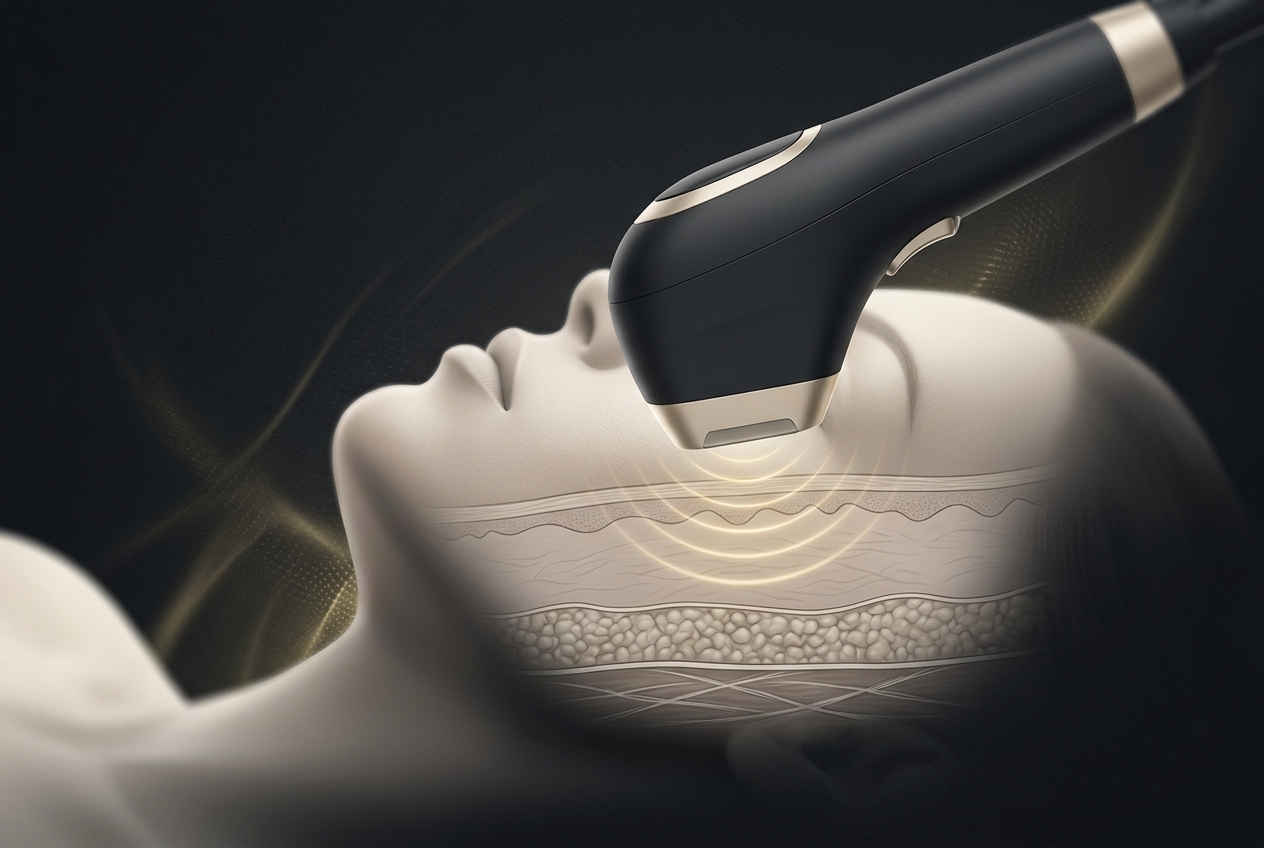
Let's start by cutting through the marketing: there is no magic. Radiofrequency and focused ultrasound use energy to produce heat. In radiofrequency, electrical energy generates heating in the tissues; in HIFU or microfocused ultrasound, acoustic energy is concentrated at specific points and produces zones of thermal coagulation. In other words: a thermal injury is deliberately created. That is precisely the mechanism of the treatment.
And where can that injury occur?
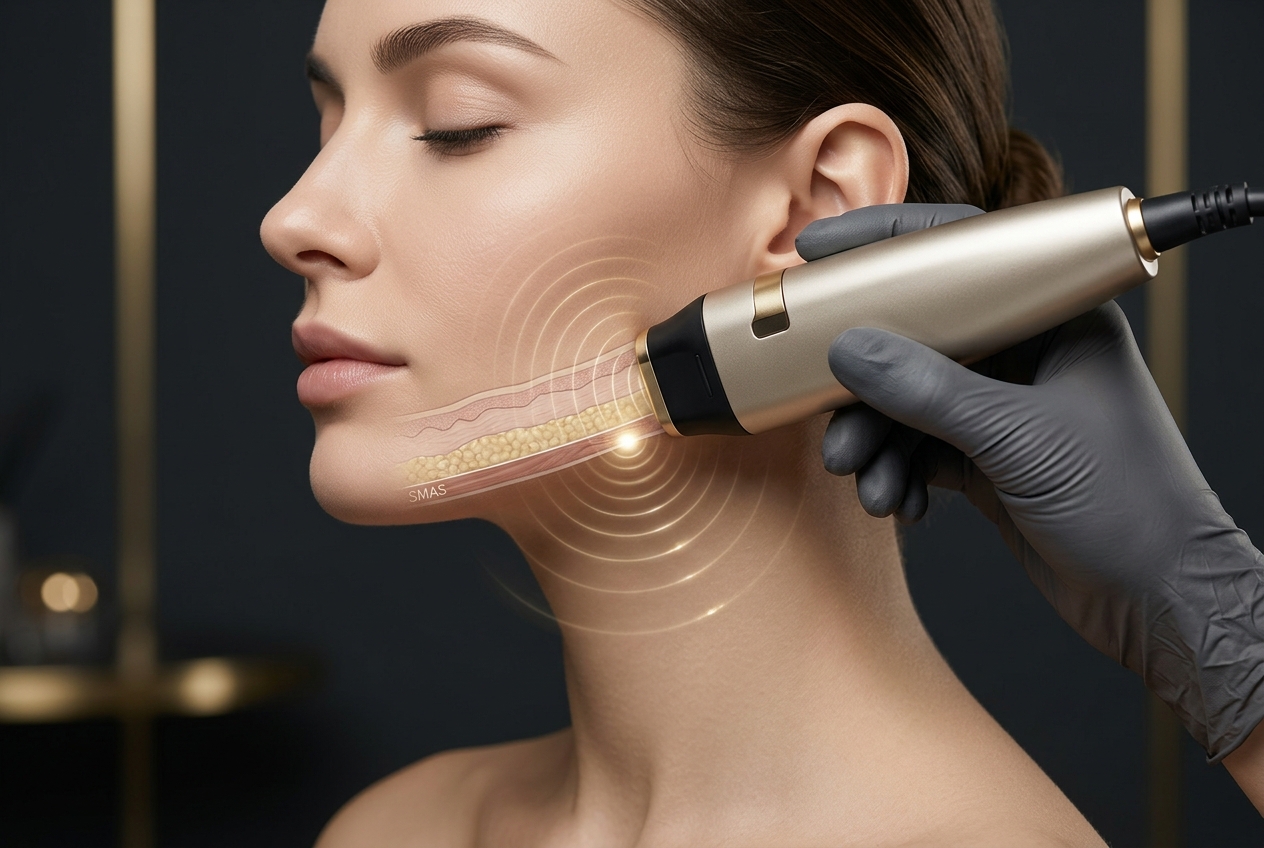
This is a fundamental part of my concern. The face is not simply made up of skin. Beneath it we find the epidermis, dermis, adipose tissue, fascia, SMAS, muscle, vessels and nerves. The SMAS, or superficial musculoaponeurotic system, is a fundamental anatomical structure of the face.
Microfocused ultrasound was developed precisely with the ability to generate focal thermal injuries even at the level of the SMAS; experimental histological studies demonstrated that reproducible zones of thermal injury can be produced at that plane. And that is where my question arises: do I really want to produce thermal injuries in the deep structures of a healthy face in an attempt to rejuvenate it? Personally, no.
The SMAS is not an 'aesthetic layer'
It is a functional structure. It is related to the fascia, the facial musculature, force transmission, movement and tissue support. When a technology is advertised as 'reaching the SMAS', this is usually presented as an advantage. For me, it compels me to ask exactly the opposite question: what happens if that energy does not stay precisely where we want it? Because the therapeutic target is separated by millimetres from muscle, fat, nerves and vessels. And on the face, a few millimetres matter enormously.
A thermal injury produces a repair response
This point also needs to be properly understood. When we injure a tissue, the body responds: inflammation appears, fibroblasts are activated, remodelling of the extracellular matrix occurs and collagen is synthesised. And that is why we constantly hear 'it stimulates collagen'. Yes. But to me that phrase is incomplete. The question is: why are you producing that collagen? Because you have previously caused a thermal injury.
Repair collagen does not automatically mean rejuvenation
I want to be especially clear on this point. When a tissue is injured, the body attempts to repair it through inflammation, reorganisation, matrix synthesis and collagen production; that collagen forms part of a healing and remodelling response. This is normal physiology. But saying 'we have produced collagen' does not automatically mean 'we have rejuvenated the face'. A scar also contains collagen; a repaired tissue contains collagen; fibrosis contains collagen.
That is why, for me, the goal cannot simply be to manufacture more collagen at any cost. What matters to me is which tissue has been injured, how it has been repaired, which structures we have preserved and how that face ages afterwards.
I draw a clear distinction between regeneration and repair
When we talk about rejuvenation, we want to preserve a healthy architecture, improve dermal quality, preserve volume, maintain vascularization, maintain function, and promote an organized extracellular matrix. In contrast, when we induce thermal injury, we activate a repair mechanism. I am not saying that all repair is pathological; that would be incorrect. But I am saying something very important: repairing an injury is not the same as rejuvenating a tissue.
And that is precisely what I question about these machines
To produce the effect sold as a 'lift,' we first generate coagulation, thermal contraction, inflammation, and repair. Personally, I do not find that logic particularly appealing for a face I want to preserve for decades.
Facial musculature also deserves respect
Muscle is not a tissue we can treat as if it were simply filler material. When deep energy reaches muscular planes, a sufficiently significant thermal injury can damage fibers. Muscle has a certain regenerative capacity thanks, among other mechanisms, to its satellite cells, but that capacity is not infinite: it diminishes with age, fibrosis, repeated injuries, inflammation, and other factors. A significant muscle injury may be partially repaired through regeneration and partially through fibrous tissue.
That is why, from my clinical perspective, I do not want to use as a rejuvenation strategy a technology whose action can intentionally approach muscular and fascial planes. That makes no sense within my preservation philosophy.
Can I claim that all HIFU destroys muscle?
No. Nor do I need to claim that in order to justify my position. What we know is that microfocused energy can act on deep planes, including the SMAS, the fascia, and superficial muscular structures. And my clinical decision is precisely not to consider it necessary to subject those planes to thermal injury in order to obtain an aesthetic benefit that, in my experience, I consider poor.
After twelve years, I do not see that famous 'lift'
This is my experience, and I stand by it completely. In the patients I have seen treated with these technologies, I do not find true tissue repositioning, I do not see convincing structural rejuvenation, and I do not see results that justify the promises being made. I mainly see patients with no change, very modest results, or individuals who subsequently report volume loss.
A true lift does not consist of heating tissue
This deserves to be explained. Lift surgery releases planes, repositions structures, corrects descent vectors, and works on anatomy. HIFU produces focal thermal coagulation; radiofrequency heats tissue. These are completely different phenomena. That is why the expression 'surgery-free lift' strikes me as one of the greatest abuses in aesthetic marketing.
Tightening does not mean rejuvenating
Imagine that we achieve some degree of contraction. Perfect. But now let us look at the face as a whole: have we improved the temple, the malar support, the volume, the eyelid-to-cheek transition, the deep structure, the skin quality? Not necessarily. And here lies another of my major objections: an aged face is not simply a face with loose skin.
With age, we already lose volume
Facial aging produces bone resorption, modification of the fat compartments, loss of projection, ligamentous changes, atrophy of certain tissues, and dermal alteration. And this brings us to a fundamental concept: facial fat is youth.
Facial fat is not excess
For years, aesthetic medicine was obsessed with reducing, slimming, emptying, and defining. But one only needs to look at a young face: it has volume, softness, curves, and support. With age, the temple hollows out, the cheek loses projection, the periorbital region becomes skeletonized, and the middle third loses support. Therefore, unwanted fat loss can visually accelerate aging.
And the fat loss associated with these technologies is not imaginary
In October 2025, the FDA issued an alert about serious complications reported with certain microneedle radiofrequency devices, including burns, scarring, fat loss, disfigurement, and nerve injury; some cases required medical or surgical treatment. And that is precisely what concerns me, because facial fat loss can be difficult to correct and, in certain situations, may not recover spontaneously.
The FDA did not say 'these machines do not work'
I want to be precise. The FDA did not issue a statement saying 'radiofrequency is ineffective.' What it said was that serious complications had been reported with certain uses of microneedle radiofrequency and that this constitutes a medical procedure, not a simple cosmetic treatment. And to me, that reinforces a message: these technologies are not harmless.
What concerns me most is repetition
One treatment, then another, then maintenance; once a year, twice a year, over several years. And my question is very simple: what do we really know about the cumulative effect of repeatedly inducing thermal injury in the same facial planes over ten or fifteen years? Personally, I do not have an answer that puts my mind at ease. And when it comes to a purely elective treatment, if I do not see a clear benefit, I do not consider it reasonable to assume that risk.
The aged muscle does not respond the same way as a young muscle
This also matters. Over the years, muscle regenerative capacity decreases, tissue composition changes, susceptibility to fibrosis increases, and repair efficiency diminishes. This does not mean that the adult muscle is incapable of regenerating — it can — but its capacity for repair decreases with age. That is why a deep insult in a patient aged 55 or 65 should not be trivialized as though all tissues will automatically return to their previous state.
And that coincides with something I see in clinical practice
I have seen patients who, after certain treatments, report weakness, a sensation of altered tissue, loss of support, hollowing, and an aged appearance. I cannot retrospectively demonstrate in each patient exactly which structure was damaged, but I can say that those cases have clearly influenced my decision not to routinely use these technologies. That is clinical experience, and it is part of how a physician builds their practice.
Not everything that causes inflammation rejuvenates
This phrase perfectly sums up my position. After thermal injury we can observe edema, inflammation, tissue contraction, remodeling, and collagen synthesis, and all of that can look very impressive in a commercial presentation. But inflammation does not mean youth; healing does not mean youth; contraction does not mean youth; and collagen production does not automatically mean youth.
The goal must be to preserve healthy tissues
My philosophy is exactly the opposite. When I treat a face, I want to preserve useful fat, preserve muscle, preserve function, preserve vascularization, improve the dermis, correct sun damage, and restore structure where it has been lost. I do not want to cause deep damage simply to achieve contraction.
"But you use CO₂ laser"
Yes. And the difference is fundamental. CO₂ laser also produces a lesion, but when I use it I know exactly what my anatomical target is: I can work on the epidermis, the dermis, an actinic lesion, a scar, or perform resurfacing. My goal is not to reach a facial muscle or the SMAS in an attempt to produce a lifting effect. The fact that two treatments both generate heat does not mean they follow the same anatomical logic.
The problem is that technology has become a sales argument
The more sophisticated it sounds — HIFU, multipolar radiofrequency, fractional radiofrequency, microneedles, focused ultrasound — the easier it is to sell as "cutting-edge technology." But a new technology does not automatically equal better medicine. A machine can cost hundreds of thousands of euros and still be the wrong indication for a specific patient.
And I am even more concerned when it is performed outside a medical setting
When deep energies are being delivered, you need to know the anatomy: where the fat is, where a nerve runs, how deep the SMAS lies, how thick the skin is, and how all of that varies across each facial zone. It should not be treated like a beauty facial. The FDA itself insists that radiofrequency microneedling is a medical procedure.
We must stop using pretty words to describe complications
And I want to say something else very clearly: a nerve injury is not 'downtime,' fat loss is not 'remodeling,' a deep burn is not 'collagen stimulation,' and a scar is not 'rejuvenation.'
So, do they work?
My personal answer is: for the type of rejuvenation I seek for my patients, no. I do not deny that a device produces heat, contraction, histological changes and collagen synthesis — that has been demonstrated. What I am saying is that, in my clinical experience, I do not believe this translates into a sufficiently convincing and lasting rejuvenation to justify these technologies. After more than twelve years, they do not convince me, and I do not recommend them on a routine basis.
Does that mean that absolutely no one will see an improvement?
I do not need to say that. There will be patients who describe improvement and there will be studies that find changes. What I am saying is that I do not base my aesthetic medicine on an average response on a photographic scale at three months. What interests me is how the tissue looks, how long it lasts, what has been sacrificed, and how that face ages afterwards. From that perspective, these technologies do not form part of my philosophy.
Serious rejuvenation must think in terms of ten years, not ten weeks
This is perhaps the fundamental difference. Aesthetic medicine has spent far too long focused on the immediate before-and-after photograph. I prefer to ask: how do I want this face to age over the next ten years? By preserving volume, skin quality, structure and function. Not by accumulating thermal treatments simply because they are fashionable.
What I want you to remember
Radiofrequency and HIFU produce thermal energy, coagulation, controlled injury, inflammation, repair and collagen remodelling. Microfocused ultrasound can be directed even towards deep planes such as the SMAS, and that is part of its own technical conception. And certain RF modalities have been associated with serious complications, including fat loss and nerve damage, according to an official FDA safety alert.
My clinical experience of more than twelve years leads me to a clear position: I do not consider these technologies a sound routine strategy for facial rejuvenation. I have no wish to injure muscle, risk fat loss, heat fascia or unnecessarily approach the nerves in an attempt to achieve a contraction that is then sold as a 'lift'.
I am Dr. Florian Vallecillo, and I would like to close with a sentence that perfectly sums up my way of working: rejuvenating is not about provoking an injury and waiting for the healing process to resemble youth. For me, rejuvenating means preserving the tissues that keep a face looking young, improving skin quality, maintaining volume, properly treating photodamage and restoring what has genuinely been lost.
That is why, personally, I do not recommend HIFU or deep radiofrequency as routine facial rejuvenation treatments. Not because they produce no biological effect — precisely because they do — but because, after years of observing how treated patients age, the biological effect they produce is not the one I want for the tissues I am trying to preserve.
What to remember
- —After more than 12 years of observing treated patients, I personally do NOT recommend deep radiofrequency or facial HIFU as a routine rejuvenation strategy. If they truly worked, I would have them in my clinic — I do not.
- —The mechanism is a controlled thermal injury that activates repair and collagen production. But repairing is not the same as rejuvenating: a scar, repaired tissue, and fibrosis also contain collagen; 'producing collagen' is not equivalent to 'rejuvenating'.
- —Microfocused HIFU can direct energy to deep planes (SMAS, fascia, superficial muscle), separated by just millimetres from nerves, fat, and vessels. I have no wish to subject a healthy face to deep thermal injury merely to achieve a contraction.
- —'Surgery-free facelift' is marketing: surgery releases and repositions anatomy; a machine only heats and contracts. Tightening the skin does not rejuvenate if volume is lost, and facial fat is youth.
- —The FDA issued an alert (Oct. 2025) regarding serious complications of radiofrequency WITH microneedles (burns, scarring, fat loss, nerve damage); it did not state that they 'do not work,' but it did underscore that this is a MEDICAL PROCEDURE. Facial fat loss may be irreversible.
- —My philosophy is to preserve healthy tissues (useful fat, muscle, vascularisation, structure) and to think about the face over a 10-year horizon, not a 10-week one. I use CO₂ laser with a precise anatomical objective (epidermis/dermis) — not to reach the SMAS.
You may also like · Aesthetic medicine
Doctor Florian A. Vallecillo Cabrera
The doctor explains
Informational content, written and reviewed by Doctor Florian A. Vallecillo Cabrera. It does not replace an in-person consultation or an individual diagnosis.