CO₂ Laser: why deliberately creating a micro-injury in the skin can regenerate it?
Why I'm telling you this
When I explain to a patient how a CO₂ laser works, there is one sentence that can seem paradoxical: in order to force the skin to renew itself, we first create an extremely precise and controlled injury.
And that is precisely the full power of the CO₂ laser. It is not simply a matter of 'heating the skin', nor of a light used randomly to stimulate collagen.
The CO₂ laser is an ablative laser, used for several decades in dermatology, capable of removing extremely precise amounts of tissue while inducing, around the treated area, a controlled thermal reaction. It can be used for resurfacing and skin rejuvenation, for certain scars, but also for various dermatological indications, including certain lesions related to sun damage.
I am Dr Florian Vallecillo, and today I am going to explain to you what actually happens in your skin when a CO₂ laser is used.

Watch the video
CO₂ Laser: Science and Dermal Repair
Why is it called a CO₂ laser?
Because the medium that produces the laser beam contains carbon dioxide. And this laser emits a very specific wavelength: 10,600 nanometers.
Why does this number matter? Because in laser medicine, we do not choose a wavelength at random. Each wavelength has a particular affinity for certain molecules present in tissues, which we call chromophores. In the case of the CO₂ laser, the primary target is something extremely abundant in our bodies: water. And our skin contains a great deal of water, which explains much of the CO₂ laser's effectiveness.
What happens when the laser contacts the skin?
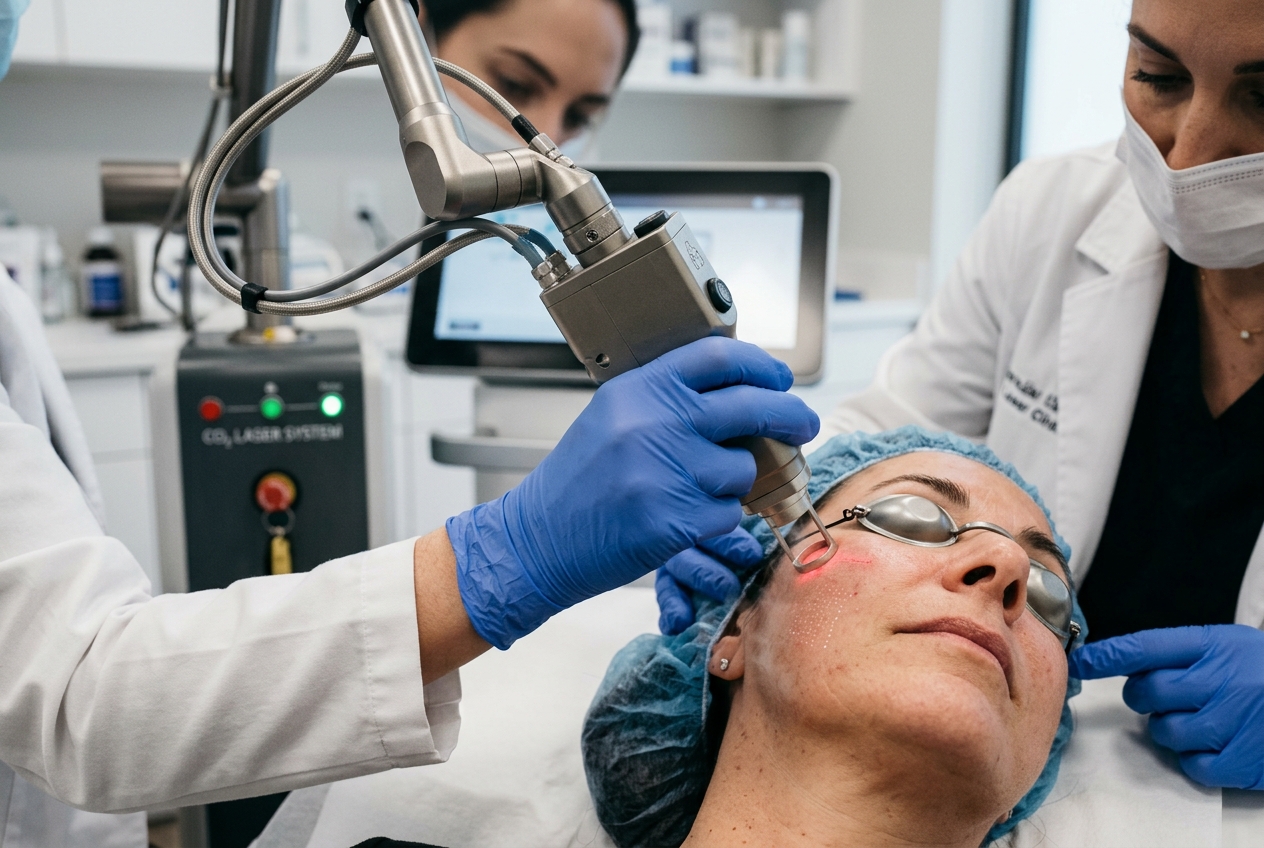
The laser's light energy is absorbed by the water contained in the tissues, then very rapidly converted into heat. When enough energy is delivered, the water inside the cells reaches a temperature that allows for extremely rapid vaporization, and a microscopic quantity of tissue is then ablated. In other words, the laser can literally remove a layer or a microscopic column of skin with very great precision.
But something else also happens in the surrounding area: the heat diffuses slightly into the adjacent tissue and creates a zone of thermal coagulation. We therefore have two phenomena — at the center, controlled ablation; around it, a controlled thermal effect — and this combination triggers an extremely interesting biological response.
The skin understands that it needs to repair itself
Our body possesses an extraordinary capacity: when a tissue is injured, it immediately triggers a repair programme. After a CO₂ laser treatment, the skin therefore enters an organised healing process. An initial inflammatory phase appears, then cells begin to migrate and rebuild the epidermis.
In the dermis, fibroblasts are activated. Fibroblasts are the cells that produce, among other things, collagen, elastin, and various components of the extracellular matrix. The laser therefore does not 'deposit' collagen into your skin: it forces your own skin to initiate a remodelling process. And this process does not stop when the redness disappears.
Your skin can continue working for several months
This is a concept I often explain to my patients. After a few days, the skin heals; after a few weeks, it already looks different. But biologically, the work continues.
Histological and molecular studies have shown, following ablative laser treatment, an increase and reorganisation of various collagens as well as a remodelling of elastic fibres. This dermal remodelling can continue for several months. This is why the result of a CO₂ resurfacing treatment should not be assessed solely fifteen days after the session: the skin continues to restructure itself gradually.
Why is CO₂ used for rejuvenation?
Over time and with repeated sun exposure, several things happen to our skin: collagen becomes disorganised, elastic fibres change, texture becomes less even, fine lines appear, pores can become more visible, pigmentation irregularities may appear, and the epidermis itself sometimes becomes less uniform.
The CO₂ laser acts simultaneously on several of these components. At the surface, it renews part of the epidermis; deeper down, the thermal effect triggers dermal remodelling. It is this dual effect that explains its value in photoageing, fine lines, certain wrinkles, irregular texture, certain scars — acne scars in particular — and certain pigmentation irregularities. This is what we call skin resurfacing: renewing the skin's surface while remodelling its deep structure.
And what is a fractional CO₂ laser?
It is probably one of the most significant advances in this technology. Historically, CO₂ lasers could treat virtually the entire skin surface. This was highly effective, but recovery could be considerable.
The principle of fractioning changed this approach. Instead of treating 100% of the surface, we create thousands of tiny treatment columns. Imagine a field: rather than turning over all the soil at once, we create a multitude of tiny, precisely controlled wells. Between these columns, a portion of the skin remains intact, and this intact skin acts as a true reservoir, allowing cells to migrate rapidly towards the treated areas. Healing therefore becomes much faster: we maintain significant stimulation while considerably reducing the burden of treatment compared with the old fully ablative resurfacing techniques.
Not all CO₂ lasers produce the same treatment
This is fundamental. Saying 'I had CO₂ done' does not provide enough information, because a doctor can adjust many parameters: power, delivered energy, pulse duration, density, spacing between impacts, number of passes, treatment depth, and whether the mode is fractional or non-fractional.
We can therefore vary the intensity of the treatment enormously. A light resurfacing and a much deeper CO₂ treatment will obviously yield neither the same result, nor the same recovery, nor the same risks. This is precisely why the protocol must be chosen according to the skin type, phototype, indication, area, and desired outcome.
CO₂ is not only an aesthetic laser
This is something I feel particularly strongly about. When people hear 'CO₂ laser' on social media, they often think of wrinkles and rejuvenation. But CO₂ is first and foremost a dermatological tool: its ability to precisely vaporise tissue explains its use in various dermatological lesions. And among the lesions that interest me particularly, actinic keratoses stand out.
What is an actinic keratosis?
This is a lesion that appears on skin that has accumulated ultraviolet-related damage. They are frequently found on the face, the balding scalp, the ears, the décolleté, the forearms, and the backs of the hands. They often resemble small rough, scaly, pink or red areas, sometimes only perceptible when you run a finger over them.
They correspond to an abnormal proliferation of keratinocytes linked in particular to ultraviolet damage. These are precancerous lesions: fortunately, not all actinic keratoses progress to cancer, but some can evolve into squamous cell carcinoma. That is why we treat them.
What role can the CO₂ laser play?
In certain selected situations, the CO₂ laser can precisely destroy pathological tissue. But there is also a particularly interesting application: treating a skin field damaged by the sun.
Because sometimes, the problem is not a single keratosis. You can see three lesions, but around them, all the surrounding skin has been exposed to the same ultraviolet radiation for years, and that skin may contain microscopic abnormalities that are not yet visible. We then speak of a field of cancerization. In this situation, treatment can sometimes be conceived not just lesion by lesion, but across an entire area.
Fractional laser can also be used in certain strategies to facilitate the penetration of other treatments, particularly photodynamic therapy. This brings us into what is known as laser-assisted drug delivery: the laser creates microchannels in the skin that can facilitate the penetration of certain therapeutic substances. This is currently a particularly exciting area of laser dermatology.
How long does recovery take after a CO₂ laser treatment?
This is probably the question I am asked most often, and the answer is: it depends entirely on the treatment performed. After a relatively moderate fractional CO₂ treatment, it is common to observe, during the first few days, redness, a sensation of heat, oedema, small dots or microcrusts, a bronzed or rough appearance of the skin, and progressive peeling.
Re-epithelialization generally occurs within a few days for standard fractional treatments, but a socially acceptable appearance may take around one week, sometimes longer depending on the intensity of the treatment and the area involved. With more aggressive treatments, recovery can be longer, and residual redness may persist for several weeks in some individuals. The more we ask of the skin, the more we must accept that it needs time to repair itself: it is a balance between intensity, the desired result, and an acceptable recovery time.
Is it possible to have a CO₂ laser treatment and return to work the next day?
For true ablative resurfacing, this is generally not what I promise my patients, and I prefer to be transparent. The CO₂ laser is effective precisely because it triggers a genuine tissue reaction: for a few days, the skin may be red, swollen, weeping, or covered with micro-crusts depending on the treatment. This is not a complication — it is the healing process. The session therefore needs to be planned with this recovery period in mind.
Is it painful?
Again, it depends on the intensity. For facial resurfacing, we generally use topical local anaesthesia and sometimes other analgesic methods depending on the depth of treatment. During the first few hours, many patients describe a sensation that feels mainly like a severe sunburn, which then gradually subsides.
Why does the skin need to be so carefully protected afterwards?
Because, during the first few days, we have intentionally disrupted its protective barrier: the skin must rebuild its epidermis and is therefore temporarily far more vulnerable. Post-laser care has several objectives: maintaining an environment conducive to healing, avoiding trauma, limiting the risk of infection, controlling inflammation, and above all preventing inappropriate sun exposure. This is particularly important in reducing the risk of post-inflammatory pigmentation.
Can CO₂ treatments be performed on all skin types?
We can treat many patients, but we do not treat all skin types in the same way. Higher phototypes require particular caution, especially regarding the risk of dyschromia and post-inflammatory hyperpigmentation, and recent tanning is also a factor we take into account. This is one of the reasons why autumn and winter are often especially good periods to schedule CO₂ resurfacing: sun exposure is generally much easier to control.
Are there risks?
Yes, and a powerful treatment must always be presented along with its risks. Expected effects include redness, oedema, crusting, peeling, and sensitivity. However, complications are also possible: post-inflammatory hyperpigmentation, hypopigmentation, bacterial infection, reactivation of herpes, persistent redness, and — rarely when the treatment is correctly indicated and performed — scarring. This is why medical history, current treatments, phototype, history of herpes, and sun exposure must all be assessed before the session.
Why is CO₂ still so widely used after so many years?
It is, in the end, an interesting question. The first CO₂ laser dates back to the 1960s. Since then, we have seen dozens of technologies emerge — new wavelengths, radiofrequency, ultrasound, hybrid devices, and non-ablative treatments. And yet, the CO₂ laser is still here.
Why? Because it achieves something very particular: it allows the physician to control very precisely the ablation, the depth, the thermal effect, the density, and therefore the intensity of the reparative response. And above all, its effect is not only visible in before/after photographs: we have observed under the microscope what it triggers in the skin — new collagen, a reorganisation of the dermal matrix, a remodelling of elastic fibres, and re-epithelialisation. This is probably what explains why, several decades after its invention, it remains one of the major technologies in dermatological resurfacing.
What I want you to remember
The CO₂ laser emits a wavelength of 10,600 nm and its primary target in the skin is water. In a few fractions of a second, it creates an extremely controlled ablation and thermal effect. And this micro-injury then triggers something no machine could produce on your behalf: your own repair process. Your epidermis renews itself, your fibroblasts get to work, your dermal matrix remodels, new collagen is produced — and this process can continue for several months.
This is why I use the CO₂ laser both as part of a resurfacing and skin rejuvenation approach and, depending on the indications, as part of a genuinely dermatological approach for certain lesions linked in particular to sun damage.
I am Dr Florian Vallecillo. And if I were to leave you with just one idea today, it would be this: the CO₂ laser does not rejuvenate the skin by concealing its imperfections; it triggers a genuine biological process of controlled destruction, repair, and remodelling. And that is precisely what makes this technology, even today, so valuable in dermatology.
What to remember
- —The CO₂ laser is an ablative laser (wavelength 10,600 nm) whose target in the skin is water: it vaporises a microscopic amount of tissue with great precision.
- —At the centre of the impact, controlled ablation; around it, a zone of thermal coagulation. This dual action triggers the skin's natural repair process.
- —The laser does not 'deposit' collagen: it activates your fibroblasts, which produce collagen and elastin. Dermal remodelling can continue for several months.
- —Fractional mode creates thousands of micro-columns while leaving intact skin between them, which accelerates healing while maintaining strong stimulation.
- —It is not just an aesthetic laser: it is a dermatological tool useful for certain actinic keratoses and field cancerisation, and for laser-assisted drug delivery (photodynamic therapy).
- —A powerful treatment means real recovery time and real risks (hyper/hypopigmentation, infection, herpes, persistent redness…). The protocol is adapted to skin phototype, indication and area; autumn and winter make sun exposure control easier.
You may also like · Aesthetic medicine
- Skinboosters, polynucleotides, collagen inducers: what is the real difference?
- Radiofrequency and facial HIFU: why I personally do not recommend them for facial rejuvenation
- How to choose a good aesthetic physician: warning signs before a treatment
- Botox: does it really stay where it's injected? What science says
Doctor Florian A. Vallecillo Cabrera
The doctor explains
Informational content, written and reviewed by Doctor Florian A. Vallecillo Cabrera. It does not replace an in-person consultation or an individual diagnosis.