
TCA CROSS for acne scars: how it works, results and risks

Why I'm telling you this
Why do some acne scars persist for years? Why do certain deep marks fail to disappear with creams, conventional peels or cosmetic treatments? And how can a localised application of trichloroacetic acid stimulate the reconstruction of a scar?
Quick answer
What is TCA CROSS and which scars is it used for?
This is a focal chemical reconstruction technique that uses trichloroacetic acid to induce a controlled injury within a scar and stimulate its remodeling. TCA CROSS is a useful medical tool for certain atrophic scars, particularly ice pick scars and some deep boxcar scars.

Watch the video
TCA CROSS: how ice pick acne scars are treated
Acne is a very common inflammatory disease. In some patients it resolves without leaving permanent sequelae, but in others it causes scars that alter the texture and surface relief of the skin.
These scars can persist for decades.
Many people seek consultation because they notice small deep pores on their cheeks, skin depressions, or irregularities that become especially visible under lateral lighting.
One of the medical treatments available for certain atrophic scars is TCA CROSS.
This is a focal chemical reconstruction technique that uses trichloroacetic acid to create a controlled injury within a scar and stimulate its remodeling.
Its goal is not to remove the entire superficial skin layer, but to act precisely on selected scars.
In this article we will explain what TCA CROSS is, how it works, which types of scars may benefit, what its limitations are, what results can be expected, and why it must be performed following an individualized medical assessment.
1. What does TCA CROSS mean?
TCA stands for trichloroacetic acid.
CROSS stands for Chemical Reconstruction of Skin Scars.
The technique involves applying the chemical agent in a strictly localized manner to specific atrophic scars.
It should not be confused with a chemical peel applied broadly across the entire face.
The fundamental difference is that TCA CROSS treats specific points, not the entire facial surface.
Learn about the TCA CROSS medical treatment for acne scars at Clínica Valorian
2. What is an atrophic acne scar?
An atrophic scar is a skin depression that forms when the inflammatory process of acne causes destruction of dermal structures and loss of supporting tissue.
During repair, the skin does not fully recover its original architecture.
As a result, a sunken area remains.
Atrophic scars are different from the red or brown marks that can linger after a pimple.
A mark primarily represents an alteration in colour.
An atrophic scar represents a structural alteration of the skin's surface relief.
For this reason, depigmenting treatments alone cannot correct a scar depression.
3. Why do acne scars form?
Intense or persistent inflammation can damage the pilosebaceous follicle and the surrounding tissue.
In certain patients, degradation of extracellular matrix components occurs, including collagen elements.
The subsequent repair may be insufficient or disorganised.
Among the factors associated with a higher risk of scarring, we find:
• Severe inflammatory acne.
• Deep nodular lesions.
• Delayed acne treatment.
• Prolonged inflammation.
• Repeated manipulation of lesions.
• Individual predisposition.
• Certain genetic and wound-healing-related factors.
Not everyone with severe acne develops the same scars.
The inflammatory response and tissue repair vary between individuals.
Part one: understanding the types of scars
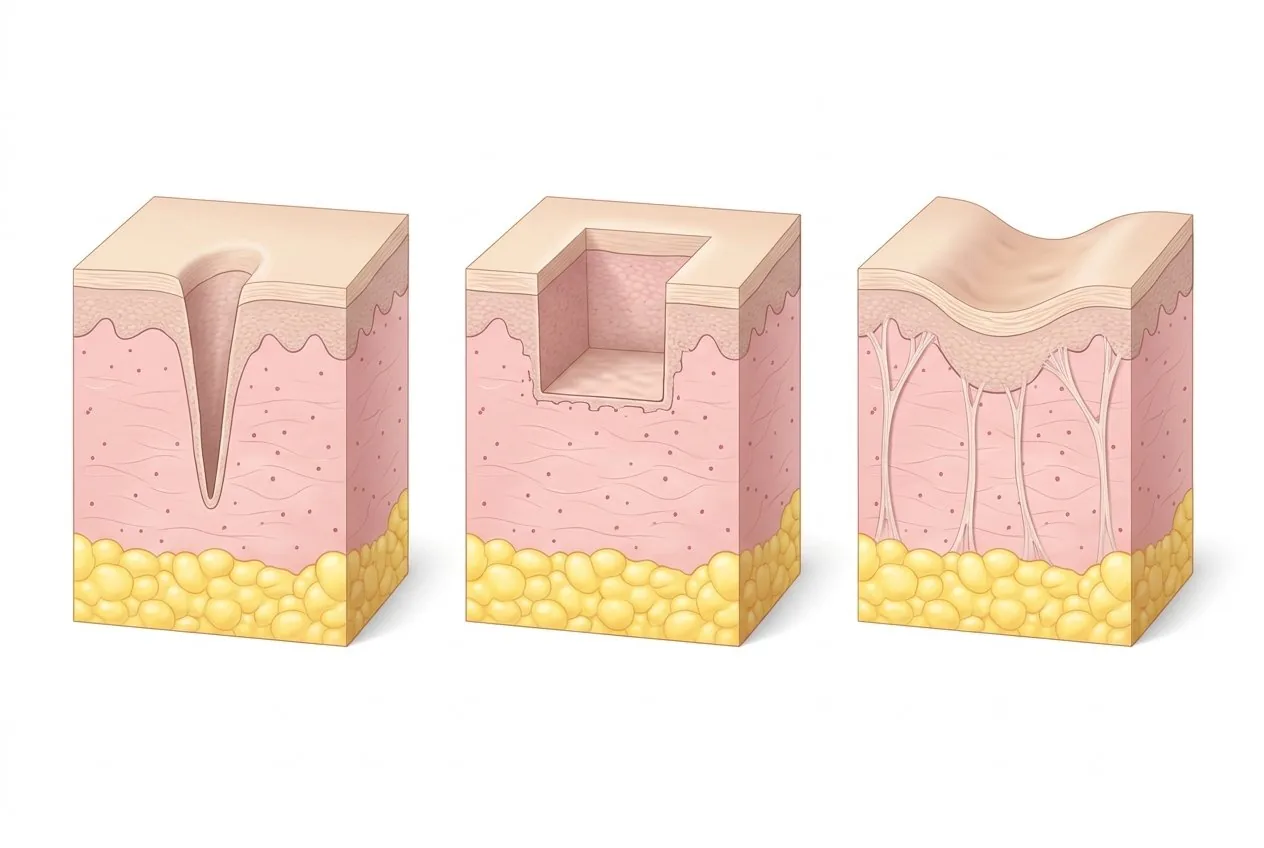
4. Ice pick scars: deep and narrow
Ice pick scars, also called punch scars, are narrow depressions that penetrate deeply into the skin.
They can look like small holes.
Their surface opening is usually relatively small compared to their depth.
They are particularly difficult to correct with treatments that act primarily on the surface.
TCA CROSS is one of the techniques specifically used for this type of scar.
5. Boxcar scars: depressions with defined edges
Boxcar scars present as a depression with relatively well-defined edges.
They can be superficial or deep.
Their shape resembles a small box or crater.
Small, deep boxcar scars may respond to TCA CROSS, although the ideal treatment depends on their width, depth, and edge characteristics.
Wider scars may require other techniques.
6. Rolling scars: skin undulations
Rolling scars produce broad, wave-like depressions.
They are often related to fibrous bands that keep the skin tethered to deeper tissue planes.
In these cases, subcision may be more appropriate to release the adhesions.
TCA CROSS is generally not the first choice when the main problem is fibrous traction.
Subcision for rolling scars: what it is and when it is indicated
7. Hypertrophic scars and keloids
Not all acne scars are depressions.
Some rise above the skin surface due to excessive production of scar tissue.
These scars require a different therapeutic approach.
TCA CROSS is not indicated as a standard treatment for hypertrophic scars or keloids.
8. Comparison table: which scars may benefit?
| Scar type | Characteristics | Role of TCA CROSS |
|---|---|---|
| Ice pick | Narrow and deep | Especially indicated in selected cases |
| Small, deep boxcar | Depression with defined edges | May be useful |
| Wide boxcar | Extensive depression | Generally requires other techniques or a combination |
| Rolling | Undulation and adhesions | Limited role; consider subcision |
| Post-acne mark | Color change without depression | Not the primary indication |
| Hypertrophic scar | Raised skin | Not the standard treatment |
| Keloid | Excessive scar growth | Not routinely indicated |
Guide: which technique for each type of acne scar
Part two: how TCA CROSS works
9. What does trichloroacetic acid do to the skin?
Trichloroacetic acid produces a controlled chemical injury through protein coagulation.
The depth and extent of the injury depend on various factors, such as concentration, the amount applied, technique, and the characteristics of the tissue.
When used in a focal manner within a scar, it triggers a repair process.
This process can promote dermal remodeling and the formation of new collagen.
The goal is to progressively reduce the apparent depth of the scar and improve its integration with the surrounding skin.
10. Why can a controlled injury improve another injury?
It may seem contradictory to use a chemical agent that produces an injury to treat a scar.
The explanation lies in the skin's reparative response.
A localized chemical injury can trigger:
• Protein coagulation in the treated tissue.
• Controlled inflammatory response.
• Activation of repair mechanisms.
• Remodeling of the extracellular matrix.
• Formation and reorganization of collagen.
• Gradual modification of the scar's surface relief.
The goal is not to indiscriminately destroy tissue, but to stimulate focal repair.
Precision is essential because excessive injury can worsen the scar.
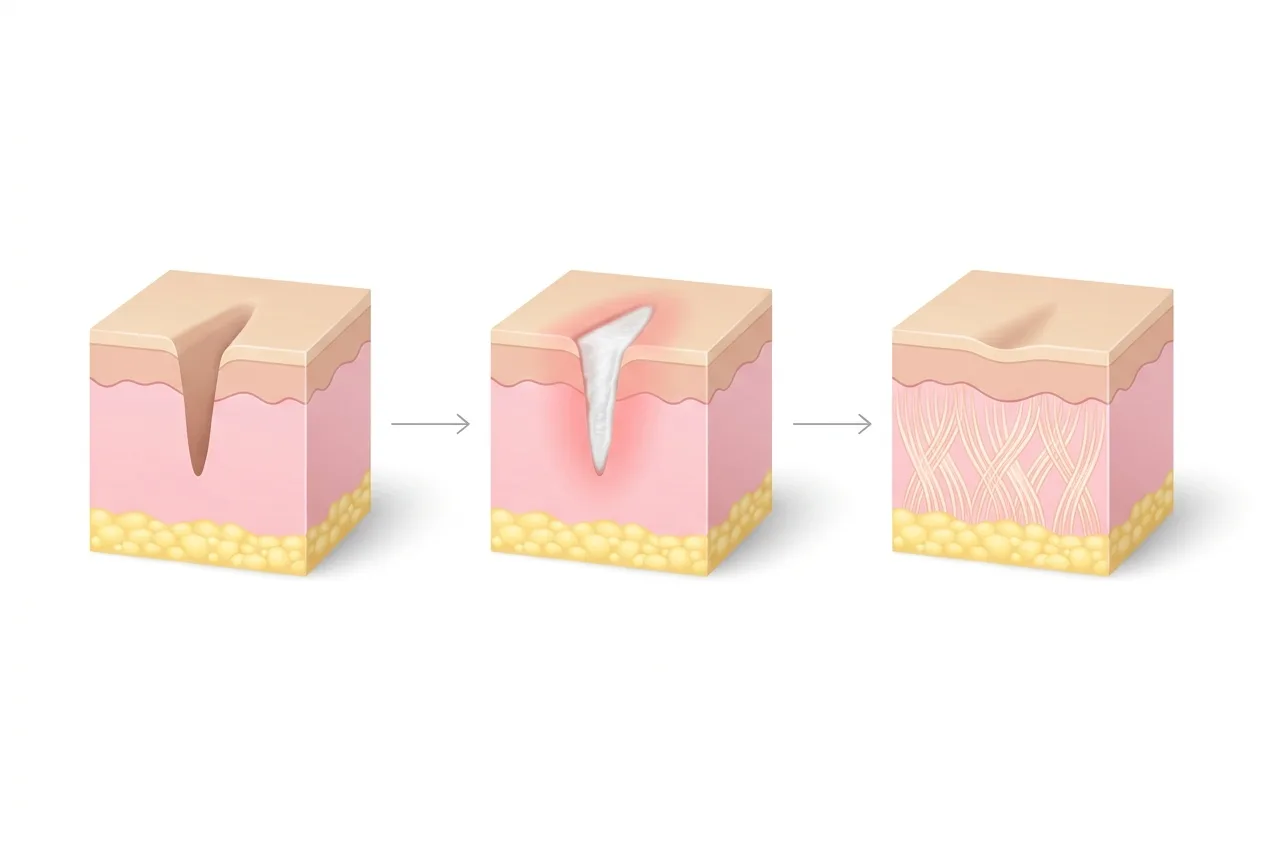
11. What is frosting?
During the application, a localized whitish coloration known as frosting may appear.
It is related to the coagulation of proteins caused by the acid.
It is a visible response of the treated tissue.
It should not be interpreted as a sign that the more intense or extensive the injury, the better the result will be.
Extension beyond the scar can increase the risk of complications.
12. Is TCA CROSS the same as a TCA peel?
No.
A conventional peel applies a chemical agent over a relatively large surface area, with goals such as improving certain pigmentation or texture irregularities.
TCA CROSS applies the acid in a focal manner to selected scars.
Although both use trichloroacetic acid, their indications, concentrations, techniques, and risks are different.
One should not attempt to replicate a TCA CROSS using a conventional facial peel at home.
13. What concentrations are used?
The scientific literature has studied TCA CROSS with high concentrations, typically between 50% and 100%.
The choice of concentration should not be based on the idea that a higher percentage always provides better results.
Comparative studies have found improvements with different concentrations, while higher ones may increase the risk of irritation, pigmentary alterations, and other adverse effects.
The appropriate concentration depends on the medical evaluation and the technique.
Part Three: Assessment Before Treatment
14. Who can be a candidate?
It may be considered in individuals presenting with localized atrophic scars, particularly ice pick and certain boxcar types.
Before recommending it, the following should be evaluated:
• Scar type.
• Depth.
• Width.
• Number of lesions.
• Facial distribution.
• Skin phototype.
• Tendency toward hyperpigmentation.
• History of abnormal scarring.
• Presence of active acne.
• Recent treatments.
• Patient expectations.
The selection of scars is one of the keys to the outcome.
15. Should active acne be treated first?
Generally, yes.
If the patient continues to develop significant inflammatory lesions, new scars may appear during the correction process.
That is why it is advisable to bring the acne under control before starting a treatment program for its sequelae.
In certain cases, both problems can be addressed within a coordinated medical plan.
16. Can it be performed on darker skin tones?
It can be considered, but it requires special caution.
Higher phototypes show a greater predisposition to certain pigmentary changes following inflammation.
Among these, post-inflammatory hyperpigmentation stands out.
This does not mean that the treatment is automatically contraindicated in all darker skin tones.
It means that the indication, concentration, technique, and follow-up must be individualized.
The available evidence in phototype VI remains limited.
17. What happens if the patient has a tendency to form keloids?
It is important to identify a history of hypertrophic or keloidal scarring.
The decision must take into account the individual risk and the available alternatives.
A technique intended to improve scars should not be applied without first assessing the patient's healing capacity.
18. What happens if the patient has used isotretinoin?
Recent use of isotretinoin must be part of the clinical history.
Historically, it was recommended to delay numerous procedures for several months after treatment.
However, modern evidence questions the need to apply a blanket prohibition to all cutaneous interventions.
Not all procedures have the same depth or the same risk.
In the case of TCA CROSS, the decision must be individualized taking into account the type of procedure, the skin condition, and the specific available evidence.
19. When should treatment be postponed?
It may be necessary to postpone it in the presence of:
• Active infection in the area.
• Open wounds.
• Severe dermatitis.
• Significant irritation.
• Recent sun exposure with skin inflammation.
• Uncontrolled inflammatory acne.
• Inability to follow post-treatment care.
• Other conditions that impair healing.
A medical evaluation will determine whether a contraindication exists or whether it is simply necessary to wait.
Part Four: how a session is performed
20. What does the procedure involve?
The session begins with an assessment of the scars to be treated.
After preparing the skin, the physician performs a focal application of the chemical agent to the selected scars.
The application must be carefully confined to the indicated area.
Localised frosting may be observed.
The treatment is not intended to produce a generalised burn across the face.
The procedure is carried out in a medical office and is usually relatively brief, depending on the number of scars.
21. Is it painful?
It may produce a localized stinging or burning sensation.
The intensity varies between patients and depends on the characteristics of the procedure.
The need for anesthesia must be assessed on an individual basis.
Not all sessions require the same pain management.
22. How long does a session last?
The duration depends primarily on the number of scars and the complexity of the case.
Focal treatment can be performed in a few minutes, although the medical visit includes assessment, preparation, the procedure itself, and post-procedure instructions.
23. What does the skin look like immediately afterward?
It is common to observe small whitish areas at the treated points, followed by localized erythema.
Small crusts may appear in the days that follow.
The specific course of healing depends on the intensity of the tissue response and the characteristics of the skin.
Part Five: Recovery and Aftercare
24. What happens during the first 24 hours?
The following may occur:
• Redness.
• Sensitivity.
• Stinging.
• Mild localized inflammation.
• Color changes at the treated points.
The intensity should be consistent with the procedure performed.
Disproportionate pain, progressive inflammation, or extensive alterations require reassessment.
25. When do scabs appear?
They may appear during the first few days.
These small scabs are part of the repair process.
They should not be removed manually.
Manipulating them can increase the risk of inflammation, infection, and pigmentary changes.
26. How long does the skin take to recover?
Small scabs usually shed during approximately the first week, although the time varies.
Redness may persist for longer.
Collagen remodeling continues for weeks or months.
Visible surface recovery does not mean that the dermal remodeling process has ended.
27. What care is important?
After the treatment, specific medical instructions must be followed.
These typically include:
• Gentle cleansing.
• Avoiding picking at scabs.
• Using the recommended repairing products.
• Avoiding irritants while the skin heals.
• Protecting the area from the sun.
• Refraining from aggressive exfoliation.
• Reporting signs of infection or abnormal healing.
Photoprotection is especially important to reduce the risk of post-inflammatory hyperpigmentation.
28. Can I sunbathe?
Intense sun exposure should be avoided during the recovery phase.
Recently inflamed skin can develop pigmentation irregularities more easily.
Your doctor will advise you when to resume your usual activities and how to maintain adequate photoprotection.
29. Can I wear makeup?
It depends on the condition of the skin and the subsequent instructions provided.
Irritating or potentially contaminating cosmetics should not be applied to eroded areas.
The reintroduction of makeup must be adapted to the healing process.
Sixth part: results and number of sessions
30. How many TCA CROSS sessions are needed?
There is no universal number.
Many clinical protocols use several sessions separated by weeks.
Programs of approximately three to six sessions are frequently described in the literature, although some patients require fewer and others may need additional or combined treatments.
Planning depends on the type and number of scars, the individual response, and tolerance.
31. When do results start to become visible?
Improvement is not usually immediate.
The goal is to induce progressive remodeling.
Changes may become more evident after several sessions and during the following months.
For this reason, a photograph taken a few days after treatment does not represent the definitive result.
32. Do scars disappear completely?
Complete disappearance cannot be guaranteed.
The realistic goal is to improve their depth and appearance.
Some scars respond better than others.
Deep or complex scars may require a combined approach.
33. What percentage of improvement can be expected?
Scientific publications describe meaningful improvements in selected patients.
However, results depend on the scale used, the type of scar, the number of sessions, and the combination of treatments.
A 2026 review brought together 34 publications and 937 patients, with generally favorable results, but also with significant methodological variability.
For this reason, it would not be appropriate to promise each patient a fixed percentage of improvement.
34. Are the results permanent?
The structural remodeling achieved may be long-lasting.
However, the skin continues to age, and new scars may appear if acne remains active.
The duration of results depends on multiple factors.
Seventh section: risks and complications
35. Is TCA CROSS safe?
It can be a useful and reasonably well-tolerated treatment when correctly indicated and performed by a qualified professional.
But it is not without risks.
The application of a high-concentration caustic acid demands precision.
36. Post-inflammatory hyperpigmentation
It is one of the most significant complications.
After inflammation, some areas may take on a darker brown coloration.
The risk may be higher in certain skin phototypes and in patients with a predisposition to pigmentation changes.
Photoprotection and appropriate patient selection are essential.
37. Hypopigmentation
In some cases, a decrease in pigment may occur in the treated area.
Some alterations may be persistent.
This risk must be explained before the procedure.
38. Prolonged redness
Erythema may persist longer than expected.
It is important to differentiate a prolonged inflammatory course from other complications.
39. Worsening of the scar
Excessive application or unwanted spread of the chemical agent can produce a more extensive lesion.
In certain cases, the scar may increase in size or change unfavorably.
This explains why precision is just as important as patient selection.
40. Union of adjacent scars
When several scars are very close together, a chemical injury that spreads between them can promote the formation of a wider depression.
The planning of treatment points must take this possibility into account.
41. Ocular and mucosal risk
Concentrated trichloroacetic acid can cause serious chemical injuries if it comes into accidental contact with the eyes or mucous membranes.
Protection of sensitive structures is indispensable.
42. Infection and abnormal scarring
Although they are not the most common complications, secondary infection or alterations in the healing process may occur.
The patient must be aware of the warning signs and have clear instructions for contacting the clinic.
Part Eight: TCA CROSS versus other treatments
43. TCA CROSS and fractional CO₂ laser
Fractional CO₂ laser produces micro-zones of controlled thermal injury and stimulates skin repair and remodelling processes.
It may be useful for improving certain texture irregularities and atrophic scars.
TCA CROSS acts in a focal manner on selected scars.
These are not identical techniques.
In a patient with deep ice pick scars and more extensive texture irregularities, both modalities can play complementary roles.
44. TCA CROSS and subcision
Subcision aims to release fibrous bands that keep certain depressed scars tethered.
It is especially relevant for some rolling scars.
TCA CROSS seeks focal chemical remodeling.
The choice depends on the mechanism producing the depression.
45. TCA CROSS and microneedling
Microneedling creates mechanical micro-injuries to stimulate skin repair.
It can be used for certain types of scars and texture irregularities.
However, very narrow and deep scars may require more specific techniques.
46. TCA CROSS and punch excision
Punch excision is a surgical technique used for certain deep scar defects.
It may be useful when the geometry of the scar makes adequate correction through remodeling procedures unlikely.
The decision depends on the size, depth, and location.
47. Can several treatments be combined?
Yes, in certain patients a multimodal approach may be appropriate.
The combination must be carefully planned, respecting recovery times and avoiding the accumulation of excessive injury.
It does not mean that all procedures need to be performed in the same session.
48. Comparative treatment table
| Treatment | Main objective | Scars where it may be especially useful |
|---|---|---|
| TCA CROSS | Focal chemical remodeling | Ice pick and some deep boxcar |
| Fractional CO₂ laser | Remodeling and texture | Various atrophic scars |
| Subcision | Releasing adhesions | Rolling and anchored scars |
| Microneedling | Dermal stimulation | Selected irregularities |
| Punch excision | Focal surgical correction | Selected deep defects |
| Combined treatments | Addressing different mechanisms | Mixed scars |
Ninth part: what the scientific evidence says
49. What do we know about the efficacy of TCA CROSS?
Scientific reviews describe favorable results, especially in ice pick scars.
However, there is heterogeneity among studies.
Concentrations, techniques, assessment scales, phototypes, and number of sessions all vary.
This limits the possibility of establishing a single protocol for all patients.
50. Is it better to use TCA at 80% than at 50%?
A clinical study published in Dermatologic Surgery in 2024 compared concentrations of 50% and 80% in ice pick scars.
Both produced improvement.
Although some measurements favoured 80%, the difference in improvement between both sides did not reach statistical significance, while adverse effects were more significant with 80%.
This serves as a reminder that a higher concentration does not guarantee a proportional clinical advantage.
51. What do the 2025 and 2026 studies contribute?
Comparative research and recent reviews have reinforced the need to individualize treatment.
The evidence suggests that efficacy depends on scar morphology, technique, number of sessions, and combination with other procedures.
High concentrations may increase the risk of complications.
The current trend is to carefully select each lesion and use a patient-tailored approach.
Tenth section: frequently asked questions
52. Is TCA CROSS useful for acne spots?
It is not its primary indication.
It is aimed at certain depressed scars.
Red or brown marks require a different evaluation.
53. Is it effective for old scars?
Yes, it can be considered for scars that have been established for years.
Age is not the only factor that determines the response.
54. Can it treat very deep scars?
It can be especially useful for some narrow and deep scars.
However, certain lesions may require focal surgery or other procedures.
55. Can it be performed on the nose?
The location requires individual assessment.
Areas close to mucous membranes and sensitive structures require special caution.
56. Can it be performed on adolescents?
The indication must take into account age, acne activity, skin maturity, risks, and clinical situation.
It should not be decided solely for cosmetic reasons without an appropriate evaluation.
57. Is it necessary to anaesthetise the entire face?
Not necessarily.
The procedure is focal and pain management is individualised.
58. Can it be performed in summer?
The time of year is not the only relevant variable.
Sun exposure, skin phototype, the ability to follow photoprotection measures, and the risk of pigmentation must all be assessed.
In patients with anticipated intense sun exposure, it may be preferable to postpone the procedure.
59. When can I return to work?
It depends on the extent of the treated area and the appearance of the skin.
Some people resume their activities quickly, although scabs and redness may remain visible for several days.
60. What happens if I only have two or three scars?
TCA CROSS may be particularly interesting when there are few suitable focal scars to treat.
It is not always necessary to treat the entire face.
61. Is it better than CO₂ laser?
There is no universally superior treatment for all scars.
TCA CROSS and fractional CO₂ laser work in different ways.
The choice depends on the morphology of the scars and the therapeutic objectives.
62. Can I buy trichloroacetic acid and do it at home?
It is not advisable.
The concentrations used in TCA CROSS can cause chemical burns, eye injuries, permanent pigmentation changes, and new scars.
The treatment requires medical indication, knowledge of the technique, and safety measures.
63. Why can't a cream achieve the same result?
Because a deep atrophic scar represents a structural alteration of the tissue.
Creams can improve certain aspects of the skin, but they do not usually reconstruct a deep dermal depression on their own.
Conclusion: treating the right scar with the right technique
Acne scars are not all alike.
Some are superficial, others are deep, some are adhered to underlying tissue planes, and others have very well-defined edges.
That is why treatment should not be decided solely based on the name of a technology.
TCA CROSS is a useful medical tool for certain atrophic scars, especially ice pick scars and some deep boxcar scars.
Its action is based on inducing a focal, controlled chemical injury that stimulates tissue remodeling.
However, it is neither a harmless procedure nor a universal solution.
Patient selection, identification of each individual scar, control of the application, and aftercare largely determine its safety.
The goal is not to apply the strongest acid possible. The goal is to achieve effective remodeling with the least reasonable risk.
In many patients, the best outcome comes from combining different techniques to address different structural problems.
Before starting any acne scar treatment, it is important to carry out an individualized medical assessment.
What to remember
- —TCA CROSS is a useful medical tool for certain atrophic scars, especially ice pick scars and some deep boxcar scars.
- —Its action is based on triggering a focal, controlled chemical injury that stimulates tissue remodelling.
- —It is neither a harmless procedure nor a universal solution.
- —The goal is not to apply the strongest acid possible. The goal is to achieve effective remodelling with the lowest reasonable risk.
- —In many patients, the best outcome comes from combining different techniques to address different structural problems.
Scientific references
- DermNet. TCA CROSS. Información clínica sobre indicaciones, mecanismo, recuperación y complicaciones. · DermNet
- Stratman S, He H. The Use of Chemical Reconstruction of Skin Scars (CROSS) Method With Trichloroacetic Acid (TCA) for Atrophic Scars: A Comprehensive Review on Application Techniques, Adjunct Therapies, and Complications. Journal of Clinical and Aesthetic Dermatology. 2026. · PubMed
- Use of Trichloroacetic Acid in Treatment of Atrophic Acne Scars: A Scoping Review. Journal of Cosmetic Dermatology. 2026. · DOI
- Thuy LND et al. Comparing the Use of 80% Trichloroacetic Acid and 50% Trichloroacetic Acid for the Treatment of Ice Pick Acne Scars. Dermatologic Surgery. 2024. · DOI
- Practical Aspects of Acne Scar Management: ASAP 2024. Revisión de modalidades terapéuticas para cicatrices de acné. · PMC
- DermNet. Acne Scarring. Clasificación de cicatrices y opciones terapéuticas. · DermNet
Do you have deep acne scars? At Clínica Valorian, Marbella, we carry out an individualised medical assessment to determine which treatments may be appropriate based on your scar type and skin characteristics.
You may also like · Aesthetic medicine
- After a laser, peel, or aesthetic treatment: what is your skin actually doing to repair itself?
- Stem cell-derived growth factors: the future of skin rejuvenation?
- Facial rejuvenation: what treatments exist and which one may be right for each skin type
- Forehead wrinkles: why they appear and how to treat them
Doctor Florian A. Vallecillo Cabrera
The doctor explains
Informational content, written and reviewed by Doctor Florian A. Vallecillo Cabrera. It does not replace an in-person consultation or an individual diagnosis.
Before proposing any treatment, Clínica Valorian offers aesthetic medicine in Marbella with a personalised assessment.


