
Subcision for rolling-type acne scars: what it is and when it is indicated
A medical technique designed to release the fibrous bands that pull certain acne scars downward. At Clínica Valorian we do not perform it, but we assess your scars and guide you.
Key points
- Designed primarily for rolling scars with fibrous adhesions
- Releases the bands that anchor the skin downward
- At Clínica Valorian: assessment and guidance (we do not perform subcision)
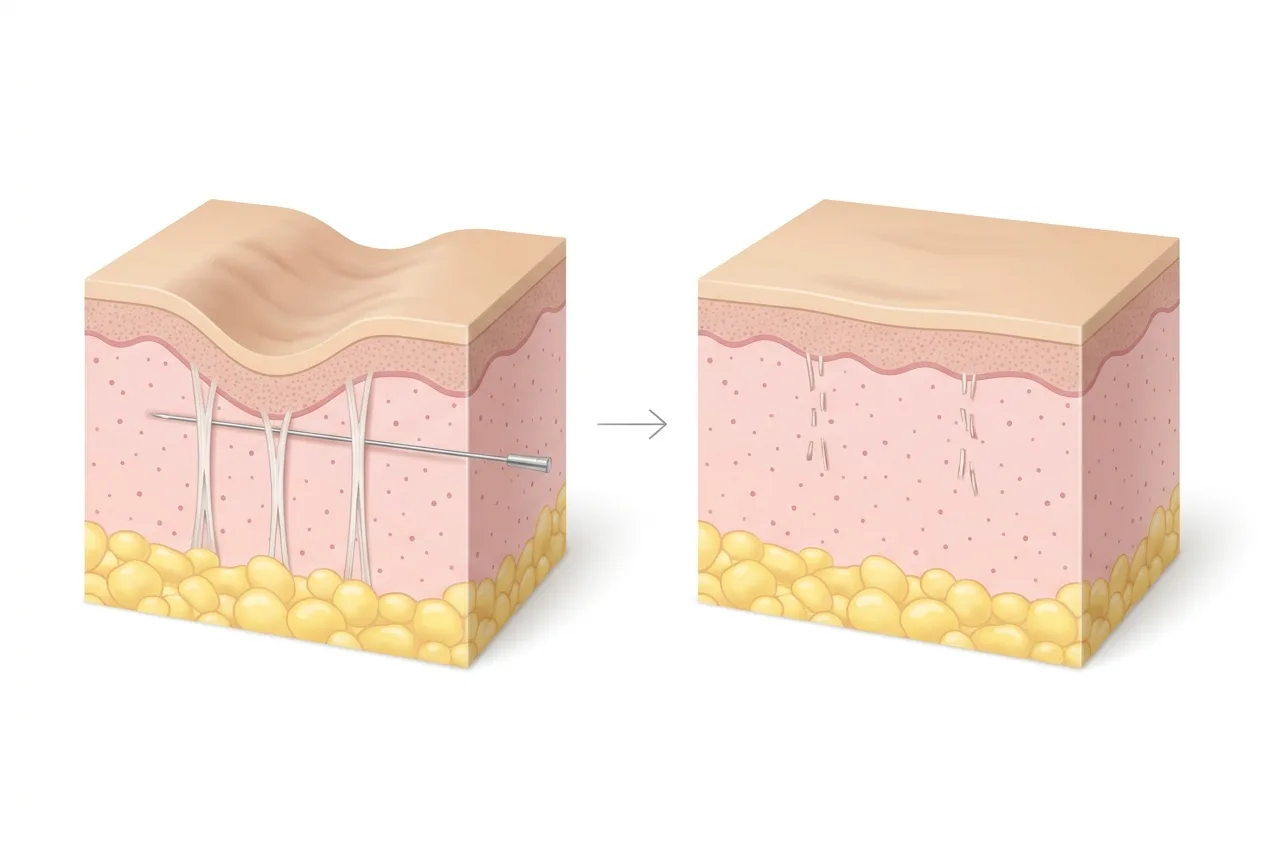
Rolling-type acne scars are broad, wave-like depressions that give the skin an uneven appearance, especially in raking light. They are often caused by fibrous bands that connect the skin to deeper tissue layers and 'pull' it downward.
Because of this mechanism, techniques that act only on the skin's surface tend to have a limited effect on this type of scar. Subcision is proposed precisely to address those adhesions.
What is subcision?
Subcision is a minimally invasive medical procedure. Under local anaesthesia, a needle or fine cannula is inserted beneath the skin through a small entry point to cut or release the fibrous bands located below the scar.
By releasing these adhesions, the skin is no longer anchored downward and can lift. In addition, the small controlled injury created beneath the scar stimulates the formation of new connective tissue and collagen.
Which scars is it indicated for?
Subcision is used mainly for rolling scars and, in some cases, for certain wide boxcar scars with smooth edges.
It is not the appropriate technique for ice pick scars — narrow and deep — for which TCA CROSS is usually considered.
TCA CROSS for ice pick scarsA simple guide: if gently stretching the skin with your fingers causes the scar to fade, there is likely an adhesion component present. This impression should always be confirmed by a doctor.
How it is performed and what to expect
The procedure is carried out under local anaesthesia. Its duration depends on the number and extent of the scars being treated.
Afterwards it is common for swelling and bruising to appear in the area, which usually subsides within one to two weeks.
Improvement is gradual and several sessions, spaced a few weeks apart, are often needed.
Risks and precautions
Like any medical procedure, subcision can have adverse effects: bruising, prolonged inflammation, infection, pigmentation changes, or the formation of small nodules under the skin.
This is why it must be performed by a professional with training and experience in this technique, following a medical assessment and with realistic expectations.
Subcision and other techniques
Acne scars are often mixed: rolling, boxcar, and ice pick scars can coexist on the same face. This is why treatment must be tailored to the morphology of each scar and not limited to a single technique.
Subcision works in depth on adhesions; TCA CROSS treats ice pick scars in a targeted way; fractional CO₂ laser can improve texture and certain types of scars; and biostimulation can help improve skin quality and firmness.
Guide: which technique for each type of scarHow we guide you at Clínica Valorian
During the consultation, we analyse the type, depth and distribution of your scars, your skin phototype and your medical history.
We explain which techniques may be suitable in your case: those we carry out at the clinic, such as TCA CROSS, fractional CO₂ laser, medical peeling or biostimulation, and, if subcision may be indicated, we guide you so that you can have it performed by a professional who practises it.
Request a medical assessment of your acne scars at Clínica Valorian, Marbella.
Frequently asked questions
Do you perform subcision at Clínica Valorian?
No. At Clínica Valorian we assess your scars, explain whether subcision may be indicated, and guide you accordingly. We do offer other techniques for acne scars, such as TCA CROSS and fractional CO₂ laser.
Is subcision suitable for all types of acne scars?
No. It is primarily designed for rolling scars with fibrous adhesions. Ice pick scars or the dark marks left by acne require other treatments.
Does it leave marks?
It is common for temporary bruising and swelling to appear. Other complications may occur, such as pigmentation changes or small nodules, which is why a prior assessment and an experienced professional are required.
Can it be combined with other treatments?
Yes. It is frequently combined with other techniques, such as fractional CO₂ laser or TCA CROSS, in a planned manner and with proper respect for the skin's recovery times.
Acne scar guide: which technique for each type
Every acne scar has a different shape and responds to different techniques. This guide helps you understand your case before your medical assessment.
TCA CROSS for acne scars
Specialised medical technique to improve certain atrophic acne scars through the localised application of trichloroacetic acid.

Biostimulation
Injectable natural collagen inducers.
Master Index
Related content
Patient guides
The doctor answers
Frequently asked questions
Request this consultation
Prefer to message us?
Request information via WhatsApp