7 min read
How to choose an aesthetic clinic in Marbella
By Clínica Valorian

Guide to choosing an aesthetic clinic in Marbella: medical qualifications, technology, key questions and warning signs you should avoid.
Key points
- A medical aesthetic clinic operates under the responsibility of a registered doctor; a beauty centre cannot perform invasive procedures.
- In Spain, 46% of the population has already undergone aesthetic medicine treatments and 30% are considering it (SEME, 2026).
- 28% of patients seek treatments in non-medical settings such as beauty salons or home visits (SEME, 2024), a risky decision.
- Before booking, ask about the doctor's qualifications, the centre's health authorisation and what happens if a complication arises.
- Evidence-based medicine protects patients from unrealistic promises and results without clinical backing.
Always look for a registered doctor working at a centre with health-authority authorisation, and be wary of anyone who promises you a specific result before examining you. That is the criterion that truly separates a good aesthetic clinic in Marbella from a mere commercial pitch.
Marbella has a large number of aesthetic centres, and not all of them operate to the same standards. In Spain, 46% of the population has already undergone aesthetic medicine treatments (SEME, 2026), so demand is enormous and the ability to make an informed comparison is decisive. This guide gives you the concrete criteria to distinguish a medical aesthetic clinic from a beauty centre with ambitions.
What sets a medical aesthetic clinic apart from a beauty centre
The difference is both legal and clinical: a medical aesthetic clinic is led by a registered doctor and holds health-authority authorisation to carry out medical procedures, whereas a beauty centre may only offer superficial cosmetic treatments. According to the Spanish Society of Aesthetic Medicine (SEME), 46% of Spaniards have already had treatment and a further 30% are considering it.
Injections, botulinum toxin, hyaluronic acid fillers, medical laser, and thread lifts are all medical procedures. They require a prior diagnosis, knowledge of facial anatomy, and the capacity to manage a complication should one arise. A beautician, however experienced, has neither the legal cover nor the clinical training to assume those risks.
The distinction matters because the skin and face do not easily forgive mistakes. A poorly placed filler can compromise a blood vessel; a miscalibrated laser can cause burns. When a doctor is in charge, there is a responsible professional with the training to prevent such problems and, if they arise, to resolve them. In a centre without medical cover, that safety net simply does not exist.
The approach to the consultation also changes. In a medical clinic, the first appointment is a clinical assessment: medical history, examination, and a treatment plan. In a beauty centre, that initial contact tends to be a sales pitch. Recognising that difference from the outset saves you from hasty decisions.
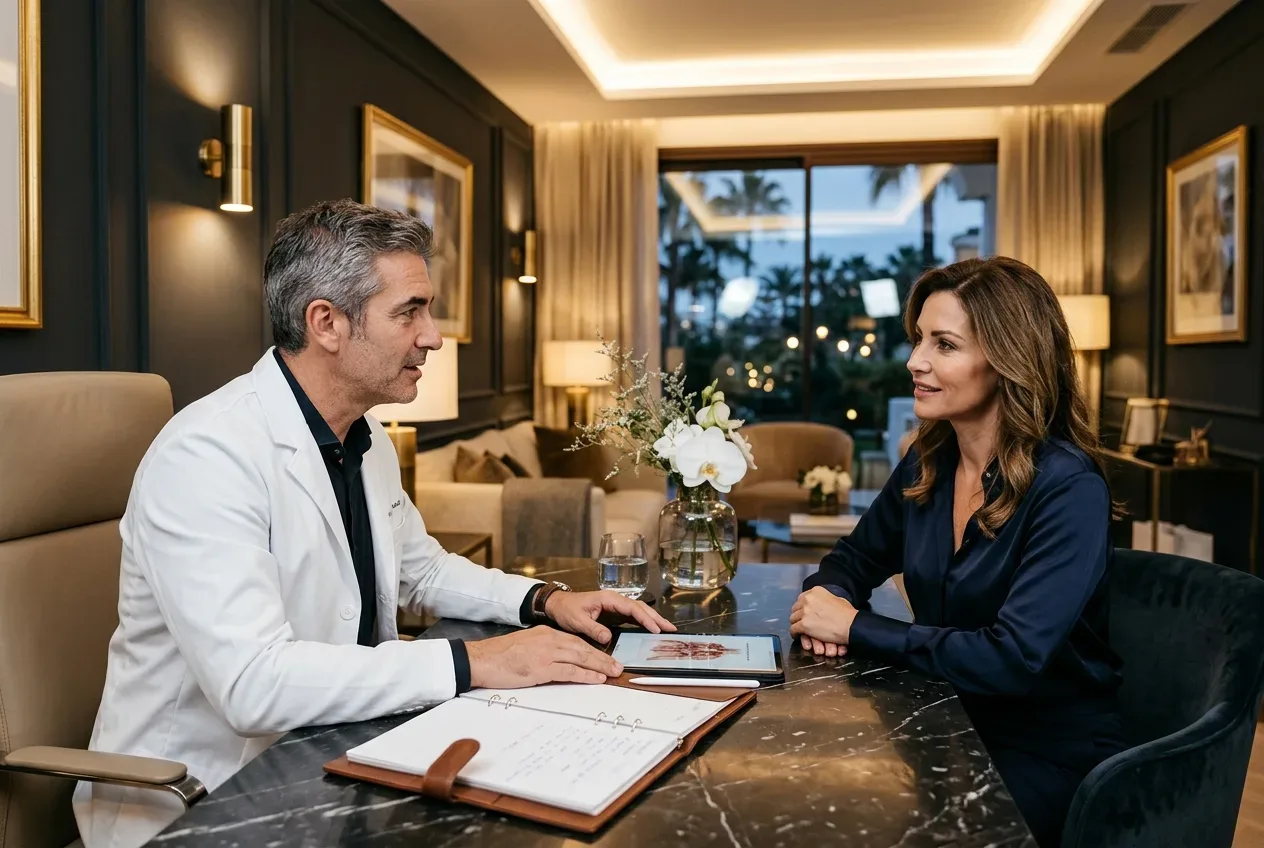
At Clínica Valorian, Dr. Florian A. Vallecillo Cabrera approaches every treatment as a complete medical act: assessment, indication, and follow-up. That structure is what separates aesthetic medicine from window-dressing cosmetics.
Key criteria: medical qualifications, technology, and honest diagnosis
The three criteria that best predict a good clinic are the practitioner's qualifications, technology with regulatory approval, and an honest diagnosis that includes the option of not treating. Globally, more than 35 million aesthetic procedures were performed in 2025, of which 7.3 million involved botulinum toxin (ISAPS, 2025), which gives an idea of the volume handled by teams with genuine experience.
Qualifications are the first filter. The doctor must hold a degree or graduate qualification in Medicine, be registered with the relevant medical council, and have accredited training in aesthetic medicine. You can verify registration with the Official College of Physicians of the province — a process that is both public and free of charge.
Technology is the second. A good laser or radiofrequency device must carry CE marking and be properly maintained. Ask for the exact name of the device and the specific product to be used.
The third — and the hardest to fake — is an honest diagnosis. A serious clinic will tell you when a treatment is not indicated, when it is better to wait, and when the result you have in mind is not realistic. That candour is a more reliable quality indicator than any promotion.
Questions you should ask before booking your first consultation
Before booking, it is worth drawing up a short list of questions that any professional clinic will answer without hedging. With nearly half the Spanish population already treated, according to SEME, you have more than enough room to choose a centre that deals with you transparently rather than settling for the first one you come across.
These are the questions that make the difference:
- Who will carry out the treatment, and what are their medical qualifications?
- Does the centre hold official health authorisation as a clinic?
- What specific product or technology will be used, and does it carry CE marking?
- What result is realistic in my case, and how long might it last?
- How is a complication managed if one arises, and is a doctor available?
- Is an assessment carried out before a fixed price is proposed?
If the answer to any of these questions is vague, defensive, or redirects you to a salesperson with no clinical training, treat that silence as an answer in itself.
Pay particular attention to the question about complications. Every medical procedure carries risks, and a clinic that claims otherwise is either withholding information or does not have a firm grasp of it. The answer you are looking for is specific: what can happen, how frequently, and who deals with it. A professional who explains the risks calmly inspires far more confidence than one who denies them.
Warning signs and unrealistic promises you should avoid
The clearest warning signs are pressure to decide on the spot, fixed prices without a prior diagnosis, and promises of guaranteed results. These are concerning because a significant share of demand seeks treatments outside the medical setting. According to data from the SEME, around one in four patients goes to non-medical venues such as beauty salons or even home visits — precisely where the risk is greatest.
Be wary of these situations:
- Offers with a countdown or discounts expiring within hours.
- "Guaranteed" results or claims of no possible side effects.
- Treatments applied by staff whose qualifications are not disclosed.
- Products with no brand name or identifiable batch number.
- Before-and-after photos that look too perfect and lack context.
When a treatment is performed outside a medical setting, the risk of complications rises and, more seriously, there may be no doctor available to resolve them in time. Aesthetic medicine is medicine, and medicine is practised where there is clinical support.
Why evidence-based medicine makes a difference in outcomes
Evidence-based medicine makes a difference because every indication is supported by clinical data rather than passing trends or sales arguments. With the global volume of procedures recorded by the ISAPS, there is enough accumulated knowledge to know what works, for whom, and with what reasonable expectations.
In practice, this means the doctor reviews your medical history, skin type, and goals before proposing anything. It also means ruling out treatments without solid backing and explaining the real limits of what can be achieved. A natural, long-lasting result almost always stems from that careful approach, not from the most eye-catching promise.
Evidence also helps set realistic expectations. Not every face responds the same way to the same treatment, and age, genetics, and lifestyle habits all influence the outcome. A doctor who works with data will tell you what percentage of improvement is reasonable to expect, and when it is worth combining techniques or, on the contrary, doing nothing at all. That honesty is hard to find in an environment focused solely on selling.
Finally, evidence protects your money. Many trendy treatments promise a great deal and deliver little. When an indication is based on proof, you invest in what can genuinely work for your case, rather than paying for a trend that will be outdated within a season.
This approach connects with a broader vision of health. If you are interested in understanding how science is applied to long-term wellbeing, you can read our guide on longevity medicine: what it is and how it works.
Making the right choice is not a matter of luck. Gather your questions, verify the doctor's qualifications and the centre's authorisation, and request an in-person assessment before committing to any treatment. If you would like to start with an honest diagnostic consultation in Marbella, the team at Clínica Valorian, led by Dr Florian A. Vallecillo Cabrera, is a great place to begin.
Frequently asked questions
What is the difference between a medical aesthetic clinic and a beauty centre?
A medical aesthetic clinic is led by a registered doctor and holds health authorisation to carry out invasive procedures such as injections or medical laser treatments. A beauty centre can only offer superficial cosmetic treatments.
What qualifications should the doctor at an aesthetic clinic in Marbella have?
They must hold a degree or graduate qualification in Medicine, be registered with the medical association, and accredit specific training in aesthetic medicine. You can verify their registration with the Colegio Oficial de Médicos of the relevant province.
What questions should I ask before my first consultation?
Ask who will perform the treatment, their qualifications, which product or technology will be used, what results are realistic, and how any potential complication is managed. A reputable clinic answers these questions with transparency.
Is it safe to have aesthetic treatments outside a medical setting?
It is not advisable. 28% of patients attend non-medical settings (SEME, 2024), where the risk of complications and incorrect diagnosis increases considerably.
Why does evidence-based medicine matter in aesthetics?
Because it ensures that every treatment is indicated on the basis of clinical evidence rather than trends or commercial promises. This improves patient safety and the predictability of results.