6 min read
Botulinum toxin: what it is and what it is used for
By Clínica Valorian
What botulinum toxin is, how it works on expression lines, how long its effect lasts, and why it should be administered by a doctor.
Key points
- Botulinum toxin temporarily relaxes the muscles that cause expression lines, smoothing the frown area, forehead, and crow's feet without touching the skin.
- The first results are usually visible between 3 and 7 days after the session, and the effect lasts on average between 3 and 4 months.
- A frozen face is not a consequence of the treatment itself, but of a poorly adjusted dose: with a natural approach, the face retains its expressiveness.
- It is a medical procedure with real contraindications, so it must be assessed and administered by a doctor with specific training.
Botulinum toxin is a medication that temporarily relaxes the muscles responsible for expression lines, such as frown lines or crow's feet. In aesthetic medicine it is used to soften those lines without surgery and without touching the skin, and it also has medical uses, for example in cases of excessive sweating or certain types of headache.
Better known by the trade name Botox, botulinum toxin has become one of the most common aesthetic treatments in the world. In fact, neuromodulators of this type account for half of all minimally invasive aesthetic procedures, according to statistics from the American Society of Plastic Surgeons. This guide explains what it is, how it works, which areas it is used on, how long it lasts, and what precautions it requires.
What is botulinum toxin
Botulinum toxin is a protein produced by the bacterium Clostridium botulinum. In high, uncontrolled doses it is dangerous, but in medicine it is used in a highly purified form and in minimal amounts, which makes it safe when administered by a professional. The type used in aesthetic treatments is botulinum toxin type A.
Botox is the most well-known trade name, which is why many people use that word to refer to any treatment of this kind. Other authorised brands exist with the same active ingredient. What matters is not the name, but that the product is approved and administered by a doctor.
How botulinum toxin works on expression lines
Expression lines appear as a result of the repeated movement of the facial muscles: frowning, raising the eyebrows, squinting when laughing. Over the years, that constant movement creates lines that eventually remain even when the face is at rest.
Botulinum toxin acts precisely at that point. It temporarily blocks the signal that the nerve sends to the muscle to contract. As that muscle relaxes, the skin above it stops folding and the line softens. It does not fill or stretch the skin: it reduces the movement that creates the line.
This is why it works especially well on what are known as dynamic lines — those that appear when making facial expressions. On static lines, those already visible at rest, the result is more subtle and it is sometimes advisable to combine it with other treatments. In those cases, hyaluronic acid can be a complement, as it acts in a different way and on a different type of groove.
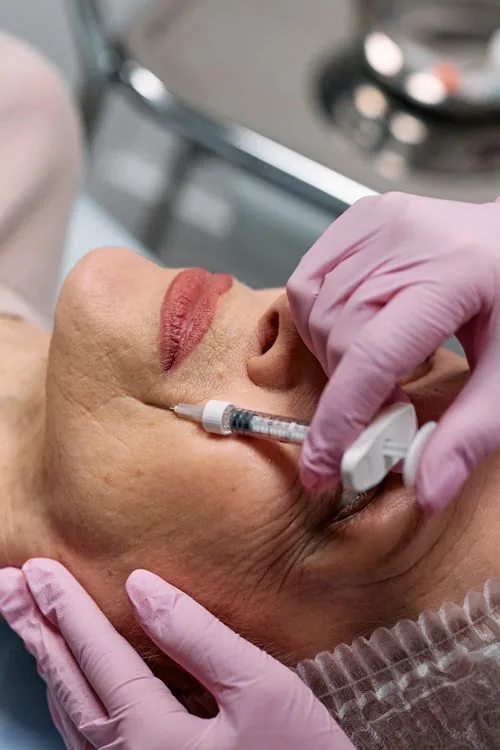
Treatable areas and expected results with a natural approach
The most common areas in the upper third of the face are:
- Glabella: the vertical lines that appear when frowning, giving a tired or angry look.
- Forehead: the horizontal lines that form when raising the eyebrows.
- Crow's feet: the fan-shaped wrinkles that appear at the outer corners of the eyes when smiling.
According to the patient information from the American Academy of Dermatology, most people begin to see results between 3 and 7 days after the session. The full effect becomes apparent around two weeks later, once the muscle is completely relaxed.
A good result does not mean a motionless face. The goal of a natural approach is to soften the wrinkle while preserving expression: the person should still be able to raise their eyebrows, smile and show emotions — just with less pronounced lines. This depends on adjusting the dose and injection points to the specific anatomy of each face, rather than applying a standard amount to everyone.
Myths about the frozen face and how to avoid them
The most widespread fear is ending up with a stiff, expressionless face. That outcome does exist, but it is not an inevitable consequence of the treatment. It almost always results from an excessively high dose, poor distribution of injection points, or treating muscles that should not have been treated.
Avoiding it comes down to three factors: a prior assessment of the face's natural movement, a dose tailored to each muscle, and the experience of the person administering it. When these three conditions are met, expression is preserved and what changes is the depth of the wrinkle.
Another common myth is that the treatment 'ruins' the face in the long term or creates dependency. This is not the case: when the effect wears off, the muscle regains its movement and the wrinkles return to how they looked before — no worse. The result simply stops being noticeable.

Duration of the effect and recommended frequency
The effect of botulinum toxin is temporary. On average it lasts between 3 and 4 months, and sometimes a little longer, as noted by the American Academy of Dermatology. After that, the muscle gradually regains its activity and the wrinkles reappear progressively.
This determines the typical frequency: repeating the treatment two or three times a year. Over time, some people find they can space out their sessions further, because the muscle becomes accustomed to less activity and the wrinkle takes longer to reappear.
It is not advisable to repeat the treatment too soon or to routinely increase the dose to make it 'last longer'. The sensible approach is to review the result at each visit and adjust accordingly. A realistic plan avoids both a stiff appearance and the frustration of expecting a permanent effect that this treatment does not provide.
Contraindications and why it must be administered by a doctor
Botulinum toxin is safe within a medical setting, but it is not suitable for everyone. It is contraindicated in the following cases:
- Pregnancy and breastfeeding, because its safety in these situations has not been studied.
- Neuromuscular diseases such as myasthenia gravis or others that affect the transmission between nerve and muscle.
- Active infection or injury in the area where the injection would be administered.
- Known allergy to botulinum toxin or any of its components.
This is the underlying reason why it must be administered by a doctor and not by a centre without clinical supervision. Botulinum toxin is a medical procedure: it requires a prior medical history, a detailed knowledge of facial anatomy to avoid affecting the wrong muscles, and the ability to act if a complication arises. Poor technique not only produces a poor aesthetic result, but can also cause unwanted effects such as a drooping eyebrow or temporary asymmetry.
This is why the training of the person administering the treatment matters as much as the product itself. At Clínica Valorian, in Marbella, both the assessment and the administration are carried out by Dr. Florian A. Vallecillo Cabrera within an evidence-based medicine approach, with an individual study of each face before deciding on the dose.
Conclusion
If you are considering this treatment, the most useful step is to book a medical assessment consultation before thinking about doses or brands. During this consultation, a doctor can study your case, explain what result is realistic for your face, and rule out contraindications before anything is injected. Book that consultation and bring your questions in writing: a good decision starts with good information.
Frequently asked questions
Is botulinum toxin the same as Botox?
In practice, the terms are used interchangeably. Botox is a well-known commercial brand of botulinum toxin type A, but there are other brands with the same active ingredient.
How long does it take to work?
Most people begin to notice results between 3 and 7 days after the session, with the full effect visible at two weeks.
Does it leave the face expressionless?
Not when it is applied correctly. The stiff appearance results from excessive dosage or poor distribution. With a natural approach, the face retains its movement.
How often does the treatment need to be repeated?
Since the effect lasts an average of three to four months, it is common to repeat the treatment two or three times a year, adjusting according to each person's response.
Who should not receive botulinum toxin?
It is contraindicated during pregnancy and breastfeeding, in people with certain neuromuscular diseases, with an infection in the area, or with an allergy to its components.