
Solar lentigines, age spots and brown patches: why do they appear more with age?

Why I'm telling you this
Over time, many people start to notice the same thing: "Doctor, I keep getting more and more spots." On the face, the hands, the décolletage, the forearms. And the question arises: "Is it simply age?".
The answer is: yes… but not only that.
I am Dr. Florian Vallecillo, and today I want to explain why the so-called solar lentigines appear, why they used to be referred to as senile lentigines, and why the skin accumulates more and more spots as the years go by.
Watch the video
Check your skin at the end of summer
What is a solar lentigo?
A solar lentigo is a benign pigmented spot that appears mainly on sun-exposed areas. It is usually light or dark brown, well-defined, flat, and generally symptom-free. Its classic locations are the face, the backs of the hands, the décolletage, the shoulders, and the forearms — in other words, the areas that have received the most ultraviolet radiation over a lifetime.
Why were they once called 'age spots'?
Because they tend to become more frequent with age. But that term can be misleading: they do not appear simply because 'we are getting older,' but above all because the skin has accumulated years of sun exposure. That is why today we prefer to speak of solar lentigines. Age matters, yes, but largely because it means more years of accumulated exposure.
The skin has a sun memory
This is probably the most important idea. The skin remembers the sun: every summer, every walk, every day at the beach, every exposure during childhood, every hour spent driving, every time we worked or exercised outdoors. It is not necessary to have suffered severe sunburns, because ultraviolet radiation can produce cellular and molecular changes even without causing a visible burn. Over time, these changes accumulate, and one of their manifestations can be the progressive appearance of lentigines.
What exactly happens with melanin?
Melanin is the pigment that gives our skin its colour, and it is produced by cells called melanocytes. When the skin receives ultraviolet radiation, melanin production increases as a defence mechanism — this is what happens when we tan. But over the years, some areas develop a more persistent and irregular pigmentary response, with greater melanocytic activity, increased melanin accumulation, alterations in pigment distribution, and structural changes in the epidermis. The visible result is a brown spot that no longer disappears when summer ends.
So, is a solar lentigo simply a permanent tan?
Not exactly. A tan is a more diffuse and temporary response, whereas a solar lentigo is a localised lesion: the skin in that area has changed in a more stable way. That is why the spot can persist throughout the year.
Why do they appear more frequently with age?
Because several factors converge. The main one is that more years of sun exposure accumulate: a sixty-year-old has had far more opportunities to build up UV radiation than a twenty-year-old. In addition, the pigmentary system ages: over time, melanocytes do not behave in exactly the same way, some areas lose uniformity, and pigmentation becomes less even, so the skin can simultaneously display darker patches, lighter patches, and a more uneven tone. Finally, cellular repair also changes: our skin has extremely sophisticated repair systems, but over the years its capacity to repair certain types of damage diminishes, molecular alterations accumulate, the dermal matrix changes, and what is known as chronic photoageing sets in.
Chronological age and photoageing are not exactly the same thing
Esto es muy importante. Dos personas de sesenta años pueden tener pieles completamente diferentes: una puede tener pocas manchas, buena textura y pocas arrugas, y otra muchos lentigos, queratosis actínicas, arrugas profundas y una piel irregular. ¿Por qué? Porque no solo cuenta cuántos años tienes, sino también cómo has vivido esos años al sol. A eso lo llamamos fotoenvejecimiento.
Where do we see photoaging most clearly?
Hay un truco muy sencillo: compara la piel del dorso de tus manos con una zona habitualmente protegida del sol, por ejemplo la parte interna del brazo o una zona cubierta del tronco. Muchas veces parece piel de dos edades diferentes, y eso demuestra hasta qué punto el sol modifica el envejecimiento cutáneo.
Are lentigines dangerous?
Solar lentigines are benign: they are not cancer and do not automatically transform into melanoma. But there is an important issue: not every brown spot is a solar lentigo. And this is where a medical evaluation comes in.
What other spots can look similar?
Una mancha marrón puede ser un lentigo solar, una queratosis seborreica, una queratosis actínica pigmentada, un nevus, una hiperpigmentación postinflamatoria, un melasma o, en algunas situaciones, un melanoma. Por eso, antes de tratar una mancha con láser o despigmentante, primero hay que saber qué es.
A rule that I consider fundamental in aesthetic medicine
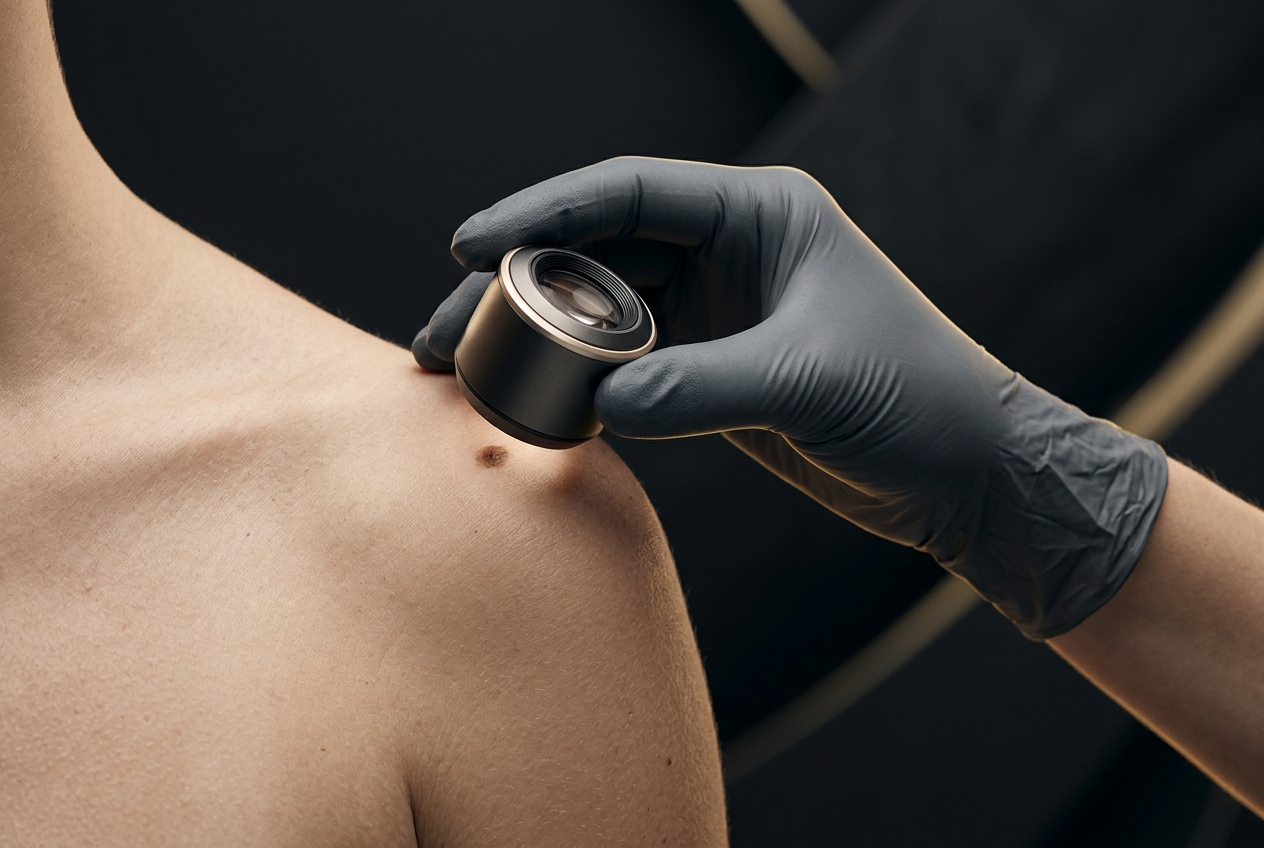
Nunca tratar una mancha pigmentada sin diagnóstico. Porque si eliminamos visualmente una lesión sin haberla evaluado correctamente, podemos ocultar información, retrasar un diagnóstico o tratar algo que no debería haberse tratado de esa manera. La dermatoscopia puede ser muy útil para diferenciar lesiones benignas de lesiones que necesitan un estudio más profundo.
What signs make a spot worth having checked?
Especialmente si aparece de nuevo y crece, cambia de forma o de color, presenta varios tonos, tiene bordes irregulares, sangra, pica de manera nueva, se ulcera o simplemente es diferente de las demás. Es el principio del «patito feo»: la lesión que no se parece al resto merece nuestra atención.
Why do they appear so much on the hands?
Because our hands receive sun exposure almost every day, even when we are not 'sunbathing': while driving, walking, having coffee outside, or exercising. Hands are exposed over years, and that is why the back of the hands is one of the classic areas for solar lentigines.
And on the face?
Exactamente lo mismo. La cara recibe radiación prácticamente todos los días, y algunas zonas —pómulos, sienes, frente, nariz— pueden acumular especialmente fotodaño. Por eso, con el tiempo, aparece una combinación de lentigos, alteraciones de textura, arrugas, vasos visibles y pérdida de elasticidad. El envejecimiento facial no es una sola cosa: es una combinación de envejecimiento cronológico y fotoenvejecimiento.
Does sunscreen completely prevent dark spots?
We cannot promise that. But good photoprotection helps reduce new pigmentation, limit the darkening of existing spots, decrease cumulative photodamage, and lower the risk of skin cancer. It is also worth remembering that sun protection is not just a cream: it also includes clothing, hats, shade, avoiding excessive exposure, and adjusting schedules when UV intensity is very high.
Why do some people have far more spots than others?
Because genetics, phototype, cumulative sun exposure, occupation, habits, use of sun protection, and individual predisposition all play a role. Someone who has worked outdoors their entire life does not have the same profile as someone with minimal exposure.
Do lentigos only appear in fair skin?
No. They can appear in different phototypes, although their appearance, intensity, and contrast may vary. In addition, in more pigmented skin types there are other causes of hyperpigmentation that can be confused with lentigos.
Can they be removed?
Yes. Once we confirm that we are dealing with benign lentigos, there are several options: pigment lasers, intense pulsed light in certain cases, cryotherapy, peels, and depigmenting treatments, depending on the depth, number of lesions, phototype, area, and exact diagnosis.
Does CO₂ laser work for lentigos?
It can be used in certain situations, but it is not always the first choice for an isolated pigmented lesion; in many cases there are technologies more specifically targeted at pigment. CO₂ can be particularly interesting when we want to work simultaneously on texture, photoaging, certain superficial lesions, and skin remodeling. But the choice depends on the type of spot.
Why can spots come back?
Because removing a spot does not eliminate the skin's tendency to produce new lesions. If we continue to accumulate sun exposure, new spots can appear. That is why treating lentigos involves two parts: correcting visible damage and preventing new photodamage.
So, does treating lentigos rejuvenate the skin?
Visually, enormously so in some patients, and this is an important point. When we think about aging, we tend to focus only on wrinkles, but the human brain also interprets color uniformity. Skin with many spots can look more aged even if it has few wrinkles. That is why improving tone, texture, and luminosity can produce a very significant rejuvenating effect without any need to change volumes.
But not everything needs to be erased
This is a point I also like to explain. Aesthetic medicine is not about turning skin into a completely artificial, uniform surface. The goal is to improve photodamage, remove unwanted lesions, maintain healthy skin, and preserve a natural appearance.
What is the difference between a solar lentigo and melasma?
They are different problems. Solar lentigo is usually a more well-defined lesion, whereas melasma typically presents as broader, symmetrical areas of diffuse pigmentation, particularly on the cheeks, forehead, and upper lip. In addition, melasma is strongly influenced by hormonal, genetic, sun, and visible-light factors. They are not treated in exactly the same way.
What about post-inflammatory hyperpigmentation?
That is different as well. It appears after acne, dermatitis, burns, procedures, or trauma — in other words, there was inflammation first, and pigment was left behind afterwards. In solar lentigo, by contrast, the main story is cumulative photodamage.
Why is it a good idea to have spots assessed before treating them?
Because a dermatological consultation can do two things at the same time: identify which lesions are benign and detect which ones require monitoring or further investigation. A spot that has been stable for ten years and has a dermoscopic appearance typical of solar lentigo does not present the same situation as a new, irregular, and changing lesion.
What I want you to remember
What are commonly known as solar lentigines — or, in older terminology, 'age spots' — are benign pigmented lesions that appear mainly as a result of cumulative sun exposure over the course of a lifetime. That is why they increase with age: not because growing older automatically produces spots, but because each year adds more sun history to our skin. Ultraviolet radiation modifies melanocytes, the distribution of melanin, the epidermis, collagen, and many other skin components, and that accumulated damage eventually becomes visible.
I am Dr. Florian Vallecillo. And if there is one single idea I want to leave you with, it is this: age spots are, to a large extent, spots that reflect your skin's solar history. But before deciding to remove a spot, it must be diagnosed — because the majority will be benign, yet not every brown spot means the same thing.
If you have new spots, many sun-damaged lesions, or pigmentation that is changing, a dermatological consultation at Clínica Valorian in Marbella allows for a clinical and dermoscopic assessment, after which a decision can be made as to whether treatment is indicated. Because in aesthetic dermatology, we diagnose first and treat afterwards.
Frequently asked questions about solar lentigines and age spots
Are solar lentigines cancer?
No. Solar lentigines are benign lesions. However, some malignant lesions can resemble a pigmented spot, which is why new or changing lesions should be assessed by a doctor.
Why do I get more spots as I get older?
Mainly because the skin accumulates years of ultraviolet exposure and the mechanisms of pigmentation and repair become less uniform.
Do age spots disappear on their own?
Established solar lentigines do not usually disappear completely on their own, although they may vary in intensity.
Does the sun make spots darker?
Yes. UV exposure can darken existing lesions and promote the appearance of new ones.
Can they be removed with laser?
Yes, certain lasers and other technologies can treat lentigines once the diagnosis has been confirmed. The choice depends on the type of lesion, the skin phototype, and the area involved.
How do I know if a spot is a lentigo or a melanoma?
It is not always possible to tell them apart correctly at home. A new, changing, irregular, or different-looking lesion deserves a dermatological evaluation with dermoscopy.
What to remember
- —Solar lentigines ("age spots") are benign pigmented lesions that appear mainly on sun-exposed areas: the face, the back of the hands, the décolletage, the shoulders and the forearms.
- —They increase with age not because of the passing years themselves, but because of cumulative sun exposure: "the skin has a solar memory," and sunburns are not required for photodamage to build up.
- —Chronological age is not the same as photoageing: comparing the back of the hand with a covered area clearly shows the real impact of the sun on skin ageing.
- —They are benign, but not every brown spot is a lentigo (seborrhoeic/actinic keratosis, naevus, melasma, post-inflammatory hyperpigmentation, or even melanoma): diagnosis comes first, using dermoscopy and the "ugly duckling" rule.
- —They can be treated (pigment lasers, intense pulsed light, cryotherapy, chemical peels, depigmenting agents; CO₂ laser primarily for texture and photoageing), but they can reappear if sun exposure continues to accumulate: treat and prevent.
- —Photoprotection (sunscreen plus clothing, a hat, shade and sensible scheduling) reduces new spots, darkening and the risk of skin cancer. The golden rule in aesthetics: diagnose first, then treat.
You may also like · Skin & spots

Doctor Florian A. Vallecillo Cabrera
The doctor explains
Informational content, written and reviewed by Doctor Florian A. Vallecillo Cabrera. It does not replace an in-person consultation or an individual diagnosis.


