
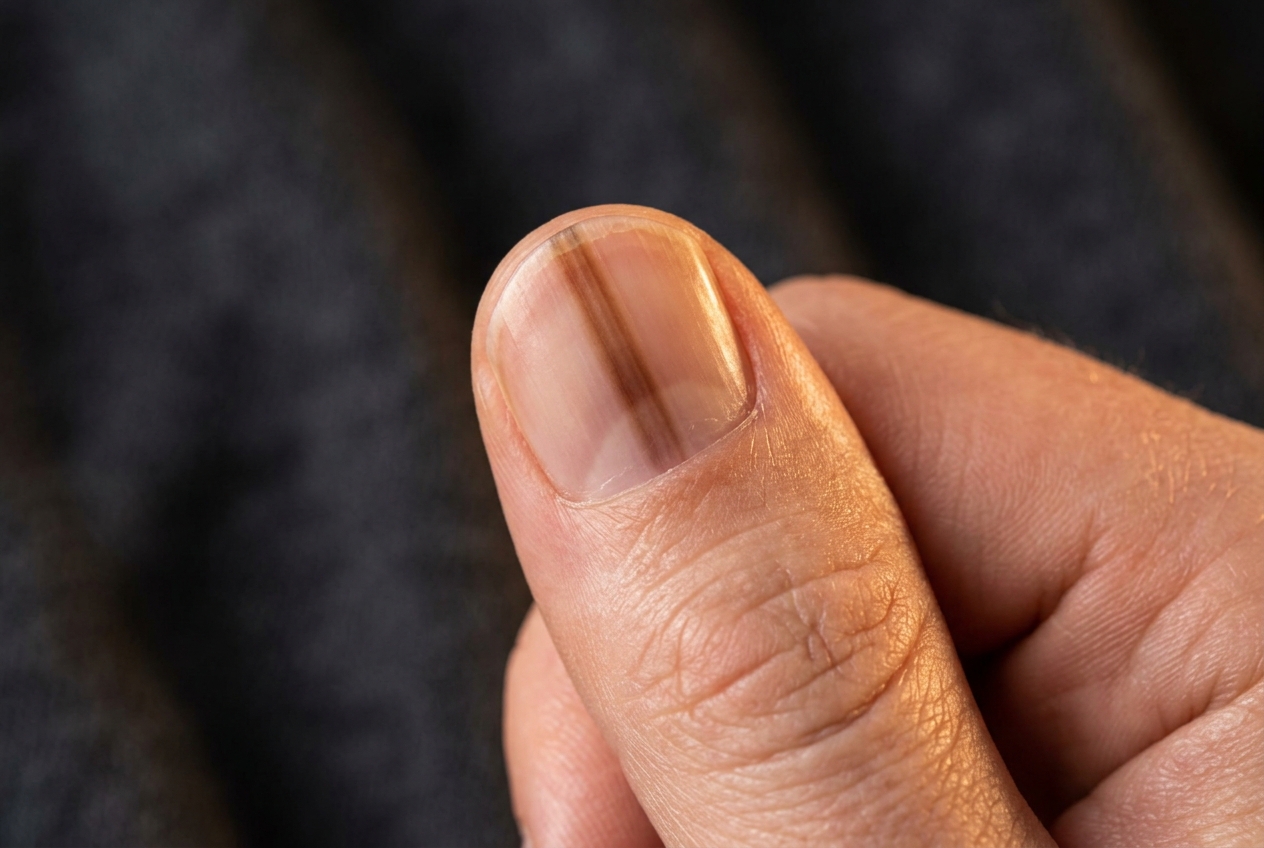
Black line on the nail: when should we be concerned?
Why I'm telling you this
A brown or black line running along a nail can be quite striking. And when we search for information online, it is easy to quickly come across a word that causes concern: melanoma. But I want to start by reassuring you: a black line on the nail does not automatically mean that a melanoma is present. In fact, there are many completely benign causes capable of producing this type of pigmentation.
However, there are certain characteristics that make it advisable to have it examined, especially when the band appears recently, changes, or evolves over time.
I am Dr. Florian Vallecillo, a physician, and today I want to explain to you what longitudinal melanonychia is, why it appears, and, above all, how we know when a black line on the nail deserves to be investigated.

Watch the video
Black line on the nail: is it always melanoma?
What is longitudinal melanonychia?
The word may sound complicated, but the concept is quite straightforward. Melanonychia refers to the presence of brown or black pigmentation in the nail plate. And when that pigmentation forms a band running longitudinally along the nail, from the cuticle area toward the tip, we speak of longitudinal melanonychia. The color usually comes from melanin, the same pigment that gives our skin and hair their color.
To understand why that line appears, we must first understand where the nail originates.
The key often lies in the nail matrix
Beneath the skin at the base of the nail there is a structure called the nail matrix. We can think of it as the nail's factory: it is there that most of the plate we see growing is produced. And within the matrix there are also melanocytes — the cells capable of producing melanin.
If a group of these melanocytes begins to produce pigment, the melanin can be incorporated into the nail as it forms. As the nail grows, that characteristic brown or black line running along it then appears. And there are many reasons why this can happen.
Does a black line on the nail mean melanoma?
No. And this is probably the most important message in this article. Longitudinal melanonychia can have numerous benign causes.
It may be due, for example, to physiological pigmentation, repeated trauma, or certain medications; also to a nevus of the nail matrix — something similar to a mole located in that area — or to a lentigo of the matrix; and, on occasion, to certain infections, particular inflammatory diseases, or other conditions capable of activating melanin production. Furthermore, the presence of pigmented bands in the nails can be far more common in people with higher phototypes or naturally more pigmented skin.
For this reason, finding melanonychia does not mean diagnosing a melanoma. Our work as physicians consists precisely in distinguishing common, benign pigmentations from those few lesions that need to be studied more thoroughly.
So, why should we pay attention to it?
Because, although it is much less common, melanoma of the nail apparatus does exist. It is a type of melanoma that can originate in structures related to the nail, frequently in the matrix, and one of its possible presentations is precisely a longitudinal melanonychia.
Nail melanoma is uncommon, but recognizing it early is important. The problem is that in the beginning it may look like nothing more than a small pigmented band. That is why we must avoid both extremes: neither assuming that every black line is a melanoma, nor ignoring for years a pigmentation that is changing. The key lies in observing what the lesion looks like and, above all, how it evolves.
A black line on the nail: what are the warning signs?
There is no single feature that allows a melanoma to be diagnosed simply by looking at a nail. But certain situations make a dermatological assessment advisable, and it is worth being aware of them.
A band that appears recently in an adult
A newly appearing longitudinal melanonychia, especially when it affects only one nail, deserves to be evaluated. This does not mean it is malignant; it simply means we should try to understand why it has appeared.
The line is getting wider
This is particularly important. A band that was thin and progressively becomes wider deserves attention. Sometimes we even observe that it is wider near the matrix and narrows toward the tip of the nail — a pattern that may require a more detailed study.
The color stops being uniform
A completely homogeneous and stable band does not carry the same significance as a pigmentation that begins to mix shades: light brown, dark brown, black, grey, or different tones within the same lesion. The appearance of several colors or of irregular pigmentation can be a warning sign.
The edges become irregular
We also look at how the pigmented lines are distributed. A pigmentation with relatively regular, parallel, and homogeneous lines can look very different from one in which we notice significant variations in thickness, spacing, color, or parallelism. These features can be studied much more precisely using dermoscopy.
The Hutchinson sign: when pigment spreads beyond the nail
There is another sign worth knowing about. Normally, the pigmentation is confined to the nail itself. But sometimes we observe that the pigment seems to extend onto the skin surrounding the nail, especially toward the cuticle or the periungual folds. This is known as the Hutchinson sign, and its presence can raise suspicion of ungual melanoma and requires a dermatological assessment.
But even here we need to add a small clarification: not all periungual pigmentation means melanoma. There are benign conditions capable of producing pigmentation around the nail, including what is known as pseudo-Hutchinson sign. For this reason, once again, do not diagnose your nail by looking at photographs on the Internet — have it examined by a doctor.
What if the nail also starts to become deformed?
We should also pay attention when the pigmentation is accompanied by changes in the actual structure of the nail: a progressive deformation of the nail, a crack or destruction of the nail plate, bleeding, ulceration, the appearance of a mass or lesion, or persistent changes around the nail. A pigmented band associated with any of these changes deserves to be examined.
One nail or several nails: it does not mean exactly the same thing
This detail can also help us. When similar pigmented bands appear on several nails, certain physiological, drug-related, or systemic causes may be more likely. On the other hand, when a new pigmented band appears on a single nail, especially in an adult, we tend to analyze it with greater attention.
But this is not an absolute rule either. A single pigmented nail does not mean melanoma; it simply modifies the clinical context and forms part of the information we use to decide whether we need to investigate it further.
The most important question: is it changing?
If I had to teach you just one practical rule, it would probably be this: long-standing, stable pigmentation does not carry the same significance as pigmentation that is new or evolving.
Imagine a person who remembers the same small brown band from many years ago: the same width, the same colour, the same shape — nothing has changed. Now compare that with someone who tells us: 'Doctor, this line appeared six months ago and it seems to be getting wider and darker.' These are two completely different situations. In dermatology, evolution over time provides extraordinarily valuable information, and that is why photographs can also be very useful.
How do we evaluate melanonychia in the clinic?
When a patient comes in with a black or brown line on the nail, we do not automatically start thinking about performing a biopsy. First, we do something much simpler: we try to understand the history of that lesion.
We ask when it appeared, whether it has changed or grown, whether the nail has been subject to repeated trauma or whether the patient plays a sport that could cause microtrauma, whether they are taking any medication, whether other nails are affected, whether they have had pigmented lesions before, and whether there is any relevant dermatological history.
We then examine the nail — and not just the line: we look at all the nails, the surrounding skin, the cuticle, the nail plate, and any associated changes.
Dermoscopy is also useful for the nails
Many people know the dermoscope because we use it to examine moles, but it is also an extraordinarily useful tool for studying the nails. Nail dermoscopy allows us to observe structures that are difficult to assess with the naked eye.
This way we can analyse more precisely the colour, the regularity of the lines, their thickness, spacing and distribution, as well as the periungual skin and other patterns that help guide the diagnosis. However, it is important to understand one thing: dermoscopy is enormously helpful, but it does not always replace histological diagnosis.
When is a biopsy necessary?
In many cases of melanonychia, a biopsy will not be needed. If the clinical and dermoscopic features are reassuring, in certain situations we may choose to take photographs, measurements, perform dermoscopy, and carry out follow-up monitoring over time.
But when there are sufficient grounds for suspicion, it may be necessary to obtain a sample from the nail matrix or from the lesion. Why? Because ultimately it is the microscopic examination of the cells — what we call histopathological analysis — that can allow a definitive diagnosis to be established in the case of a suspicious lesion. Biopsy of the nail matrix is a procedure that must be carefully indicated and planned, because the matrix is precisely the structure that produces the nail.
Could it simply be from an injury?
Yes. And it is extremely common to confuse a pigmentation with a small bruise beneath the nail. Trauma can produce blood under the nail plate and create a black, brown, violet, or reddish area. Furthermore, the patient does not always remember having injured themselves: tight shoes, running, hiking, or repeated minor traumas can be enough.
There is a very useful clue here: as the nail grows, the bruise normally migrates toward the tip, because the blood is trapped within the growing plate. A melanonychia originating in the matrix, on the other hand, continues to produce pigment from the base. This difference can be very helpful during follow-up.
Not everything dark beneath a nail is melanin
This point is also important. When someone searches for 'black line on the nail' they may be describing completely different situations. It could be melanin, but it could also be a bruise, pigmentation produced by certain microorganisms, material accumulated beneath the nail, inflammatory changes, or various nail diseases. That is why we use the term melanonychia specifically when we are genuinely talking about pigmentation related to melanin.
There is no need to be afraid of every line on a nail
The internet has a problem: you search 'black line on nail' and five minutes later you are convinced you have melanoma. It does not work that way. The vast majority of nail changes we see in practice have far more common and benign causes.
The goal of this article is not for you to look at your nails with fear. It is exactly the opposite: I want you to know what deserves to be checked so that you can feel reassured.
When would I recommend a dermatological consultation?
I would recommend having a pigmentation evaluated especially when a new brown or black band appears without a clear explanation; when it affects a single nail and is of recent onset; when it progressively increases in width; when it changes color; when it develops irregular borders or lines, or displays different shades; when the pigment extends onto the surrounding skin; when the nail begins to deform or break down; when bleeding, ulceration, or an associated lesion appears; or, simply, when we do not know what it is.
And this last point seems important to me: you do not need to meet a complete checklist of warning signs in order to seek advice. Sometimes, quite simply, it is worth having the lesion properly examined and putting any doubts to rest.
What I want you to remember
A black line on the nail is not synonymous with melanoma. Longitudinal melanonychia has numerous benign causes, and many people have pigmented bands without any serious underlying disease. However, there is a small proportion of lesions in which that pigmentation may be the initial manifestation of a nail melanoma; and precisely because it is uncommon, yet significant, we need to be aware of its warning signs: a new, changing, progressively wider, irregular band, with multiple colors, pigmentation around the nail, or associated with a change or destruction of the nail plate. These are features that justify an evaluation.
I am Dr. Florian Vallecillo, and if there is one simple idea I want to leave you with, it is this: a line that has looked the same for years and a line that has just appeared and is changing do not tell the same story. There is no need to be alarmed by every pigmented mark, but we should not ignore a lesion that is evolving either. In dermatology, noticing a change in time can allow us to act in time.
If you have noticed a black or brown line on a nail, a recent change to the nail, or any lesion that raises doubts for you, you can request a dermatological consultation at Clínica Valorian in Marbella for a clinical and dermoscopic assessment. In most cases, the examination will be reassuring; and in the few situations that require further investigation, we will be able to decide early on what the next step should be.
Frequently asked questions about melanonychia
Does a black line on the nail always mean melanoma?
No. There are many benign causes of dark lines on the nails, such as physiological pigmentation, trauma, certain medications, matrix nevi or lentigines, and other nail conditions. What matters is assessing the appearance of the band and how it evolves.
How can I tell whether a black line on my nail is dangerous?
It cannot be determined with certainty at home alone. A new band that is growing wider, changing, showing multiple colors or irregular borders, affecting only one nail, or spreading pigmentation onto the surrounding skin deserves a dermatological assessment.
What is Hutchinson's sign?
It is the extension of pigmentation from the nail onto the surrounding skin, especially the cuticle or the nail folds. It can be a warning sign of nail melanoma, although benign causes are also capable of producing a similar appearance.
Can an injury cause a black line on the nail?
Yes. Trauma can cause a dark subungual hematoma. As the nail grows, the hematoma typically moves toward the free edge. If the pigmentation persists from the base, changes, or there is any doubt about its origin, it should be examined.
How is nail melanoma diagnosed?
Evaluation begins with the clinical history, examination of the nail, and dermoscopy. Some lesions can be monitored with photographs and follow-up. When there is sufficient suspicion, a biopsy may be necessary to obtain a histological diagnosis.
Should I seek advice if I have had a black line for many years?
A long-standing band that remains completely stable generally presents a different picture from a recently appeared or progressive melanonychia. However, if it has never been assessed, has started to change, or you simply have doubts about it, a dermatological review can determine whether it needs follow-up.
What to remember
- —A brown or black line on the nail (longitudinal melanonychia) is almost never a melanoma: the majority of causes are benign (physiological pigmentation, trauma, medications, matrix nevus or lentigo, higher skin phototypes).
- —The pigment usually originates in the nail matrix — the 'factory' of the nail — where melanocytes can produce melanin that is incorporated into the nail plate as it grows.
- —Warning signs: a new band in an adult that is widening, with multiple colors or irregular borders, on a single nail, or that changes over time.
- —Hutchinson's sign (pigment extending onto the surrounding skin) and deformation or destruction of the nail increase suspicion and require evaluation.
- —A hematoma from an impact moves toward the tip as the nail grows; a melanonychia of the matrix continues to pigment from the base: how it evolves over time is key.
- —Clinical history, nail dermoscopy, and, when there is sufficient suspicion, a biopsy with histological examination make it possible to distinguish benign findings from those that require further investigation; when in doubt, a medical evaluation is advisable.

Doctor Florian A. Vallecillo Cabrera
The doctor explains
Informational content, written and reviewed by Doctor Florian A. Vallecillo Cabrera. It does not replace an in-person consultation or an individual diagnosis.