
MITO LIGHT cabin in Marbella: photobiomodulation, wellness and medical indications
Whole-body photobiomodulation sessions with red and near-infrared light. We explain which uses are wellness-based, which indications have scientific support and which precautions we apply.
Key points
- 990 dual-chip LEDs and 6 wavelengths, from 630 to 850 nm
- Standard sessions of 20 minutes, adjusted following a medical assessment
- No ultraviolet or ionising radiation
- Available in Marbella and the Costa del Sol
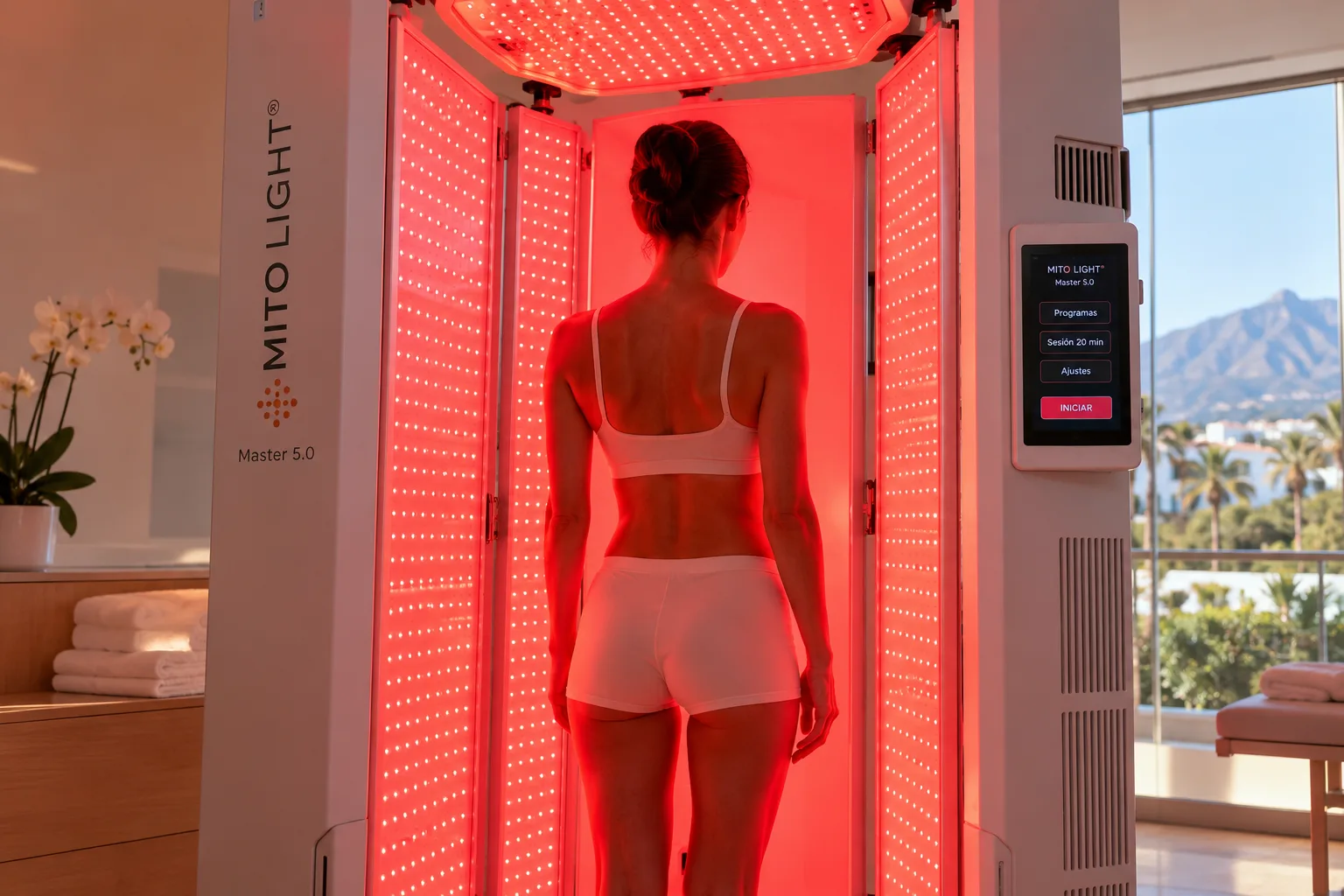
The MITO LIGHT Master 5.0 cabin is a photobiomodulation system that exposes a large body surface area to visible red and near-infrared light using LED technology.
At Clínica Valorian, in Marbella, we use it within a medical framework: before any session we assess your situation and clearly explain what it may offer, what has not been proven and what precautions are necessary.
What is photobiomodulation?
Photobiomodulation (photobiomodulation therapy, PBM) is a non-invasive technique that uses specific wavelengths of visible and near-infrared light. It does not use ultraviolet or ionising radiation.
Light can interact with cellular components, particularly the mitochondrial respiratory chain, and modulate processes related to energy metabolism, inflammation and tissue repair.
The response depends on the wavelength, irradiance, delivered energy, duration and frequency of the sessions. This is why the results of one protocol cannot be automatically transferred to a different device or a different form of exposure.
Red light and mitochondria: how photobiomodulation worksTechnical specifications of the device
The clinic uses the MITO LIGHT Master 5.0 device, a photobiomodulation system based on visible red and near-infrared LED technology.
The device features 990 dual-chip LED diodes and six wavelengths: 630, 660 and 670 nm (red light), and 810, 830 and 850 nm (near-infrared).
It includes independent intensity control for each wavelength, selection of red light, infrared or combined mode, a timer and four pre-configured programmes: Complete Therapy, Skin & Beauty, Evening Recovery and Ambient Light.
Its dimensions are 183 × 53 × 6.5 cm, with an emission angle of 30°. The spectrometric irradiance declared by the manufacturer is 90 mW/cm² at a distance of 15 cm, under its measurement conditions.
The standard session duration at the clinic is 20 minutes, with the possibility of adjusting the parameters based on individual assessment.
| Feature | Description |
|---|---|
| Brand and model | MITO LIGHT Master 5.0 |
| Technology | Non-invasive LED photobiomodulation |
| Number of LEDs | 990 dual-chip LEDs |
| Visible red light | 630 · 660 · 670 nm |
| Near-infrared (NIR) | 810 · 830 · 850 nm |
| Panel dimensions | 183 × 53 × 6.5 cm |
| Emission angle | 30° |
| Stated irradiance | 90 mW/cm² at 15 cm (manufacturer's spectrometric measurement) |
| Settings | Independent intensity for each wavelength; red, infrared or combined light; timer |
| Typical duration at the clinic | 20 minutes |
| Treated area | Large body surface area, depending on panel position and configuration |
The four programmes of the device
The manufacturer includes four pre-configured programmes:
| Programme | Objective stated by the manufacturer |
|---|---|
| Complete Therapy | General combined exposure |
| Skin & Beauty | Skin care and aesthetics |
| Evening Recovery | Recovery and relaxation |
| Ambient Light | Ambient lighting |
The device also allows manual selection of red light, near-infrared, or a combination of both, with individual intensity adjustment across the six wavelengths.
Wellness and medical indications: a necessary distinction
Wellness uses
Full-body cabin sessions are carried out for wellness purposes: relaxation, recovery, and general skin care, in line with the objectives the manufacturer states for its programmes.
These are wellness experiences, not treatments for a disease, and the response varies from person to person.
Medical indications with scientific support
In medicine, photobiomodulation has scientific evidence for certain supportive care applications, particularly the prevention of oral mucositis associated with oncological treatments through specific protocols.
Those protocols are intraoral and localised, with defined devices, doses and application times. A whole-body cabin is not equivalent, and its results cannot be extrapolated to a 20-minute session.
Other applications, such as radiodermatitis, peripheral neuropathy, lymphoedema and cancer-related fatigue, continue to be the subject of research, with varying levels of evidence.
| Use | Type | Level of evidence |
|---|---|---|
| Relaxation and recovery | Wellbeing | Manufacturer's stated objective |
| Skin care | Wellbeing and aesthetics | Manufacturer's stated objective |
| Prevention of oral mucositis | Oncology supportive care | Established for certain indications, with specific intraoral protocols |
| Radiodermatitis | Oncology supportive care | Promising |
| Chemotherapy-induced peripheral neuropathy | Oncology supportive care | Preliminary |
| Lymphoedema | Oncology supportive care | Variable results |
| Cancer-related fatigue | Oncology supportive care | Insufficient for whole-body LED |
| Destruction of cancer cells | Not applicable | Not demonstrated: it is not an anticancer treatment |
Photobiomodulation and cancer: our rule
It is essential to clarify that photobiomodulation does not destroy cancer cells, does not cure cancer, and does not replace chemotherapy, radiotherapy, immunotherapy, or other oncological treatments.
The safety and efficacy of whole-body LED sessions in patients with active cancer have not been sufficiently established.
If you have had cancer and have already completed your treatments, a session may be considered after an individual medical evaluation that takes into account the type of tumour, the time elapsed, your current situation and, where applicable, the opinion of your oncologist.
If you are undergoing oncological treatment and are interested in photobiomodulation for a specific complication, such as oral mucositis, discuss it with your oncology team: validated protocols are specific and localised.
The Doctor Explains: photobiomodulation and cancer, what science really saysWhat does a session involve?
Before the first session, we carry out a medical assessment: we review your medical history, the medications you are taking — some of which may be photosensitising — your goals and any possible contraindications.
A standard session lasts 20 minutes. The programme, intensity and wavelengths are adjusted according to the individual assessment, and the frequency of sessions is also personalised.
The exposure covers an extensive body surface area, depending on the position and configuration of the panels.
Safety and contraindications
Photobiomodulation is generally well tolerated when applied correctly. It may cause discomfort, a sensation of warmth, transient erythema or skin irritation.
Certain photosensitive conditions, photosensitising medications, eye problems and other clinical circumstances must be taken into account.
The informed consent form explains, in plain language, the expected benefits, the limitations of the evidence and the existing uncertainties.
Photobiomodulation at Clínica Valorian, Marbella
Our aim is to provide rigorous medical information: distinguishing what has been demonstrated, what is promising and what still lacks sufficient evidence, without making promises about results.
Request a medical assessment before your first photobiomodulation session at Clínica Valorian, Marbella.
Scientific and technical references
- Elad S et al. MASCC/ISOO clinical practice guidelines for the management of mucositis secondary to cancer therapy. Cancer, 2020;126(19):4423–4431.
- Robijns J et al. Photobiomodulation therapy in management of cancer therapy-induced side effects: WALT position paper 2022. Frontiers in Oncology, 2022;12:927685.
- Bensadoun RJ et al. Safety and efficacy of photobiomodulation therapy in oncology: A systematic review. Cancer Medicine, 2020;9(22):8279–8300.
- Zadik Y et al. Systematic review of photobiomodulation for the management of oral mucositis in cancer patients and clinical practice guidelines. Supportive Care in Cancer, 2019;27(10):3969–3983.
- MITO LIGHT. MITO LIGHT Master 5.0 — ficha técnica del fabricante.
Frequently asked questions
What is the MITO LIGHT Master 5.0 cabin?
It is a photobiomodulation device featuring 990 dual-chip LEDs and six wavelengths of red (630, 660 and 670 nm) and near-infrared (810, 830 and 850 nm) light, exposing a large body surface area.
How long does a session last?
At Clínica Valorian, a standard session lasts 20 minutes. The parameters and frequency are adjusted following an individual assessment.
Does red light emit ultraviolet radiation?
No. Photobiomodulation does not use ultraviolet or ionising radiation.
Are the device's programmes medical treatments?
No. Complete Therapy, Skin & Beauty, Evening Recovery and Ambient Light are programmes pre-configured by the manufacturer with wellness objectives; they are not medical protocols for any disease.
Does the MITO LIGHT cabin treat cancer?
No. Photobiomodulation does not destroy cancer cells, does not cure cancer and does not replace any oncological treatment.
Can I have sessions if I have an active cancer?
No. At Clínica Valorian we do not perform cabin sessions on patients with active cancer, because the safety and efficacy of whole-body sessions in this situation have not been sufficiently established.
What if I have already finished my cancer treatments?
This may be considered following an individual medical evaluation, taking into account your medical history, your current situation and, where appropriate, the opinion of your oncologist.
Is it the same as photodynamic therapy?
No. Photodynamic therapy uses a photosensitising agent to produce cellular damage in specific indications; photobiomodulation aims to modulate cellular functions without destroying tissue.

Request this consultation
Prefer to message us?
Request information via WhatsApp