Atopic dermatitis: why does it itch more at night?
Why I'm telling you this
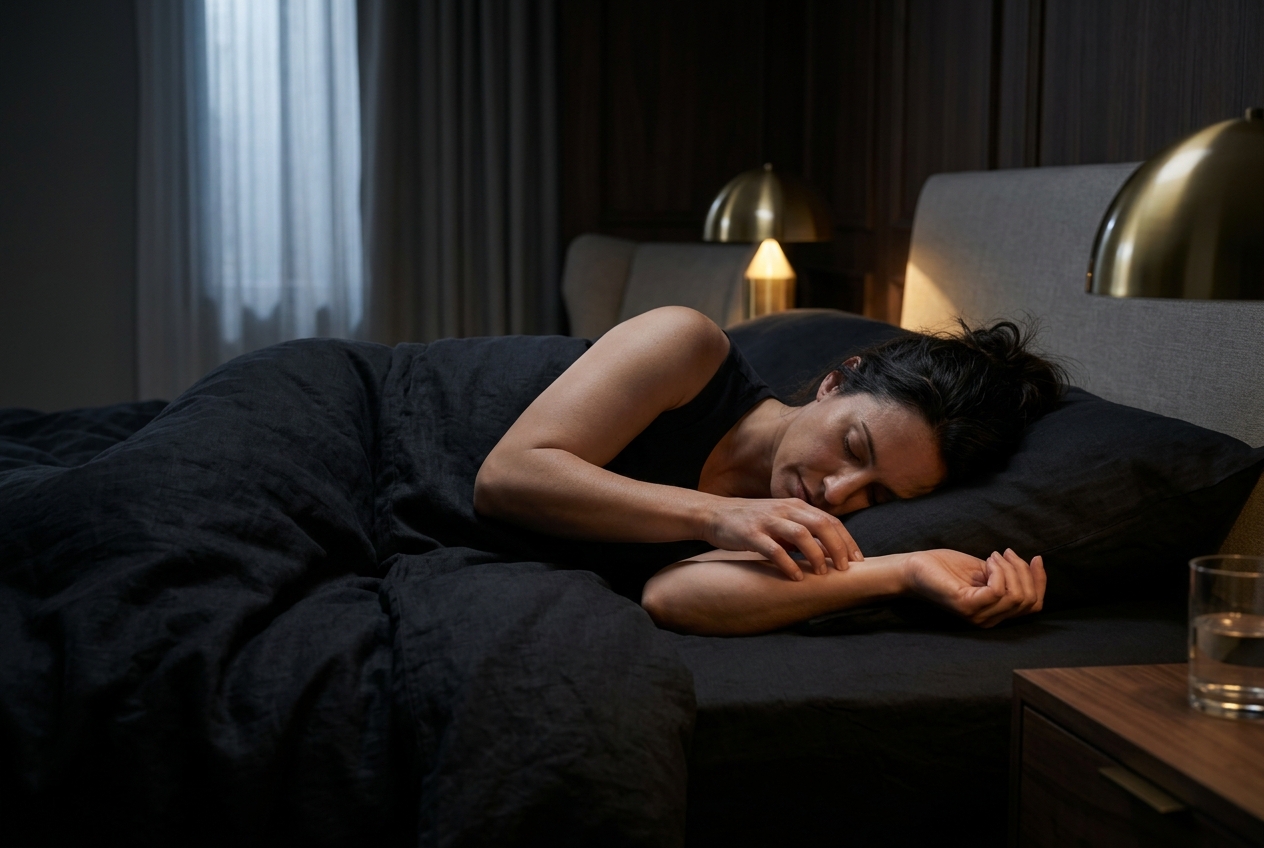
Some patients tell me something very specific: "Doctor, I manage reasonably well during the day, but at night it becomes unbearable." They go to bed, the itching starts, they scratch, they wake up, they scratch again… and the next day they are exhausted.
I am Dr. Florian Vallecillo, and today I want to explain why atopic dermatitis can itch so much more at night, why it affects sleep so severely, and what we can do to break that cycle.
Because one thing is important: nighttime itching is not an exaggerated sensation or a matter of "just putting up with it." It has a biological explanation.
Watch the video
Atopic dermatitis: four simple answers
Itching is one of the central symptoms of atopic dermatitis
When we talk about atopic dermatitis, many people think first of dry skin, redness, plaques, or flaking. But for many patients, the most important symptom is the itch. And it is not a superficial or trivial itch: it can be persistent, deep, maddening, hard to ignore, and especially intense at night. In fact, for some patients the main problem with dermatitis is not so much the visible appearance of the skin as the impossibility of sleeping properly.
Why does it itch more at night?
There is no single cause. Several mechanisms are probably at work at the same time, and understanding them helps explain why nocturnal itching can be so intense.
Our physiology changes at night
Our body does not function the same way at ten in the morning as it does at two in the early hours. We have biological rhythms of approximately twenty-four hours called circadian rhythms, which influence sleep, body temperature, hormones, the immune system, and the skin as well. At night, certain skin variables change, and this can promote a greater sensation of itching in atopic patients.
The skin may lose more water during the night
Atopic skin already has an impaired skin barrier, which means it loses water more easily. We call this loss of water through the skin transepidermal water loss. When the skin loses water it becomes drier, the barrier becomes even more fragile, and nerve endings may become more exposed to irritating stimuli. During the night this water loss can increase during certain phases, and the result is that the skin may feel drier and itch more.
Skin temperature changes
Body temperature also follows a circadian rhythm. At night, the core body temperature drops to facilitate sleep, but the skin may undergo changes in blood flow and peripheral temperature. In addition, the bed, the duvet, pyjamas, or the heating can increase local heat. Many patients with atopic dermatitis tell me: 'When I am hot, I itch so much more.' And it makes sense, because heat can increase vasodilation, sweating, the activation of certain nerve fibres, and the perception of itching.
Sweat can irritate atopic skin
Sweat is not 'bad', but on inflamed skin with a damaged barrier it can cause stinging, irritation, and itching. If a person sleeps wearing too many clothes, in a very warm room, or under a very thick duvet, they may sweat during the night, and that sweat can increase irritation.
During the night, the inflammatory signal changes
Atopic dermatitis is an immunological disease, and some inflammatory molecules also follow circadian rhythms; among them are mediators related to inflammation, the immune response, and itching. There is also one molecule that is especially important in atopic pruritus: interleukin-31, or IL-31, a cytokine that can directly activate pathways linked to the sensation of itching. It is so significant that today there are treatments specifically targeting this pathway, which shows just how much the itching of atopic dermatitis is not simply 'dry skin,' but also an immunological and neurological phenomenon.
At night we have fewer distractions
This may seem very simple, but it matters. During the day we work, talk, walk, drive, and think about other things; our brain receives thousands of stimuli. At night we turn off the light, lie down, and stay still, and suddenly the itching takes up all of our attention. That does not mean it is psychological: it means our brain no longer has other stimuli competing with that sensation.
Sleep modifies the perception of itching
Sleeping poorly increases sensitivity to many stimuli. When a person has been sleeping little for several days, they become more sensitive, more irritable, perceive pain less well, and may also perceive itching with greater intensity. Another vicious cycle then appears: itching, poor sleep, heightened sensitivity, and even more itching.
The famous itch-scratch cycle
This is one of the most important concepts in atopic dermatitis. The skin itches, the patient scratches, and for a few seconds feels relief; but scratching breaks the skin barrier, causes micro-injuries, increases inflammation, promotes the entry of irritants and microorganisms, and activates the itch pathways even further. Then it itches again, and the patient scratches again: itch, scratching, injury, inflammation, and more itching. At night, when the patient may scratch even while asleep, this cycle becomes especially significant.
Why do some patients wake up with wounds without remembering having scratched?
Because scratching can occur during sleep. The person may make repetitive movements in a semi-conscious state, and upon waking finds scratch marks, crusts, bleeding, redder skin, or more inflamed plaques. This explains why some patients feel that 'I go to bed feeling fairly well and wake up feeling worse.'
Can nighttime itching really affect quality of life?
Enormously. Sleeping poorly night after night can cause fatigue, difficulty concentrating, irritability, reduced work or school performance, memory problems, greater sensitivity to stress, and an overall worse perception of the disease. That is why we should not consider a case of dermatitis mild simply because it covers a small surface area: if the patient is not sleeping, the disease has a significant impact.
What can we do to reduce nighttime itching?
There are several strategies, and the first is probably the most important: properly controlling the inflammation. Because if the skin is very inflamed, no sleep strategy alone is going to solve the problem on its own.
Using anti-inflammatory treatment correctly
During a flare, topical corticosteroids, tacrolimus, pimecrolimus, or other prescribed treatments can help reduce inflammation, redness, and itching. The key is to treat the disease, not simply try to sleep in spite of it.
Moisturising the skin well before bedtime
A good application of emollient at night can reduce dryness, especially after a short, lukewarm shower. The cream should be applied without rubbing aggressively, and for very dry skin some richer formulations can be helpful overnight.
Avoiding very hot showers
Very hot water may feel pleasant for a few minutes, but afterwards it increases lipid loss, dries out the skin, and can worsen itching. Lukewarm water, short showers, and gentle cleansers are preferable.
Keeping the bedroom cool
A room that is too warm can worsen sweating, vasodilation, and the sensation of itching. Many patients tolerate a cool bedroom better; there is no need to sleep in the cold, but excess heat should be avoided.
Choosing bedding and pyjamas carefully
Some fabrics can irritate sensitive skin. As a general rule, it is advisable to avoid wool directly against the skin, rough fabrics, and very tight-fitting garments; soft cotton or other well-tolerated fabrics can be more comfortable. But, as always, tolerance is individual.
Keeping nails short
This may seem like a minor detail — it is not. If a person scratches in their sleep, short nails reduce trauma, excoriations, and bleeding. They do not eliminate the itching, but they can limit the damage.
Are antihistamines useful?
This is a very common question. In atopic dermatitis, itching does not depend primarily on histamine, which is why classic antihistamines do not always work particularly well for controlling atopic pruritus. Some sedating antihistamines can help with sleep in specific situations, but they are not directly addressing the main cause of the itching and should not automatically become the chronic solution.
So why can the itching persist even when the skin looks better?
Because in atopic dermatitis there is also an alteration in the communication between the skin, the immune system, and the nerves. The nerve fibres can become more sensitive — a phenomenon we can simply call sensitisation: the skin begins to react excessively to stimuli that would normally be minor, such as heat, sweat, friction, fabrics, or even small changes in the environment. This is why itching can persist even when the skin no longer appears so red visually.
Itch also has memory
It is a simple way to explain it. If an area has been inflamed for a long time, the nervous system can remain hyperreactive, and then any small stimulus reactivates the sensation of itch. This is similar to what happens in some types of chronic pain. It does not mean that 'everything is in the head,' but rather that the nervous system has learned to respond with excessive intensity.
What happens in moderate or severe cases?
When the itch is intense, persistent and clearly affects sleep, we sometimes need to move on to more specific treatments. Today we have modern therapies that act directly on the pathways responsible for inflammation and pruritus — for example dupilumab, tralokinumab, lebrikizumab, JAK inhibitors and, more recently, treatments targeting the IL-31 pathway such as nemolizumab. This is very important, because for years we treated dermatitis thinking almost exclusively about visible inflammation, and now we know that itch deserves to be a therapeutic target in its own right.
When should nocturnal itch be a cause for concern?
If the itch appears only at night and is very intense — especially if other people in the household are also scratching, or if lesions appear on the wrists, fingers, armpits, genitals or abdomen, or small linear lesions are present — other diagnoses must also be considered, for example scabies. Because not every nocturnal itch is atopic dermatitis.
What if the eczema suddenly gets much worse?
It is important to assess whether there is a bacterial superinfection, herpetic eczema, contact dermatitis or a new trigger — especially if pain, yellow crusts, discharge, fever, multiple small and painful lesions or a very rapid worsening appear.
Something I explain a great deal in the clinic
When a patient tells me 'Doctor, I cannot sleep because of my skin,' I do not simply think 'I need to give them something to help them sleep.' I think: 'the dermatitis is not sufficiently controlled.' Because the goal should not be to sedate the patient so they can tolerate the itch, but to reduce the itch until they can sleep normally.
Sleep is also part of the treatment
Sleeping properly supports hormonal regulation, immune response, stress control, tissue repair and metabolic health. A disease that constantly disrupts sleep can have consequences far broader than the skin. That is why, when we assess atopic dermatitis, we should ask: 'How many nights a week does the itch wake you up?' It is a very simple question, but it gives us enormous information about the true severity of the disease.
A small bedtime ritual can help
In a patient with atopic dermatitis, a simple routine might look like: a short shower with lukewarm water, gentle cleansing, patting the skin dry without rubbing, applying the anti-inflammatory treatment to the active areas according to the medical plan, applying an emollient, wearing comfortable and breathable clothing, and keeping the bedroom cool while avoiding excess heat. It is not miraculous, but a good routine reduces many small factors that can feed the itch.
What I do not recommend
I do not recommend scratching aggressively, taking very hot showers, applying alcohol or irritating products, constantly switching creams every two days, or using corticosteroids for months without a clear plan. And I also do not recommend thinking 'if I itch at night, it must be a food allergy,' because the nocturnal itch of atopic dermatitis has a far more complex explanation.
What I want you to remember
Atopic dermatitis can itch more at night due to a combination of circadian changes, increased skin dryness, temperature shifts, sweating, inflammatory signals, hypersensitivity of nerve endings, and reduced distraction. And when that itch disrupts sleep, we must not normalise it: sleeping poorly because of a skin condition means the condition is having a real impact and deserves an appropriate therapeutic strategy.
I am Dr. Florian Vallecillo. And if I could leave you with a single idea, it is this: if your dermatitis is waking you up at night, do not treat only the insomnia — treat the dermatitis properly. Because when we manage to repair the skin barrier, control the inflammation, reduce the itch, and break the itch-scratch cycle, sleep tends to improve alongside the skin.
And if you have atopic dermatitis with intense nocturnal itching, frequent night awakenings, or flares you cannot bring under control, a dermatological consultation at Clínica Valorian in Marbella allows us to assess severity, confirm the diagnosis, and tailor the treatment. Because in dermatology, sleeping well can also be a sign that the skin is finally under control.
Frequently asked questions about atopic dermatitis, itching and sleep
Why does atopic dermatitis itch more at night?
Probably due to a combination of circadian rhythms, changes in the skin barrier, increased water loss, temperature, inflammation, and a heightened perception of itch when we are at rest.
Does nocturnal itching mean my dermatitis is severe?
Not necessarily, but if it causes frequent night awakenings or prevents you from sleeping properly, it indicates a significant impact of the condition and warrants a review of the treatment.
Do antihistamines relieve the itch of atopic dermatitis?
Not always. Atopic itch does not depend primarily on histamine. Some sedating antihistamines may help with sleep in specific cases, but they do not address the main cause of the pruritus.
What temperature should the bedroom be?
There is no universal figure, but as a general rule it is advisable to avoid an overly warm bedroom and any situation that causes night sweating.
Why do I wake up with wounds if I don't remember having scratched myself?
Because scratching can occur during sleep in a semi-conscious state. Keeping nails short and properly managing the itch can reduce these lesions.
When should I seek medical advice?
If the nighttime itching is intense, regularly disrupts sleep, the skin worsens despite treatment, or signs of infection appear, a dermatological evaluation is advisable.
What to remember
- —Itching is the central symptom of atopic dermatitis and tends to worsen at night — this is not an exaggeration; it has a biological explanation.
- —At night, several mechanisms combine: circadian rhythms, increased water loss, temperature changes, sweat, inflammatory mediators (such as IL-31), and fewer distractions.
- —The itch-scratch cycle damages the skin barrier and perpetuates inflammation; scratching can occur during sleep, which is why people wake up with wounds.
- —Nighttime itching disrupts sleep and quality of life: atopic dermatitis that prevents sleep is not "mild" even if it affects only a small surface area.
- —Helpful measures: controlling inflammation (topical corticosteroids, tacrolimus, pimecrolimus), moisturizing before bed, avoiding hot showers, keeping the bedroom cool, choosing bedding carefully, and keeping nails short.
- —Classic antihistamines do not control atopic pruritus well; for moderate-to-severe forms there are targeted treatments (dupilumab, tralokinumab, lebrikizumab, JAK inhibitors, nemolizumab). A word of caution: itching that occurs only at night with typical lesions may be scabies, not necessarily atopic dermatitis.
You may also like · Skin & spots

Doctor Florian A. Vallecillo Cabrera
The doctor explains
Informational content, written and reviewed by Doctor Florian A. Vallecillo Cabrera. It does not replace an in-person consultation or an individual diagnosis.