
Atopic dermatitis in adults: symptoms, causes and treatments
Why I'm telling you this
"Doctor, my skin is dry, it itches terribly, and at certain times it turns red. I put on cream, it gets better… and then it comes back again." It is a story I hear constantly in my practice, and behind it there may lie an extremely common condition: atopic dermatitis.
Many people think that atopic dermatitis is an exclusively childhood disease. That is not the case: it can persist from childhood into adulthood, reappear after years of calm, or, in some patients, manifest for the first time in adulthood. And we are not simply talking about "having dry skin" — this is a chronic inflammatory disease of the skin, involving impairment of the skin barrier, inflammation, and, above all, a symptom that can profoundly affect quality of life: itching.
I am Dr. Florian Vallecillo, and today I want to explain to you what really happens in atopic skin, why flare-ups occur, and, most importantly, what we can currently do to keep them under control.
Watch the video
Atopic dermatitis: four simple answers
What exactly is atopic dermatitis?
Our skin is not simply a wrapping: it is a true organ, and one of its fundamental functions is to act as a barrier. We can imagine the outermost layer of the skin as a wall: the cells would be the bricks, and between them there would be a kind of mortar made up of, among other substances, lipids. When that barrier works well, we retain water inside the skin and make it harder for irritants, allergens, and microorganisms to get in.
In atopic dermatitis this barrier works less effectively: the skin loses water more easily, becomes drier, more permeable, and more reactive. And, at the same time, there is an altered immune response that promotes inflammation. That is why atopic dermatitis is not simply dry skin, but rather an interaction between the skin barrier, the immune system, genetics, and the environment.
Why does atopic dermatitis appear?
There is no single cause, and this is very important: atopic dermatitis is a multifactorial disease. There is a genetic predisposition, and one of the best-known genes is that of filaggrin, which is involved in the structure and function of our skin barrier. Some people carry genetic variants that reduce its function and make for a more permeable barrier. But not everyone with atopic dermatitis has a filaggrin abnormality, and carrying a particular variant does not necessarily mean developing the disease: genetics is only one part of the problem.
The second key player is the immune system
In atopic dermatitis there is abnormal activation of certain immunological pathways. Among these, so-called type 2 inflammation is of particular importance, involving signalling molecules (cytokines) such as interleukin-4 (IL-4), interleukin-13 (IL-13), and other inflammatory pathways. These molecules transmit messages between immune system cells and help sustain inflammation. This is very interesting, because understanding these pathways has made it possible to develop some of the most effective modern treatments for atopic dermatitis, which we will discuss further on.
What are the symptoms of atopic dermatitis in adults?
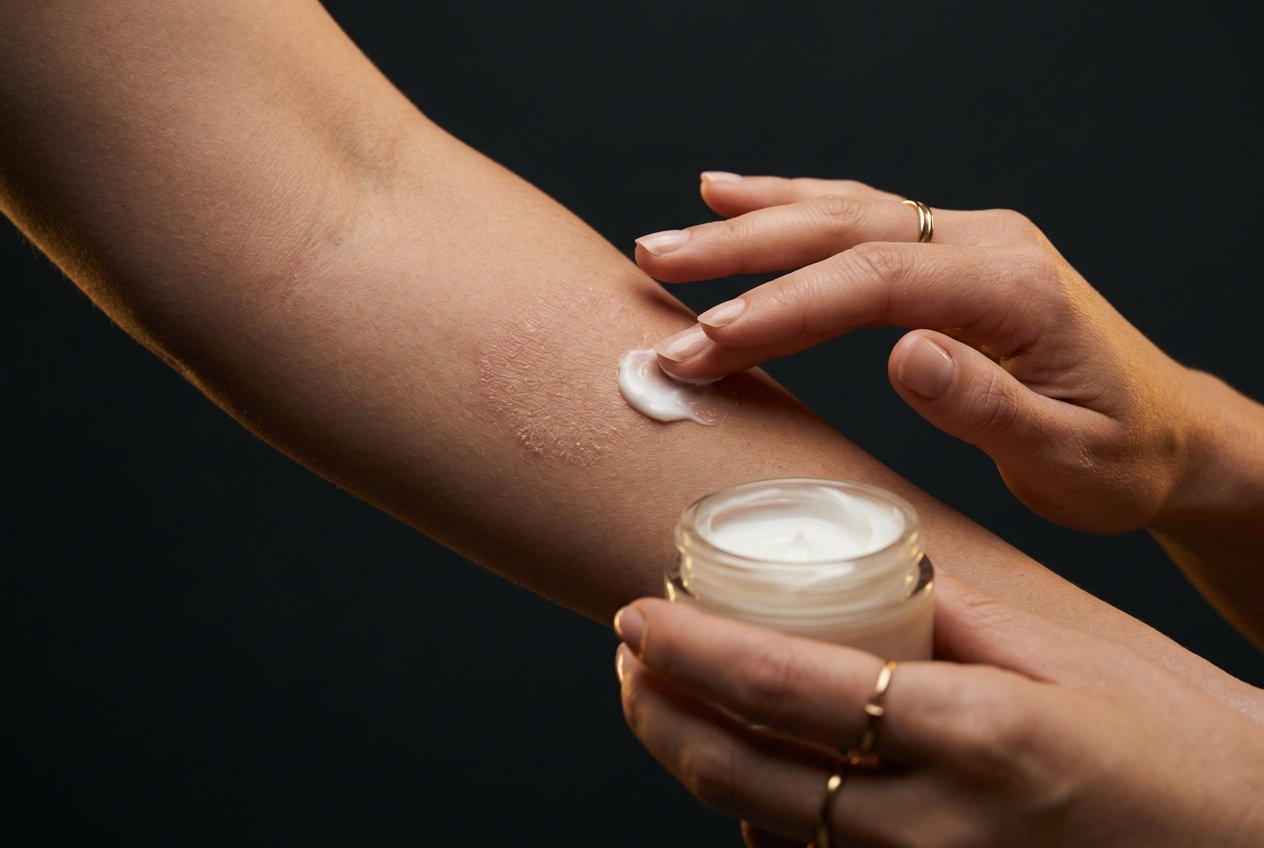
Presentation can vary enormously from one person to another, but there is one practically central symptom: itching. The skin may show intense dryness, redness, flaking, eczema plaques, cracks, small lesions caused by scratching, thickening when scratching becomes chronic, and pigmentation changes following inflammation.
In fair skin, the inflammation usually appears red or pink; in more pigmented skin it may look violet, brown, greyish, or simply darker than the surrounding skin. This is important, because atopic dermatitis can be less visually evident in higher phototypes.
Where does atopic dermatitis appear in adults?
Puede aparecer prácticamente en cualquier zona, pero hay localizaciones frecuentes. En la cara y el cuello suele afectar a los párpados, el contorno de los ojos, la frente y la zona alrededor de la boca. La dermatitis crónica de las manos puede ser una manifestación particularmente problemática. También son típicos los pliegues —la parte anterior de los codos y la posterior de las rodillas—, así como el tronco y las extremidades; algunos pacientes presentan formas mucho más extensas.
Atopic dermatitis on the face: a very common situation in adults
Facial involvement deserves special attention. The patient may present dry skin, redness, scaling, itching, a burning sensation and inflamed eyelids. And here one must be careful, because not every facial eczema in an atopic patient is necessarily atopic dermatitis: contact dermatitis, seborrheic dermatitis, rosacea, a reaction to cosmetics or even a sensitization to one of the products the patient themselves uses to treat their skin may all coexist. This is why persistent facial dermatitis warrants a thorough evaluation.
«Doctor, the worst part is not how it looks; it is how much it itches»
I understand this perfectly, because the itch of atopic dermatitis can be extraordinarily intense, especially at night. The patient goes to bed, the itching starts, they scratch, they wake up, they scratch again… and the next day they are exhausted and their skin is even more inflamed. We then enter what we call the itch–scratch cycle: inflammation causes itching, the patient scratches, the scratching further damages the barrier, the skin releases new inflammatory signals and the itching starts again. Breaking this cycle is one of the fundamental goals of treatment.
Why does it itch more at night?
Probablemente intervienen varios mecanismos: por la noche cambian la temperatura cutánea, la pérdida de agua a través de la piel, los ritmos circadianos y distintos mediadores inflamatorios; además, al desaparecer las distracciones del día, la percepción del picor se hace mucho más evidente. Por eso preguntar «¿cómo duerme?» forma parte de la evaluación de una dermatitis atópica: una enfermedad que impide dormir no puede considerarse leve solo porque afecte a una superficie pequeña.
Is atopic dermatitis an allergy?
No exactamente, y esta confusión es muy frecuente. La dermatitis atópica se asocia a una predisposición llamada atopia: las personas atópicas tienen mayor tendencia a desarrollar dermatitis atópica, asma, rinitis alérgica y determinadas alergias. Pero esto no significa que toda dermatitis atópica esté provocada por «algo que has comido», ni que hacer decenas de pruebas de alergia vaya necesariamente a encontrar la causa. En algunos pacientes existen alergias relevantes; en otros, no. No debemos convertir automáticamente la dermatitis atópica en una investigación interminable de alimentos prohibidos.
So, what can trigger a flare-up?
Although the disease has a genetic and immunological basis, there are factors that can make it worse: cold and dry air, heat and sweat, excessively hot showers, harsh soaps, detergents, fragrances and certain cosmetics, irritating fabrics, friction, stress, lack of sleep, skin infections, and certain allergens when true sensitization exists. But every patient is different: the strategy is not to live trying to avoid absolutely everything, but to identify which triggers are genuinely yours.
Can stress cause atopic dermatitis?
El estrés no es «la causa» de la dermatitis atópica, pero puede empeorarla, porque existe una comunicación constante entre el cerebro, el sistema nervioso, el sistema inmunitario y la piel. Por eso los períodos de estrés intenso pueden coincidir con brotes. Y aquí aparece otro círculo: el estrés empeora el eccema, el eccema produce picor, el picor impide dormir, dormir mal aumenta el estrés y el estrés vuelve a empeorar la piel. Tratar una dermatitis atópica significa también romper estos círculos.
Is atopic dermatitis contagious?
No. It is not an infection. You cannot transmit atopic dermatitis by touching someone, sleeping with another person, sharing a towel, or through sexual contact: it is an inflammatory disease.
But atopic skin can indeed become infected
Esta diferencia es importante. Cuando la barrera cutánea está alterada y además hay rascado, los microorganismos pueden aprovechar esas pequeñas puertas de entrada; de hecho, las personas con dermatitis atópica presentan con frecuencia una mayor colonización por Staphylococcus aureus. Si aparecen costras amarillentas, supuración, dolor creciente, un empeoramiento brusco o lesiones que cambian rápidamente, hay que valorar una posible sobreinfección.
An infection worth recognizing early: herpetic eczema
Puede ocurrir cuando el virus del herpes simple infecta una piel con dermatitis atópica. Produce múltiples erosiones o vesículas pequeñas y dolorosas, bastante parecidas entre sí, y puede acompañarse de fiebre, malestar general y un deterioro rápido de la piel. Requiere una valoración médica rápida, porque en este caso sí estamos ante una complicación infecciosa que necesita un tratamiento específico.
How do we diagnose atopic dermatitis?
No existe una analítica de sangre que diga «positivo para dermatitis atópica»: el diagnóstico es fundamentalmente clínico. Analizamos cómo son las lesiones, dónde aparecen, desde cuándo, cuánto pican, si existen brotes, los antecedentes personales y familiares (asma, rinitis, alergias), los tratamientos utilizados, los cosméticos y los posibles desencadenantes. En determinadas situaciones podemos realizar estudios adicionales, como pruebas epicutáneas si sospechamos una dermatitis alérgica de contacto asociada, o una biopsia cuando el diagnóstico es atípico y necesitamos descartar otras enfermedades. Pero en la mayoría de los pacientes, una buena historia clínica y una buena exploración son las herramientas fundamentales.
How is atopic dermatitis treated?
Treatment has several levels: there is no such thing as simply 'the cream for dermatitis.' We have to work simultaneously on the skin barrier, inflammation, itching, triggers, and, when necessary, the immune system.
First pillar: repairing the skin barrier
Even when there is apparently no significant flare-up, atopic skin continues to have a more vulnerable barrier. This is why emollients and moisturizers are a fundamental part of treatment, and not merely cosmetic: current dermatological recommendations, such as those of the American Academy of Dermatology, consider them a basic therapeutic intervention. We generally look for products that are free of unnecessary fragrances, well tolerated, and formulated for dry and sensitive skin; ingredients such as ceramides, glycerin, and other humectants and lipids can help restore barrier function.
When should you apply moisturizer?
A particularly good moment is after a shower: we pat the skin dry gently, without rubbing, and apply the emollient while it still retains some moisture, with the aim of reducing water loss and rebuilding the barrier. And this should be done regularly, not only when a flare-up appears.
Second pillar: controlling inflammation
When a true inflammatory flare-up occurs, moisturizing alone may not be enough, and this is where topical corticosteroids come in — they remain one of the cornerstone treatments for atopic dermatitis: they reduce inflammation, redness, and itching. Used correctly — with the appropriate potency, in the appropriate area, and for the appropriate length of time — they are extraordinarily useful, and dermatological guidelines continue to recommend them firmly.
'Doctor, I am afraid of corticosteroids'
This is something we hear constantly, and I understand why: using an excessively potent corticosteroid for months, especially on delicate areas, can produce side effects. But that does not mean 'corticosteroids are bad' — it means they have to be used correctly. We do not use the same corticosteroid on an eyelid, a hand, the trunk, or a very thickened plaque: the potency and duration must be adapted to each situation.
There are also corticosteroid-free treatments
This is particularly relevant in certain areas or as a maintenance strategy. We have topical calcineurin inhibitors available, such as tacrolimus and pimecrolimus, which are especially useful in delicate areas such as the face, eyelids, neck, and skin folds, because they do not cause the cutaneous atrophy associated with prolonged corticosteroid use; current guidelines consider them reference treatments within the topical strategy.
And dermatology has advanced even further: today we also have, depending on the country and the indication, topical treatments that act on specific molecular pathways, such as PDE-4 inhibitors, topical JAK inhibitors, and other more recent options. The 2025 update from the American Academy of Dermatology incorporated firm recommendations for new topical treatments such as tapinarof and roflumilast in adults. All of this demonstrates something important: atopic dermatitis is no longer treated solely with 'moisturizing cream and cortisone.'
What do we do when dermatitis is moderate or severe?
This is an area where medicine has changed enormously in recent years. For a long time, when atopic dermatitis was very significant, we had available mainly relatively broad systemic immunosuppressants, such as cyclosporine, methotrexate, azathioprine, or mycophenolate; some of these still have an indication in certain patients. But now we can act in a much more targeted way on specific inflammatory pathways.
Biological treatments
One of the major changes was the introduction of dupilumab, a monoclonal antibody directed against the signaling of interleukins 4 and 13, two key molecules in type 2 inflammation. This was followed by other biologics targeting specific pathways, such as tralokinumab and lebrikizumab, and more recently strategies such as nemolizumab, directed against the IL-31 receptor pathway, which is particularly associated with pruritus. The updated European recommendations already include several of these biologics in the therapeutic arsenal for atopic dermatitis requiring systemic treatment.
And JAK inhibitors?
These represent another therapeutic revolution. JAKs are intracellular enzymes involved in the transmission of signals from various inflammatory cytokines, and we have drugs capable of inhibiting some of those pathways, such as upadacitinib, abrocitinib, and baricitinib. They can act quickly, particularly on pruritus, and are now integrated into the recommendations for certain adults with moderate-to-severe atopic dermatitis. However, they require tailored medical selection and monitoring, because their safety profile and contraindications differ from those of biologics.
And oral corticosteroids?
This is an important question. A short course can sometimes be considered in specific situations, as a rescue treatment. However, systemic corticosteroids are not a good chronic treatment for atopic dermatitis: they can produce a spectacular and rapid improvement followed by a significant rebound upon discontinuation, and their repeated or prolonged use carries numerous side effects. This is why current recommendations advise against their use as a long-term systemic strategy.
And phototherapy?
It still holds its place. Medical phototherapy, using specific ultraviolet wavelengths in a controlled manner, can be of interest for certain patients. It is clearly not 'go and get some sun': medical phototherapy involves a defined wavelength, a calculated dose, progressive increases, and ongoing monitoring. It remains a conditionally recommended option in certain cases of atopic dermatitis that require more than topical treatment.
Can atopic dermatitis be definitively 'cured'?
I prefer to explain it this way: we can control it very well, but we cannot always permanently eliminate the atopic predisposition. The disease typically evolves through flares and periods of remission; in some patients it becomes much less active over time, while in others it remains chronic. Our goal is to reduce the number and intensity of flares, suppress itching, restore the skin barrier, prevent complications, and allow the patient to live normally.
A very common mistake: stopping all treatment as soon as the skin improves
The patient treats their flare, the skin improves, and they stop everything; a few days or weeks later, a new flare appears. This is why, in certain recurrent forms, we can use a strategy called proactive therapy: rather than always waiting for inflammation to return fully, we maintain some low-frequency local anti-inflammatory treatments on areas that relapse consistently, alongside emollients, with the aim of prolonging remission.
What about diet?
This is a very important topic because there is an enormous amount of misinformation out there. Online you will find 'eliminate gluten', 'eliminate dairy', 'eliminate eggs', 'do a detox'… Be careful: in a patient with a genuinely confirmed food allergy, that food must obviously be taken into account. But in an adult with atopic dermatitis, arbitrarily eliminating several food groups without a diagnosis can lead to nutritional deficiencies, unnecessary restrictions, and food-related anxiety, without necessarily improving the skin. Atopic dermatitis is not automatically a hidden food intolerance.
What about the microbiome?
It is a fascinating area of research. We know that the skin microbiome is different during certain flares, with a frequent increase in Staphylococcus aureus, and the gut microbiota is also being studied extensively. But beware of shortcuts: today we cannot claim that 'your dermatitis comes from your gut', let alone promise to cure atopic dermatitis with a probiotic or a 'microbiome restoration'. The science is far more complex.
When should you see a doctor?
When the itching becomes significant, when sleep is disrupted, when lesions become widespread, when the face or eyelids are repeatedly affected, when the condition recurs constantly, when standard treatments stop working, when you need to use corticosteroids continuously without a clear strategy, when an infection is suspected, or simply when you are no longer certain that it is truly atopic dermatitis. Because before treating, one must be sure of the diagnosis.
A dermatitis that does not respond sometimes deserves to be reconsidered
This is an important point in dermatology. If a supposedly atopic patient shows absolutely no response to the expected treatment, we sometimes need to ask ourselves whether it really is just atopic dermatitis. There may be allergic contact dermatitis, psoriasis, seborrhoeic dermatitis, scabies, an infection, a drug reaction, or — far more rarely — other conditions. European guidelines specifically emphasise reconsidering the diagnosis and aggravating factors before escalating to certain systemic treatments.
Atopic dermatitis is not 'just a skin problem'
Imagine someone who scratches all day long, wakes up three or four times every night, feels ashamed to show their hands, avoids certain activities because they sweat, can no longer tolerate certain fabrics, has visible lesions on their face, and lives in constant fear of the next flare. Telling them 'it's just eczema' is profoundly reductive. Atopic dermatitis can affect sleep, concentration, work, social life, sexuality, and quality of life. That is precisely why moderate or severe dermatitis deserves proper treatment.
What I want you to remember
Atopic dermatitis is a chronic inflammatory skin disease characterised above all by a fragile skin barrier, immune-driven inflammation, dry and reactive skin, and, frequently, significant itching. It is not contagious, not simply psychological, not necessarily triggered by a food allergy, and not exclusively a childhood condition. And, above all, today we have far more therapeutic options than we did ten years ago: we can act on the barrier, control inflammation locally, use steroid-free topical treatments, turn to phototherapy in some patients, and — when the disease is sufficiently severe — target specific immune pathways with great precision using biologics and JAK inhibitors that are now integrated into modern dermatological guidelines.
I am Dr. Florian Vallecillo. And if I had to leave you with just one idea today, it would be this: atopic skin is not simply skin that needs more moisturising; it is a fragile barrier associated with inflammation that must be understood and managed. When we correctly identify the diagnosis, the severity, the triggers, the affected areas, and the impact on daily life, we can build a treatment plan tailored to each individual patient.
If you have persistent dermatitis, significant itching, or recurrent flares, a dermatological consultation at Clínica Valorian in Marbella makes it possible to establish the diagnosis, assess the severity of the condition, and decide on the most appropriate therapeutic strategy. Because the goal is not simply to 'apply a cream when it itches', but to restore controlled skin and a life that no longer revolves around eczema.
Frequently asked questions about atopic dermatitis in adults
Can atopic dermatitis appear for the first time in adulthood?
Yes. It usually begins in childhood, but it can persist, recur, or sometimes appear for the first time in adulthood. A late onset does, however, warrant a precise dermatological diagnosis to rule out other forms of eczema.
Why does my atopic dermatitis itch more at night?
Atopic itch depends on multiple inflammatory and neurological mechanisms, compounded by the skin's circadian variations. In significant cases, sleep can be considerably disrupted.
Is atopic dermatitis contagious?
No. It is an inflammatory condition, not a transmissible infection. That said, damaged atopic skin can become secondarily superinfected.
What foods should be avoided in cases of atopic dermatitis?
There is no universal list of foods to eliminate. In the absence of a diagnosed food allergy or a clearly demonstrated clinical relationship, systematic elimination diets are generally not justified.
Can corticosteroids be used for atopic dermatitis?
Yes. Topical corticosteroids remain a cornerstone treatment for flares and are strongly recommended by current dermatological guidelines. Their potency, the areas of application, and the duration of use must be tailored to each individual patient.
Are there modern treatments for severe atopic dermatitis?
Yes. When topical treatments fail to achieve adequate control, targeted systemic treatments are now available, including biologics (dupilumab, tralokinumab, lebrikizumab) and JAK inhibitors (upadacitinib, abrocitinib, baricitinib). The choice depends on the patient's profile, disease severity, and any potential contraindications.
What to remember
- —Atopic dermatitis is a chronic inflammatory skin disease (fragile skin barrier + type 2 immune-mediated inflammation) — not "just dry skin" nor solely a childhood condition: it can begin or reappear in adulthood.
- —The central symptom is itching, often worse at night, with an itch-scratch cycle that damages the skin barrier and perpetuates inflammation; its impact on sleep and quality of life is real.
- —It is not contagious and is not automatically a food allergy, and stress does not 'cause' it, although it can make it worse. Damaged atopic skin can become superinfected (S. aureus; watch out for eczema herpeticum).
- —The diagnosis is clinical; when faced with facial dermatitis or dermatitis that does not respond to treatment, other causes must be reconsidered (contact dermatitis, seborrheic dermatitis, psoriasis, etc.).
- —Treatment by pillars: repair the barrier with emollients (the cornerstone of treatment), control inflammation with properly used topical corticosteroids and calcineurin inhibitors (tacrolimus, pimecrolimus), and newer topicals (tapinarof, roflumilast, PDE-4/JAK inhibitors).
- —For moderate-to-severe forms there are targeted systemic treatments: biologics (dupilumab, tralokinumab, lebrikizumab, nemolizumab) and JAK inhibitors (upadacitinib, abrocitinib, baricitinib); oral corticosteroids are not a chronic treatment. Today, the condition is managed far better than it was ten years ago.
You may also like · Skin & spots

Doctor Florian A. Vallecillo Cabrera
The doctor explains
Informational content, written and reviewed by Doctor Florian A. Vallecillo Cabrera. It does not replace an in-person consultation or an individual diagnosis.