My hormones are normal… so why do I have acne and am I losing my hair?
Why I'm telling you this
"Doctor, I've had all my tests done. My gynaecologist told me everything was normal: my testosterone is normal, my thyroid is normal, everything is within the laboratory reference values. So why do I still have acne? Why is my hair getting thinner? Why do I sometimes have more hair in certain areas? If my hormones are normal, it can't be hormonal… can it?"
Not necessarily. I'm Dr Florian Vallecillo, and today I want to explain something I come across very often in my consultations: a normal hormonal panel does not necessarily mean that your symptoms have no connection to your hormones.
And to understand this, we need to stop looking at a hormone as a simple number.

Watch the video
Normal test results but with acne and hair loss? A doctor explains
First, what does a 'normal test result' actually mean?
When your laboratory measures a hormone, the result is compared against a reference range. Let us imagine — purely to understand the principle — that a laboratory indicates a normal value between X and Y. If your result falls between those two values, the laboratory simply classifies it as 'within the reference range.'
But that does not mean: 'we have proven that this hormone plays no role in your symptoms.' It means only: 'the measured concentration does not exceed the threshold considered abnormal with this method and in this reference population.' That is a very different thing.
A laboratory range is not a diagnosis
Reference values are essential — we need them — but they can never replace the clinical history. Consider two women with the exact same testosterone concentration. The first has no acne, thick hair, regular cycles, and no excess body hair. The second has persistent jawline acne, hair that is gradually thinning at the top of the scalp, and more noticeable hair on the chin. The same blood result, yet a completely different clinical picture.
Why? Because hormones do not work simply on the basis of their concentration in a blood test.
First explanation: not all the hormones in your blood are equally active
Take testosterone. A portion of it circulates bound to proteins, one of which is called SHBG (Sex Hormone-Binding Globulin). Think of SHBG as a transport protein that 'attaches' a portion of the sex hormones: the bound fraction is less immediately available to the tissues, while another fraction remains freer. And it is this biologically available fraction, in particular, that interests us.
Two women can therefore have the same total testosterone yet different SHBG levels, and consequently a different hormonal availability. That is why, in certain situations, looking at total testosterone alone may not be enough.
Second explanation: your skin also produces its own hormonal response
And this is probably the most fascinating part. The skin is not simply a tissue that passively waits for the hormones present in the blood: it has its own enzymes, hormone receptors, sebaceous glands, hair follicles, and an entire local machinery capable of transforming and interpreting hormonal signals.
For example, an enzyme called 5-alpha-reductase can convert testosterone into a molecule that is even more active on certain tissues: dihydrotestosterone, or DHT. And the activity of this enzyme can vary depending on the individual, the area of the body, the follicle, and probably genetics as well. In other words, your blood test measures what is circulating; it does not measure exactly what is happening inside each hair follicle or each sebaceous gland. And that distinction changes a great deal.
Why can androgens cause acne?
Androgens in particular stimulate the sebaceous glands, which produce sebum. When androgenic activity is high, or when the sebaceous gland is particularly sensitive to it, sebum production increases, the follicle can become blocked more easily, the environment becomes favourable to inflammation, and acne lesions may appear. This is one of the reasons why some women develop particularly pronounced acne along the jawline, chin, and lower face, sometimes with cyclical flare-ups before their periods.
But a word of caution: not all adult acne is necessarily caused by a measurable hormonal abnormality. Some women simply have skin that is highly sensitive to perfectly physiological hormone levels.
What about hair?
Here too, androgens play an important role, but with a striking particularity: the same hormone can produce opposite effects depending on the follicle. On certain areas of the face and body, androgens can promote the growth of thicker hair; on the scalp of certain genetically predisposed individuals — particularly in female androgenetic alopecia — androgenic activity can, on the contrary, progressively miniaturise the follicles. The hair then becomes finer, shorter, less pigmented, and density gradually decreases.
And yet, many women with androgenetic alopecia have perfectly normal blood androgen levels. This is a fundamental point: the problem is not necessarily 'you have too much testosterone in your blood,' but may rather be 'your follicles are particularly sensitive to androgens present at normal concentrations.'
It's exactly like insulin sensitivity.
I like that comparison. Two people can have the same insulin level, yet their tissues do not necessarily respond in the same way. With sex hormones, it is likewise a matter of concentration, availability, and tissue sensitivity. This is why medicine cannot be reduced to 'normal number = hormone ruled out.'
Third explanation: the timing of your blood test matters.
In a pre-menopausal woman, hormones are obviously not the same every day of the month: they change with the cycle. Context therefore matters enormously — which day of the cycle, whether cycles are regular or not, hormonal contraception, a recent discontinuation of contraception, pregnancy, the postpartum period, perimenopause, or hormone therapy. All of this information can alter the interpretation of a hormonal panel, and certain hormones must be requested or interpreted at an appropriate time depending on the clinical question.
The pill can also completely alter the hormonal panel.
A combined oestrogen-progestogen contraceptive can in particular increase SHBG and modify the measured concentrations of androgens. So when a woman tells me 'my hormones are normal,' the next question may well be: 'under what conditions were they measured?' Because a blood test never exists independently of its context.
What hormones might be worth looking at when an androgenic problem is suspected?
That obviously depends on the symptoms. But depending on the context, a doctor may look at total testosterone, SHBG, an estimate of free testosterone or the free androgen index, DHEA-S, sometimes androstenedione, and depending on the clinical picture, TSH, prolactin, or 17-hydroxyprogesterone, as well as other targeted tests when a particular endocrine cause is suspected.
But that doesn't mean we should order twenty hormones for every woman who has a few spots: the investigation must answer a specific clinical question.
And what about polycystic ovary syndrome?
It is obviously an important cause to be aware of. PCOS can involve, depending on the patient, irregular cycles, ovulation disorders, clinical or biological hyperandrogenism, acne, hirsutism, androgenetic alopecia, and frequently metabolic abnormalities, particularly insulin resistance.
But, once again, a woman does not need to have a spectacularly elevated testosterone level to have PCOS: the diagnosis is based on a set of criteria, and some manifestations may be primarily clinical.
And insulin itself can influence sex hormones
This is another very interesting connection. When insulin remains elevated in a context of insulin resistance, it can stimulate ovarian androgen production and reduce hepatic SHBG production. The result: available androgenic activity can increase.
This is one of the reasons why, in certain patients presenting simultaneously with acne, irregular cycles, abdominal weight gain, hirsutism or other metabolic signs, I also look into carbohydrate metabolism. Because, once again, the skin, the ovaries, the liver and the pancreas all communicate.
But be careful: a woman can have hormone-dependent acne without PCOS
This is extremely common. A patient can have perfectly regular cycles, no significant hirsutism, no insulin resistance, no PCOS, normal testosterone and normal DHEA-S, and yet still present with acne that is clearly influenced by hormones. Why? Because her skin may be particularly sensitive to androgens. As I explained earlier, an abnormal hormonal response does not necessarily require an abnormal hormonal concentration.
The same applies to female alopecia
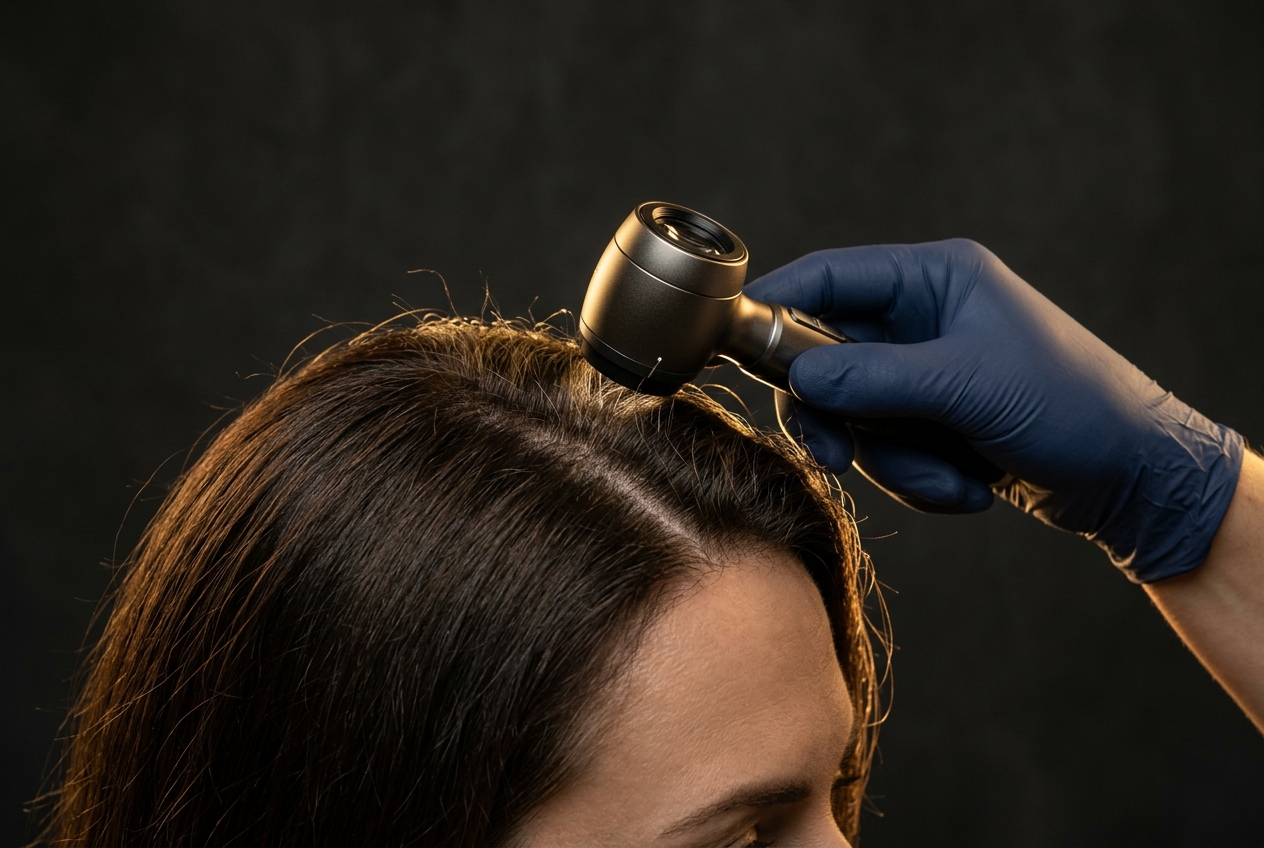
A woman can present with androgenetic alopecia with normal hormonal test results. We then look at the distribution of hair loss, follicular miniaturization, scalp dermoscopy, family history, duration of progression and other causes that may be worsening the hair loss. Because not all hair loss is obviously hormonal.
And this is where another pitfall appears
A woman can have androgenetic alopecia… and simultaneously a telogen effluvium, for example following an illness, significant weight loss, physiological stress, the postpartum period, iron deficiency, severe caloric restriction, or certain medications. In this case, two mechanisms can coexist, and if one looks for a single explanation, part of the problem may be missed.
Ferritin and the thyroid can also matter for hair
Depending on the context, we may also check ferritin and iron metabolism, TSH and sometimes free T4, vitamin B12, vitamin D depending on the situation, and other parameters when clinically indicated. But, here again, we are not looking for 'perfect values': we are looking for a cause that is medically consistent with the symptoms.
I want to be very precise about the word 'optimal'
One hears a great deal today: 'your tests are normal, but not optimal.' And this term can become dangerous, because it sometimes allows any normal figure to be turned into a pseudo-abnormality. I do not want to do that: there is no mysterious universal 'optimal' hormonal number that applies to all women.
What we are looking for is something else entirely: is the result consistent with the clinical picture? Was the right marker measured? Was it measured under the right conditions? Is there a different free fraction? Could the tissue be particularly sensitive? Is there another cause? That is what medical interpretation means.
So 'everything is normal' can mean two different things
First possibility: we have properly investigated the likely causes and nothing abnormal has been found. Very well — this points us toward local mechanisms or other diagnoses. Second possibility: we simply carried out a general work-up that was not designed to answer this specific question precisely. It is not a bad set of tests; it simply answers a different question.
It is exactly like ordering a chest X-ray to explain knee pain: the X-ray may be perfectly normal, but it does not answer the right question.
How do I approach a woman who tells me: 'I have acne and I am losing my hair'?
I start with the history. Since when? Are the cycles regular? Does the acne vary with her period? Is there any new hair growth? Has her weight changed? Has there been a pregnancy, stopping the pill, weight loss, significant physiological stress? Any family history of hair loss? What medications? What diet?
Then I examine the skin, the scalp, the follicles, the distribution of the acne, and any possible signs of hyperandrogenism. And only then do I decide which investigations can genuinely contribute something.
Symptoms matter
This is probably the message I most want to convey. A blood test is an extraordinary tool, but it never replaces what the patient describes and what the physician observes. If a woman presents with persistent acne, hirsutism, irregular cycles, progressive alopecia, or a combination of these signs, the fact that an isolated testosterone result falls 'within the normal range' is not always sufficient to close the case: we need to understand the underlying mechanism.
But the reverse is equally true.
We should not go searching for a 'hidden hormonal imbalance' in every woman who presents with acne or hair loss. Acne can be multifactorial, alopecia has many causes, and normal biological variations are not necessarily diseases. The goal is not to find something at any cost: the goal is to understand what is most likely.
Key takeaways
If you have acne, hair loss, or excessive hair growth and your test results are reported as normal, do not automatically conclude 'so my hormones have nothing to do with it' — but do not conclude either that 'the laboratory made a mistake and my hormones must be too high for me.' The truth is more interesting: a hormone can be normal in the blood yet produce a significant response in a particularly sensitive tissue.
Total testosterone does not always tell the whole story; SHBG and the free fraction can matter; the local metabolism of androgens in the skin and hair follicle matters; the timing within the cycle and hormonal treatments matter. And above all, the clinical diagnosis matters.
I am Dr Florian Vallecillo. And if I had to leave you with just one idea today, it would be this: a laboratory value is never treated in isolation — and it is never interpreted in isolation. 'Normal' means 'within a reference range'; it does not necessarily mean 'we have explained why you have acne or why you are losing your hair.' When symptoms persist, the right question is not 'how do I push my hormones outside the normal range?', but rather 'have we truly understood what is happening in my skin, my hair, and my hormonal environment?' Because in medicine, the diagnosis rarely begins with a number: it begins with the person sitting in front of us.
What to remember
- —"Normal" means "within the laboratory reference range" — not "we have proven that your hormones play no role". A reference range is not a diagnosis.
- —The same total testosterone can have very different effects: what also matters is SHBG and the free fraction (biologically available), not just the total value.
- —The skin and hair follicles have their own hormonal machinery (receptors, 5-alpha-reductase → DHT): a marked response does not necessarily require an abnormal blood concentration — it is a matter of tissue sensitivity.
- —Hormone-dependent acne and androgenetic alopecia can exist with perfectly normal test results, with or without PCOS; insulin resistance can increase androgenic activity (↑ ovarian androgens, ↓ hepatic SHBG).
- —The context of the blood draw matters: day of the cycle, contraception (↑ SHBG), postpartum period, perimenopause… Some cases of hair loss are also related to ferritin, the thyroid, or a superimposed telogen effluvium.
- —Be wary of the word "optimal": there is no universal ideal hormonal number. The goal is not to push hormones "outside" the normal range, but to understand the mechanism. The diagnosis starts with the person, not with a number.

Doctor Florian A. Vallecillo Cabrera
The doctor explains
Informational content, written and reviewed by Doctor Florian A. Vallecillo Cabrera. It does not replace an in-person consultation or an individual diagnosis.