
Exercise or snack: how does our brain arbitrate between effort and food reward?
In mice, the orexin system helps the brain sustain physical activity in the face of a food temptation — a motivation mechanism, not yet a human therapeutic avenue.

Doctor Florian A. Vallecillo Cabrera
Author
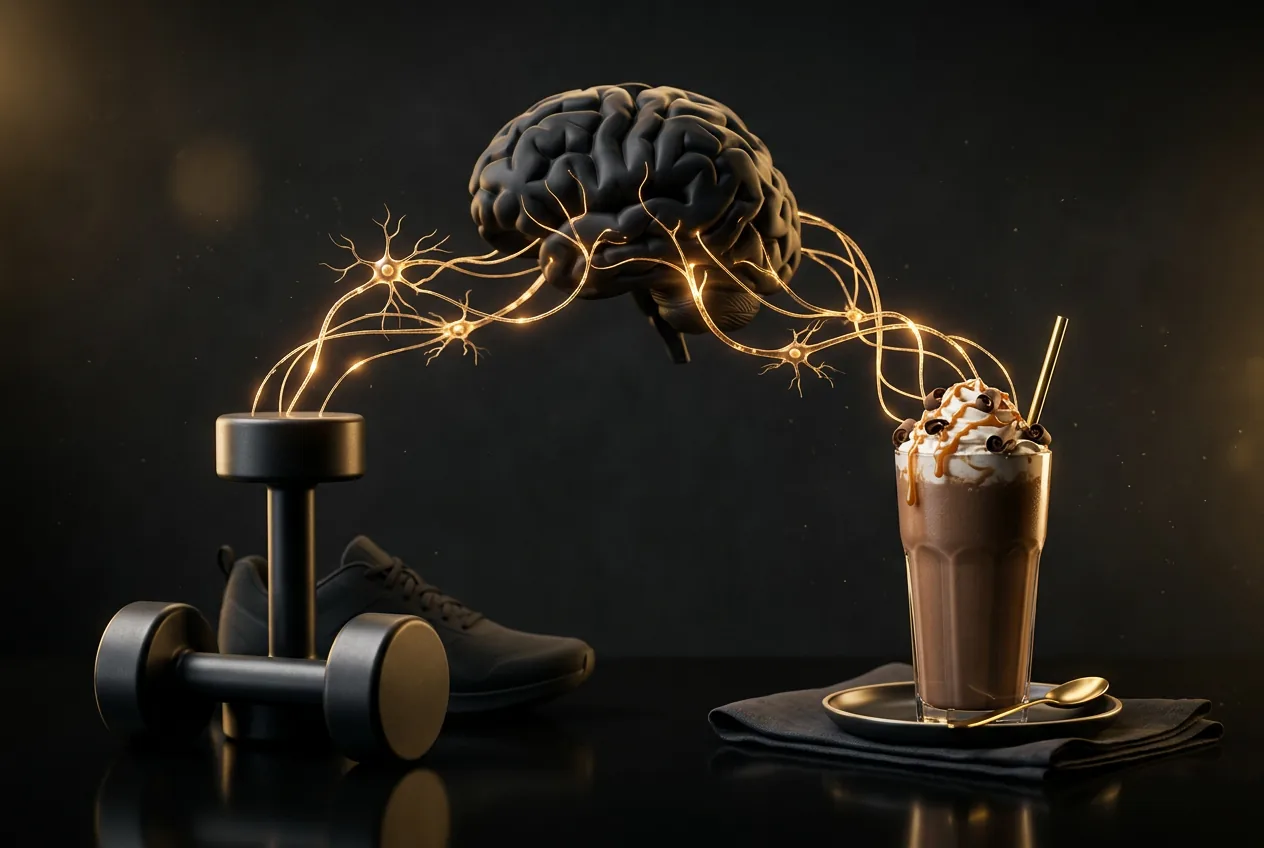
A study from ETH Zurich (Nature Neuroscience, 2024) shows in mice that the orexin (hypocretin) system helps the brain arbitrate between running on a wheel and drinking a sugary, fatty milkshake. Intact system → more running, less milkshake; blocked orexin → preference for the calorie-rich drink. The effect appears mainly when several rewards compete. Orexin acts as a coordinator of motivation (wakefulness, engagement, resistance to temptation), beyond dopamine alone. Promising results but not directly transferable to humans: neither a "willpower hormone" nor a ready-to-use drug target.
Summary
Why do we sometimes choose to exercise when an immediately pleasant food reward is within reach?
Swiss researchers have identified in mice an important brain player in this arbitration: the orexin system, also called the hypocretin system.
When this system functioned normally, the animals spent more time running on a wheel, even when a milkshake rich in sugar and fat was available. When orexin signalling was blocked, they favoured the calorie-rich drink more.
These results suggest that orexin does not simply control hunger or movement. It could help the brain assign relative value to the different available options and maintain physical activity in the face of a competing temptation.
This discovery adds a new piece to the understanding of eating behaviour and sedentary lifestyle, but it is not yet a validated therapeutic avenue in humans.
What is orexin?
Orexin is not a single hormone simply circulating in the blood. It is primarily a system made up of two neuropeptides:
- orexin A;
- orexin B.
They are produced by a relatively small number of neurons located in the lateral hypothalamus, but their projections reach many brain regions.
The orexinergic system is involved in particular in:
- wakefulness and the stability of alertness;
- motivation;
- orientation towards a reward;
- feeding;
- locomotor activity;
- energy expenditure;
- adaptation to stress and metabolic needs.
It thus represents an interface between the body's energy state and the behaviours needed to respond to it.
Why is dopamine not enough to explain our choice?
Dopamine plays a central role in motivation, learning and the anticipation of rewards.
But it is inaccurate to simply say that "exercise and dessert both release dopamine" and that the brain would then need another hormone to decide between them.
Decision-making relies on several brain networks that simultaneously integrate:
- the expected pleasure;
- the effort required;
- the state of fatigue;
- hunger;
- habits;
- past experience;
- the environment;
- the immediate availability of the reward.
Orexin seems to be involved in this integration by promoting wakefulness, engagement and the pursuit of a motivated behaviour. More recent animal work also suggests that the activity of orexin neurons varies during the anticipation of a reward and can modify certain decision strategies.
How was the study carried out?
The researchers placed mice in an environment giving them access to several voluntary activities, including:
- running on a wheel;
- drinking a strawberry milkshake rich in sugar and fat;
- exploring other objects or spaces.
This set-up is important: it was not only about imposing a binary choice between food and exercise, but about observing how the animals spontaneously distributed their time in an environment rich in possibilities.
The scientists then compared mice whose orexinergic system functioned normally with animals in which it had been inhibited, either pharmacologically or through genetic manipulation.
What were the results?
When several possibilities were accessible, mice with an intact orexinergic system:
- spent more time running;
- consumed less milkshake;
- resisted the competing food reward more.
When orexin signalling was reduced, the animals abandoned the wheel more in favour of the milkshake.
A key point: when the researchers offered only a single activity, or a much simpler choice, the differences between the groups were less marked.
This suggests that orexin does not solely determine the ability to run or the amount of food ingested. It seems to be involved above all when the brain has to arbitrate between several competing rewarding behaviours.
Does orexin make you want to exercise?
Not in the simple sense of the term.
The data instead indicate that orexin neurons help to maintain:
- wakefulness;
- behavioural energy;
- engagement in an activity;
- resistance to an immediate competing reward.
In the experiment, the wheel was not necessarily perceived as a chore. In rodents, running voluntarily can be an intrinsically rewarding activity.
The study therefore does not exactly compare a human hesitating between going to the gym and eating a cake. It studies the competition between two activities that the mouse may find motivating.
What is the link with obesity?
Obesity does not result from a simple lack of willpower. It involves a complex interaction between:
- biology;
- food environment;
- sleep;
- stress;
- physical activity;
- socio-economic factors;
- genetics;
- the brain's reward circuits.
The orexinergic system can influence several elements of this balance:
- alertness;
- the spontaneous level of activity;
- food seeking;
- energy expenditure;
- the response to metabolic signals.
Some orexin neurons also integrate information related to blood sugar and movement, showing how much this system links metabolic state and behaviour. Nevertheless, it would be premature to make it a central cause of obesity or a ready-to-use drug target.
What is the link with sleep?
The best-established role of orexin concerns the stability of wakefulness.
A loss of orexin-producing neurons is directly involved in type 1 narcolepsy, characterised in particular by excessive daytime sleepiness and, frequently, cataplexy.
Conversely, some recent insomnia medications block orexin receptors. This is the case with daridorexant, a dual antagonist of the OX1 and OX2 receptors, authorised in Europe for certain chronic insomnia in adults.
This shows that modifying this system has very concrete effects on alertness. But it does not allow us to conclude that these treatments cause a food preference or a significant decrease in exercise in humans.
Do orexin-blocking insomnia medications make you move less?
To date, there is no sufficient clinical evidence to state that orexin antagonists used at therapeutic doses lead patients to abandon physical activity in favour of food.
Their aim is to reduce the wakefulness signal during the night, not to durably inhibit the orexinergic system throughout the day.
Drowsiness may nevertheless occur in some patients, as with other sleep treatments. It must be taken into account individually, particularly for driving or activities requiring sustained alertness.
Can you naturally stimulate your orexin?
There is currently no validated clinical method to specifically "boost" orexin in order to prefer exercise over food.
The functioning of this system is, however, indirectly influenced by:
- the sleep-wake cycle;
- nutritional status;
- metabolic variations;
- physical activity;
- stress;
- environmental signals.
Presenting certain foods, supplements or routines as "orexin activators" capable of causing weight loss would therefore be scientifically unjustified.
Why do we often choose the snack?
Food reward has several immediate advantages for the brain:
- it is quickly available;
- it requires little effort;
- its pleasant effect is predictable;
- foods rich in sugar and fat are strongly reinforcing.
Physical activity, on the other hand, often requires an initial cost before its pleasant benefits are felt.
The context therefore plays a major role. Making exercise more accessible and reducing the availability of temptations can sometimes be more effective than relying on motivation alone.
A few practical measures can help:
- schedule the activity in advance;
- prepare your sports clothes;
- choose an activity that is genuinely enjoyable;
- start with a short duration;
- avoid keeping very appetising snacks constantly visible;
- sleep enough to limit fatigue and food impulsivity.
These strategies act on the decision environment without claiming to directly modify orexin.
What this study does not demonstrate
This study does not prove that:
- orexin is "the willpower hormone";
- sedentary people lack orexin;
- obesity is caused by a deficiency of this system;
- stimulating orexin would automatically make people exercise more;
- orexin-blocking medications systematically cause weight gain;
- the results observed in mice are directly applicable to humans.
It identifies an interesting neuronal mechanism, which will need to be studied in complementary models and then in clinical research.
The Valorian analysis
This study brings a more modern view of motivation. Our choices are not solely the product of a conscious decision pitting willpower against indulgence. They result from brain networks that constantly compare the value of rewards, the effort to be made, our level of wakefulness, our energy state and the possibilities present in the environment.
Orexin seems to play a coordinating role between these different dimensions. It does not simply push us to eat or to move: it helps the body select and maintain a relevant behaviour when several rewarding options are in competition.
For Valorian, the main lesson is not that we should try to pharmacologically manipulate orexin. It is rather that sedentary lifestyle and eating behaviours cannot be reduced to a lack of discipline.
An effective metabolic-health strategy must act simultaneously on:
- sleep;
- the food environment;
- the pleasure associated with physical activity;
- habits;
- muscle mass;
- stress;
- hormonal and metabolic health when necessary.
Understanding the neurobiology of decision-making can help design better behavioural strategies, but we are still far from a treatment capable of directly turning a preference for snacking into a desire to exercise.
Key points
- ◆In mice, an intact orexinergic system = more time running and less milkshake; blocked orexin = preference for the calorie-rich drink.
- ◆Orexin is not "the willpower hormone": it coordinates wakefulness, motivation and engagement, especially when several rewards compete.
- ◆Dopamine alone does not explain everything: the decision integrates expected pleasure, effort, fatigue, hunger, habits, environment and reward availability.
- ◆No validated method can "boost" orexin to prefer exercise: slimming "orexin activators" are scientifically unjustified.
- ◆The practical lever = the decision environment: schedule activity, sleep enough, make exercise enjoyable and limit the visibility of snacks.
Valorian level of evidence
- Scientific quality(4/5)
Rigorous experimental study published in Nature Neuroscience, using genetic and pharmacological interventions to explore the causal role of the orexinergic system.
- Current clinical application(2/5)
The results concern mice. There is currently no clinical test or validated treatment targeting orexin to voluntarily increase physical activity or modify food choices.
- Future potential(4/5)
This work could improve the understanding of the interactions between sleep, motivation, food and physical activity. Its translation into prevention or treatment of obesity will, however, require in-depth human studies.
References
- Tesmer AL et coll. Orexin neurons mediate temptation-resistant voluntary exercise. Nature Neuroscience. Publication en ligne : 6 août 2024. Étude menée à l'ETH Zurich sur le rôle des neurones à orexine dans le choix entre activité physique volontaire et nourriture appétissante chez la souris.
Frequently asked questions
What is the orexin system?
Orexin (or hypocretin) is a system of two neuropeptides (orexin A and B) produced by neurons in the lateral hypothalamus. It regulates wakefulness, motivation, feeding, activity and energy expenditure, linking metabolic state and behaviour.
Is orexin "the willpower hormone"?
No. That is a misleading shortcut. It helps the brain maintain wakefulness, engagement and resistance to an immediate temptation when several rewards compete, but it does not "create" willpower and does not alone determine our choices.
Do the results in mice apply to humans?
Not directly. The study identifies an interesting neuronal mechanism in animals. To date there is no clinical test or validated treatment targeting orexin to increase physical activity or modify food choices in humans.
Do orexin-blocking sleeping pills cause weight gain or less movement?
No sufficient clinical evidence shows this at therapeutic doses. These medications (e.g. daridorexant) aim to reduce the wakefulness signal at night, not to inhibit orexin all day. Drowsiness remains possible and must be assessed individually.
Can you naturally stimulate orexin to prefer exercise?
No, there is no validated method. The system is indirectly influenced by sleep, nutritional status, activity and stress. The best strategies act on the decision environment (planning, sleeping, making activity enjoyable), not on orexin directly.