Losing weight after 40: why is it harder and which strategies really work?
After 40, loss of muscle mass, hormonal changes, sleep and stress alter the energy balance. The key: preserve muscle, food quality and metabolic health.

Doctor Florian A. Vallecillo Cabrera
Author
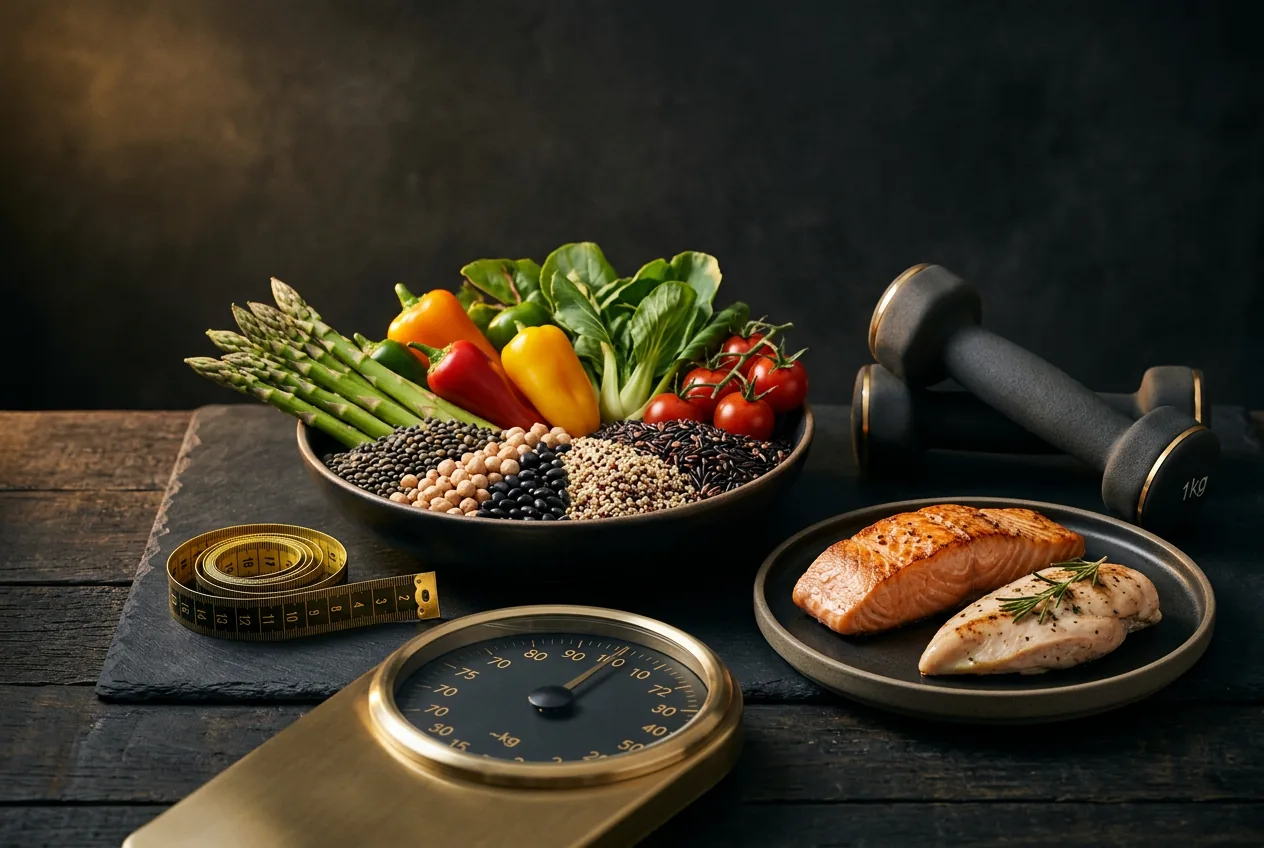
After the age of 40, losing weight often becomes harder: loss of muscle mass (sarcopenia), hormonal changes (menopause, declining testosterone), disrupted sleep and chronic stress alter the energy balance. Basal metabolism falls only slightly before 60. Effective strategies rely on adequate protein intake (1.2–1.6 g/kg/day), strength training (2–3 sessions/week), at least 150 min of moderate activity, sleep optimisation and management of medical factors. Sources: EASO, ESPEN, Endocrine Society, ACSM.
Summary
Many people find that it becomes harder to lose weight after the age of 40, even while keeping the same eating habits and the same level of physical activity.
This impression is far from imaginary. With age, several biological mechanisms gradually alter our energy balance: loss of muscle mass, hormonal changes, a decline in spontaneous physical activity, disrupted sleep and an increase in certain stress factors.
The good news is that these changes do not make weight loss impossible. They simply call for a different strategy, focused more on preserving muscle mass, the quality of the diet and metabolic health than on restrictive diets.
Does metabolism really slow down after 40?
Yes, but not as much as people think.
For a long time, age-related weight gain was attributed to a sharp decline in basal metabolism. Recent research shows that this decline is relatively moderate before the age of 60.
Instead, several factors explain the weight gain seen in many people:
- gradual loss of muscle mass (sarcopenia);
- reduced daily physical activity;
- hormonal changes;
- less restorative sleep;
- increased chronic stress.
It is the combination of these elements that promotes an increase in fat mass.
Loss of muscle mass: a key factor
From the age of forty onwards, muscle mass gradually declines if it is not maintained.
Muscle is a highly active tissue metabolically. The more its mass decreases, the more daily energy expenditure tends to fall.
Beyond its role in metabolism, muscle also helps to:
- improve insulin sensitivity;
- maintain balance;
- preserve independence with age;
- support bone health.
Preserving muscle mass is therefore essential, not only to lose weight but also to age in good health.
Do hormones play a role?
Yes.
In women
Perimenopause and menopause are accompanied by a gradual decline in oestrogen. These hormonal changes promote:
- a redistribution of fat towards the abdomen;
- a decrease in muscle mass;
- sometimes a reduction in energy expenditure.
In men
Testosterone gradually declines with age. In some men, this decline can contribute to:
- a decrease in lean mass;
- an increase in fat mass;
- a reduction in physical strength.
However, not all weight gain is linked to a hormonal deficiency, which is why a medical assessment is important when a disorder is suspected.
The role of sleep and stress
Lack of sleep influences several hormones involved in appetite, in particular:
- ghrelin, which stimulates hunger;
- leptin, which contributes to the feeling of fullness.
At the same time, chronic stress raises cortisol levels. In the long term, this can promote:
- an increase in appetite;
- a preference for foods high in sugar and fat;
- an accumulation of abdominal fat in some people.
The most common mistakes
After 40, many people adopt strategies that end up slowing their progress. The most common mistakes are:
- cutting calorie intake excessively;
- skipping meals;
- doing only cardio without strength training;
- neglecting protein;
- seeking very rapid weight loss.
These approaches often promote loss of muscle mass, which makes it harder to maintain results.
What diet should be favoured?
Current recommendations emphasise quality rather than extreme diets. The main objectives are to:
- consume enough protein (about 1.2 to 1.6 g/kg/day in many adults after 40, depending on the clinical context and level of activity);
- increase vegetables, fruit and legumes;
- favour whole grains;
- limit ultra-processed foods;
- reduce sugary drinks;
- maintain a moderate calorie deficit when the goal is weight loss.
A sustainable diet is more effective than a very restrictive diet followed by weight regain.
Physical activity: strength training becomes essential
Contrary to a common belief, cardio is not enough. International recommendations advise combining:
- at least 150 minutes of moderate physical activity per week;
- two to three weekly strength-training sessions.
Brisk walking, cycling or swimming remain excellent for cardiovascular health, but muscle work is essential to preserve metabolism.
What if the weight does not go down despite the effort?
When weight loss remains difficult despite a good lifestyle, a medical check-up may be helpful. Some situations can hinder results:
- hypothyroidism;
- sleep apnoea syndrome;
- insulin resistance or diabetes;
- certain medications (corticosteroids, antidepressants, etc.);
- hormonal disorders.
Identifying these factors makes it possible to adapt the management.
New treatments for obesity
In recent years, new medications, particularly GLP-1 receptor agonists and dual GIP/GLP-1 agonists, have profoundly changed the management of obesity in some patients.
These treatments do not replace a balanced diet or physical activity, but they can be a valuable aid when prescribed as part of appropriate medical follow-up. They should be reserved for validated indications and integrated into an overall health strategy.
What this idea does not mean
The fact that losing weight is harder after 40 does not mean that:
- metabolism is "broken";
- diets are useless;
- hormones explain all weight gain;
- it is impossible to reach a healthier weight.
With an appropriate strategy, lasting results remain entirely achievable.
The Valorian analysis
Weight gain after 40 is multifactorial. It rarely results from a single factor and cannot be solved by a single solution. Modern approaches favour a holistic view integrating nutrition, physical activity, sleep, stress management and, when necessary, a hormonal or metabolic assessment.
At Valorian, we favour a personalised, evidence-based approach. The goal is not limited to lowering the number on the scale, but to improving body composition, preserving muscle mass, reducing visceral fat and optimising metabolic health over the long term. This approach is more compatible with the principles of "well-aging" and longevity medicine than restrictive diets or quick fixes.
Key points
- ◆Basal metabolism falls only slightly before 60: weight gain comes mainly from muscle loss, reduced activity, hormones, sleep and stress.
- ◆Preserving muscle mass is central: muscle supports metabolism, insulin sensitivity, balance and bone health.
- ◆Diet: favour quality, adequate protein intake (≈ 1.2–1.6 g/kg/day), vegetables, legumes and whole grains, while limiting ultra-processed foods and keeping a moderate calorie deficit.
- ◆Cardio alone is not enough: combine ≥ 150 min of moderate activity/week with 2–3 strength-training sessions.
- ◆If there is no progress despite a good lifestyle, consider a medical check-up (thyroid, sleep apnoea, insulin resistance, medications). New treatments (GLP-1, GIP/GLP-1) are an aid under medical supervision, not a substitute.
Valorian level of evidence
- Scientific quality(5/5)
The recommendations are based on international learned societies (EASO, ESPEN, ACSM, Endocrine Society) and on numerous studies on ageing, body composition and metabolic health.
- Current clinical application(5/5)
The strategies described (adequate protein intake, strength training, regular physical activity, sleep optimisation and management of medical factors) are at the heart of the modern management of excess weight after 40.
- Future potential(5/5)
The integration of personalised medicine, body-composition analysis and new metabolic therapies will allow an increasingly individualised approach to weight loss and to the prevention of age-related diseases.
References
- European Association for the Study of Obesity (EASO) — recommandations sur la prise en charge de l'obésité de l'adulte.
- European Society for Clinical Nutrition and Metabolism (ESPEN) — recommandations sur la nutrition clinique et l'apport protéique de l'adulte.
- Endocrine Society — recommandations sur les troubles hormonaux et métaboliques.
- American College of Sports Medicine (ACSM) — recommandations sur l'activité physique et le renforcement musculaire.
Frequently asked questions
Does metabolism really collapse after 40?
No. The decline in basal metabolism is moderate before 60. Weight gain is mainly explained by loss of muscle mass, reduced physical activity, hormonal changes, less restorative sleep and chronic stress.
How much protein should you eat after 40?
Often in the range of 1.2 to 1.6 g/kg/day in many adults, depending on the clinical context and level of activity. The aim is to preserve muscle mass during weight loss. A personalised medical or nutritional assessment is recommended.
Is cardio enough to lose weight after 40?
No. You need to combine at least 150 minutes of moderate activity per week with 2–3 strength-training sessions. Muscle work is essential to preserve metabolism and lean mass.
What if the weight does not go down despite the effort?
A medical check-up may help to look for hypothyroidism, sleep apnoea syndrome, insulin resistance/diabetes, the effect of certain medications or a hormonal disorder, so that management can be adapted.
Are the new medications (GLP-1) a solution?
They have transformed the management of obesity in some patients, but do not replace a balanced diet or physical activity. They should be reserved for validated indications and prescribed as part of medical follow-up.