Why Do We Get Wrinkles? A 'Skin-on-a-Plate' Model to Study How They Form
Korean researchers have created an in vitro skin model — a bilayer of cells and collagen that can be compressed — to observe in real time how wrinkles arise and which factors promote them.
Doctor Florian A. Vallecillo Cabrera
Author
Published in Nature Communications, this device reproduces 'wrinkles in a Petri dish' using epithelial cells on a collagen hydrogel. It allows researchers to see how mechanical compression and dehydration create folds, and confirms the protective role of collagen, without animal experimentation. We analyse what this advance contributes — and what it does not.
Why this news matters
Wrinkles preoccupy us and we spend considerable sums on creams to slow them down… with mixed success. And, surprisingly, we still understand rather poorly exactly how they form. We know that age promotes them — because skin thins over time — and that factors such as dehydration do not help either, but studying the phenomenon up close is difficult.
The problem is methodological: animal models do not allow real-time observation of what happens in the skin at a cellular and molecular level, and classical in vitro models do not resemble real skin conditions closely enough. A Korean team now proposes an elegant alternative.
The essential point in one sentence
A new laboratory model reproduces 'wrinkles on a plate' and shows that they form through mechanical compression of the skin, with collagen and water as the decisive factors.
'Wrinkles in a Petri dish'
The model was presented on 19 August 2024 in the journal Nature Communications by researchers from the Pohang University of Science and Technology (POSTECH), in South Korea. Their 'artificial skin' is made with real epithelial cells (lines derived from the intestine or lung) placed on a collagen hydrogel, the protein that provides structure to the skin and other epithelial tissues.
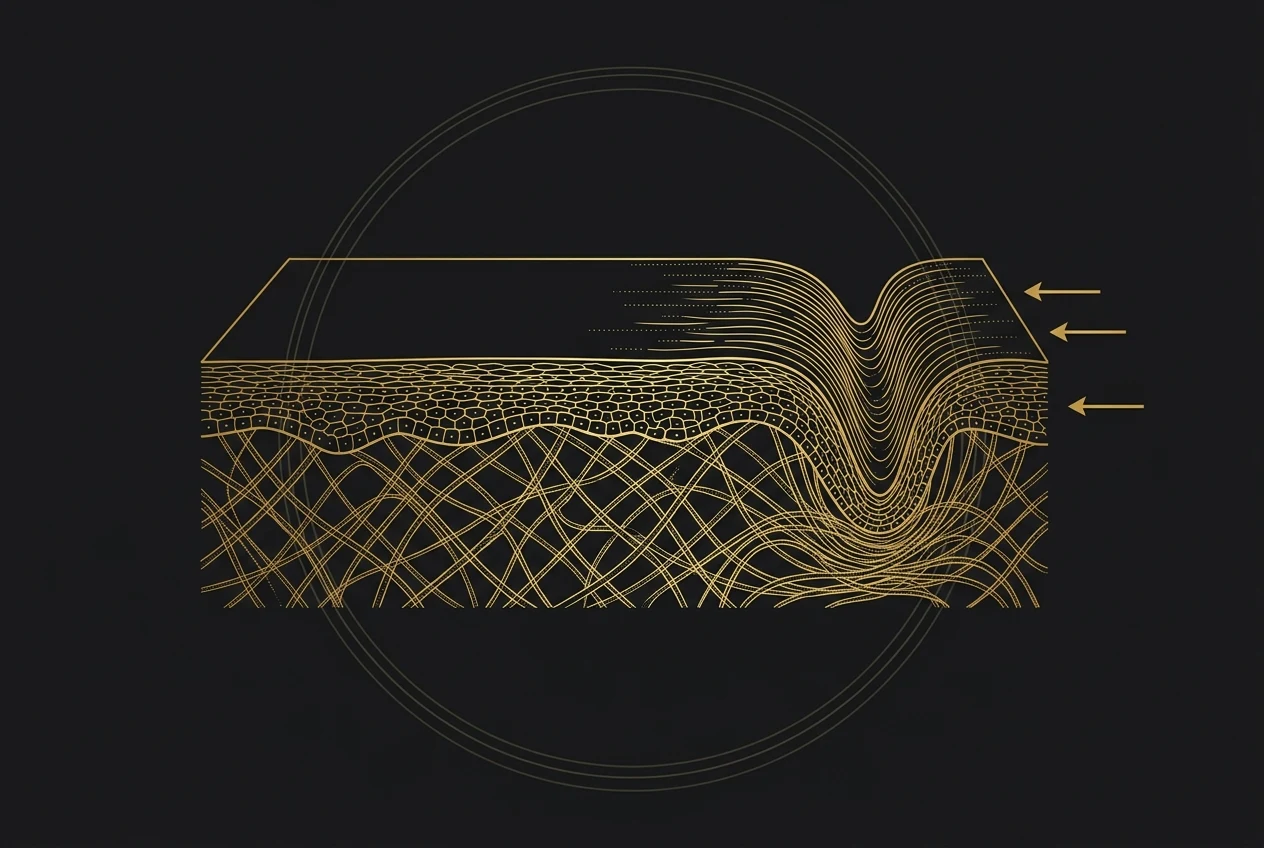
This double layer mimics the composition of such tissues and is placed in a device capable of compressing it. In this way, the researchers can study how mechanical pressures — such as those generated by muscle contraction — induce the appearance of wrinkles, and observe the process as it occurs.
Wrinkles arise from compression of the skin
The first result is revealing: the shape of the wrinkle depends on the pressure exerted on the tissue. Initially, compression stiffens the cell layer; it then generates a multitude of very small wrinkles, like ripples on a calm sea. But as pressure increases, these micro-wrinkles merge to form a single fold: our familiar, everyday wrinkles.
Collagen protects; dehydration promotes wrinkles
The researchers also tested their device with layers of epithelial cells without the second collagen layer. In that case, the cells deformed and formed folds much earlier, under lower compression than was needed when they were protected by collagen. This is a direct confirmation of the role this protein plays in supporting the skin and epithelial tissues.
Dehydration of the bilayer proved equally important and promoted wrinkle formation. Under compression, water is expelled outward, much like wringing a wet cloth. And this water loss depends directly on collagen density: the more collagen present, the more water it retains and the more it resists releasing it under pressure. At high collagen concentrations, compression no longer generated small wrinkles but rather a large fold that deformed the tissue less.
Level of evidence
★★★☆☆ — An innovative and well-characterised in vitro model, but it is a laboratory system (epithelial cells on collagen), not complete human skin in vivo. It describes physical mechanisms; it does not demonstrate the efficacy of any product.
Less animal experimentation, greater precision
"We have designed a platform capable of reproducing different wrinkle structures in living tissue without resorting to animal testing," said one of the study's authors, Dong Sung Kim, in a press release. The researcher hopes that this approach will allow wrinkle research — including in the cosmetic field — to become more ethical and more precise.
Clínica Valorian's analysis
We find this work interesting because it shifts the focus from the chemistry to the physics of skin. We tend to think of wrinkles as a problem of 'insufficient cream'; this model reminds us that, to a large extent, they are also a problem of material mechanics: compression, elasticity and water content. And it reinforces two ideas we repeat in our consultations: collagen and hydration genuinely matter for skin structure, and many expression wrinkles are linked to repeated mechanical forces (muscle contraction), not only to what we apply on the surface.
That said, we keep our feet on the ground: this is an in vitro model, not proof that any particular product 'erases' wrinkles. What truly has solid backing for long-term skin care remains what is already known: daily photoprotection, not smoking, good hydration, adequate rest, and a medical assessment when treatments are being considered. Science refines the 'why'; the fundamentals of skin care do not change.
Valorian Assessment
- Originality of approach (physics of wrinkle formation): ★★★★☆
- Robustness of the in vitro model: ★★★★☆
- Evidence in human skin in vivo: ★★☆☆☆
- Current clinical applicability: ★★☆☆☆
Overall rating: ★★★☆☆ — A promising tool for understanding (and preventing) wrinkles; still far from a specific product. One to follow closely.
Key points
- ◆We understand less than it might seem about how wrinkles form; animal models and classical cultures do not allow this to be studied well in real time.
- ◆Researchers from POSTECH (South Korea) presented in Nature Communications an in vitro model: epithelial cells on a collagen hydrogel that can be compressed.
- ◆Wrinkles form through mechanical compression: at low pressure, many micro-wrinkles appear; as pressure increases, they merge into a single fold (the visible wrinkle).
- ◆Collagen protects: without it, skin folds earlier and under less pressure. Its density regulates how much water the tissue retains.
- ◆Dehydration promotes wrinkles: under compression, water is expelled; more collagen means more retained water and fewer folds.
- ◆Key advantage: studying wrinkles without animal experimentation. This is a laboratory model, not proof that any specific cosmetic product erases them.
References
- Equipo de la Pohang University of Science and Technology (POSTECH), Corea del Sur. Modelo in vitro (bicapa de epitelio sobre hidrogel de colágeno) para estudiar la formación de arrugas por compresión mecánica. Nature Communications. 2024.DOI: 10.1038/s41467-024-51437-z
- Naylor EC, Watson REB, Sherratt MJ. Molecular aspects of skin ageing (aspectos moleculares del envejecimiento cutáneo y el papel del colágeno). Maturitas. 2011.
- Kligman AM. Fisiología del estrato córneo, la hidratación cutánea y la barrera de la piel (fundamentos del contenido de agua en la piel).
Frequently asked questions
Does this study prove that a cream erases wrinkles?
No. It is a laboratory model for understanding how skin folds form; it does not evaluate the efficacy of any specific product nor does it promise to erase wrinkles.
Is this of any practical use to me right now?
It confirms that collagen and hydration matter for skin structure, and that mechanical forces (such as muscle contraction) play a role in expression wrinkles. These are useful ideas, not a new treatment.
Why does it matter that no animals are used?
It allows research to be conducted more ethically and, above all, to observe the process in real time — something impossible with animal models. This accelerates research and makes it more precise.
So what really prevents wrinkles?
In the long term, what has solid backing: daily photoprotection, not smoking, good hydration and adequate rest; and a medical assessment before considering any treatment.