Vitiligo: can new treatments really repigment the skin?
Ruxolitinib (Opzelura), the first specific anti-JAK treatment, enables melanocytes to recolonise the skin. A therapeutic revolution, but reserved for less extensive forms.
Doctor Florian A. Vallecillo Cabrera
Author
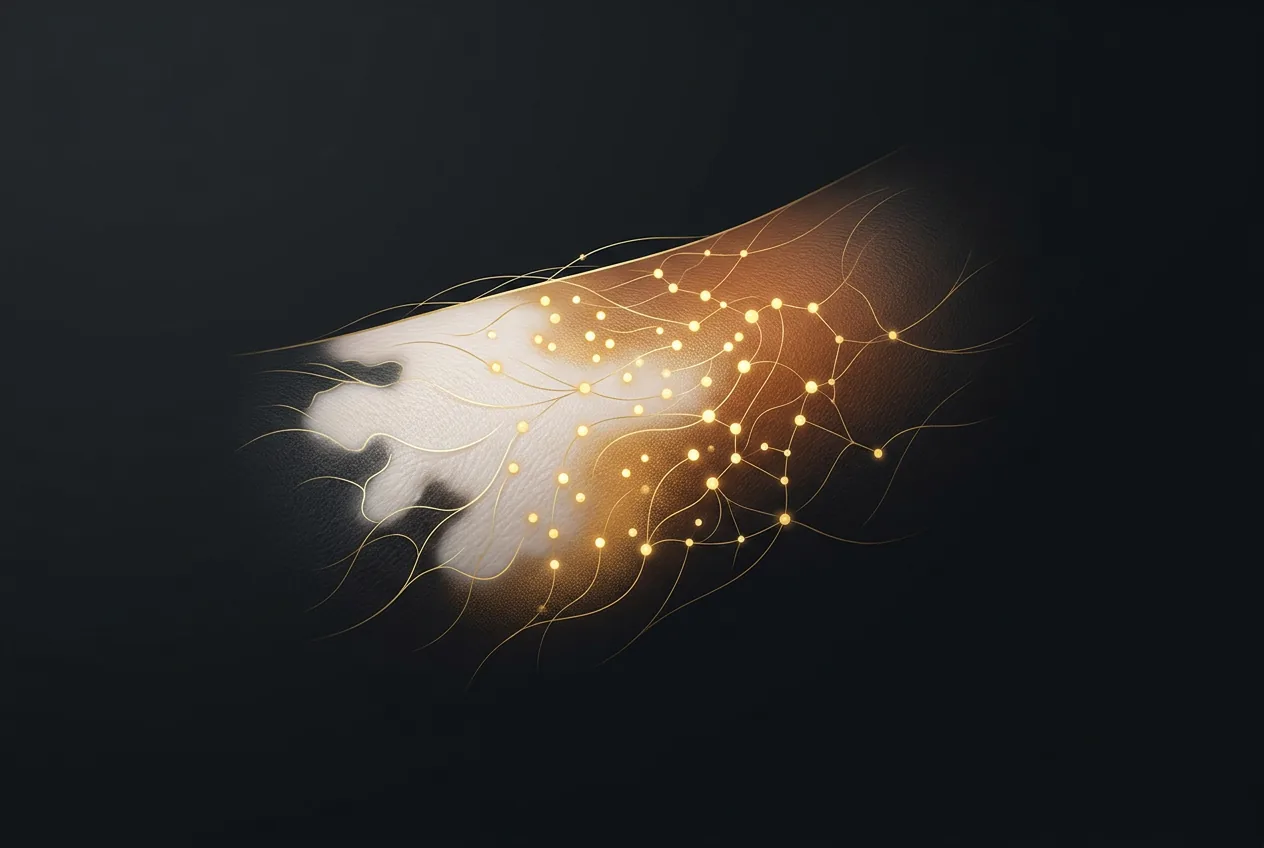
Vitiligo, an autoimmune disease affecting 1-2% of the population, appears as patches of depigmentation. Long considered to have 'no solution', it is now experiencing a therapeutic revolution: ruxolitinib (Opzelura), the first specific anti-JAK treatment, enables melanocytes to recolonise the skin, with on average 75% repigmentation of the face in one in two patients. But application is demanding, results are slow (6 to 24 months) and the treatment is reserved for less extensive forms. Vitiligo is neither contagious nor psychosomatic: several options exist (immunomodulators, cortisone, UVB phototherapy, melanocyte autograft), and early management is decisive.
Summary
Vitiligo is an autoimmune disease that appears as patches of skin depigmentation, and sometimes of hair. It affects 1-2% of the population and remains, even today, a stigmatising condition that is often poorly managed.
For a long time, patients were told there was "nothing to be done". That message is changing. A genuine therapeutic revolution is under way, driven in particular by a new molecule, ruxolitinib (Opzelura), the first specific treatment for vitiligo, which enables melanocytes to recolonise the skin and restore its colour.
What is vitiligo?
Vitiligo is an autoimmune dermatological disease defined by patches of skin depigmentation. It affects 1-2% of the general population and can appear on any area of the body: face, hands, feet, trunk, genitals. It is not life-threatening, but it can seriously affect quality of life.
Its social impact remains major in some contexts. As the French Vitiligo Association noted in 2024, the disease can be a source of discrimination: in some countries it is an obstacle to marriage, or even a cause of rejection. Public figures, such as the Canadian model Winnie Harlow, are helping to change how the disease is perceived.
Persistent misconceptions
For too long, mistaken beliefs led to inadequate care. They must be clearly corrected:
- "There is nothing to be done": false. Several treatment options exist, and new ones are arriving.
- "You must avoid the sun": this needs nuance. Controlled exposure can actually be part of care (medical UVB phototherapy, not to be confused with cosmetic UVA).
- "It is psychosomatic, all in the head": false. Vitiligo is a real autoimmune disease, linked to the destruction of melanocytes.
- "It is contagious": completely false. Vitiligo is not transmissible.
A study led in 2023 by Prof. Khaled Ezzedine (Henri-Mondor hospital, Créteil) revealed the scale of the problem: more than 80% of the patients surveyed had been offered no treatment at all.
An autoimmune mechanism
We now know that vitiligo is linked to a dysfunction of the immune system, leading to the loss of melanocytes, the cells that produce melanin, the skin's natural pigment.
About fifty genes (HLA, CTLA4, NLRP1, TYR…) are associated with vitiligo, but the disease is not hereditary in the strict sense. There is a genetic predisposition on which external factors trigger the autoimmune process that destroys melanocytes. These factors are linked to the exposome, that is, the set of exposures to which the body is subjected throughout life.
Which factors can trigger the disease?
In a predisposed person, a "stress" in the medical sense can set the process in motion. The list of possible triggers is long:
- surgery;
- an infection;
- hormonal changes (pregnancy, puberty, menopause);
- psychological stress;
- repeated friction on the skin;
- a burn, such as sunburn;
- contact with certain chemicals.
However, the trigger is not always identified, and treating that factor is not enough to improve vitiligo or to prevent its progression.
The different forms of vitiligo
In 90% of cases, the disease is non-segmental: all areas of the body may be affected symmetrically. It begins with a white patch, and evolution is then unpredictable: the patch may remain stable, spread more or less quickly, or regress.
Vitiligo is said to be "active" when the disease is in a flare phase. Small signs are then present: "confetti" depigmentation, pale non-depigmented borders. These signs are often invisible to the naked eye and are only detected under ultraviolet light, with the Wood's lamp.
What are the treatment options?
Whether one or several areas are depigmented, several treatments can be considered:
- immunomodulators;
- cortisone;
- medical phototherapy (sun or UVB rays supervised by a doctor, not cosmetic UVA);
- in rare cases, a melanocyte graft (fewer than 100 patients a year in France).
The principle is clear: the more active or recent the vitiligo, the sooner it should be treated. Care pursues three goals: to halt depigmentation, to induce repigmentation, and to prevent recurrences, which occur in about 50% of cases.
Melanocyte autograft
This technique is reserved for patients with stable vitiligo (no signs visible under ultraviolet), localised (few areas), and after the failure of medical treatments. It is performed under local anaesthesia, in about three hours:
- a skin biopsy is taken from a healthy, pigmented, inconspicuous area (scalp, pubis, buttock);
- a chemical treatment separates the dermis from the epidermis to harvest only the epidermal layer;
- the resulting solution is applied to the recipient area, previously stripped of its surface layer with a laser;
- a dressing is left in place for about eight days.
The patient must then wait around nine months to assess the success of the operation.
A new molecule that reactivates melanocytes
For just over a year, a new weapon has been available: the first specific treatment for vitiligo, ruxolitinib, marketed by Incyte Biosciences under the name Opzelura. In France, the 100 g tube costs 838 euros and has been reimbursed at 65% by social security since summer 2024. One amount treats the equivalent of the surface of a hand, i.e. 1% of the body surface, for six months.
Its application is demanding: twice a day, in thin layers. It therefore remains reserved for less extensive forms. It is offered from the age of 12 to patients whose area to be treated does not exceed 10% of total body surface, i.e. around 30-40% of patients.
How does it work? The anti-JAK mechanism
Awarded the Galien 2024 prize at the end of 2024, this molecule is the first so-called anti-JAK treatment. In vitiligo, melanocytes are destroyed by certain immune cells, the T lymphocytes, via biological pathways activated by proteins called Janus kinases (JAK 1, 2, 3). Ruxolitinib inhibits precisely the action of these proteins. The result: a reduction in the aggressiveness of the lymphocytes, and melanocytes that repopulate the affected skin. The treatment is very well tolerated.
What results can be expected?
Ruxolitinib achieves on average 75% repigmentation of the face in one in two patients. But results take time: they appear only after long months of treatment, at least six and often up to twenty-four months. Moreover, the hands, feet and wrists respond less well than the face.
Other trials aim to improve these results. Current feedback suggests that combining UVB sessions with the oral intake of certain antioxidants would repigment lesions faster. These data, however, still need to be confirmed and published.
UVB and skin cancer risk
One reassuring point is worth highlighting: experience with the use of UVB has shown that the risk of developing skin cancer (melanoma and other types) is lower in patients with vitiligo than in the general population.
The Valorian analysis
Vitiligo perfectly illustrates a paradigm shift in skin medicine: a disease long considered "without a solution" now has concrete options and a first specific treatment. The essential message is twofold: vitiligo is neither contagious nor "psychological", and it is no longer true that "there is nothing to be done".
That said, a realistic view must be kept. Ruxolitinib is a major advance, but it is not a universal solution: it targets less extensive forms, requires prolonged and rigorous application, and gives better results on the face than on the extremities. Speed of care, especially in active or recent forms, remains decisive. Finally, therapeutic combinations (UVB, antioxidants) are promising but still need to be confirmed.
At Valorian, skin health is approached from a comprehensive, evidence-based perspective: recognising depigmentation early, guiding towards specialist evaluation, and avoiding the two pitfalls of vitiligo — therapeutic resignation on one side, excessive promises on the other.
Key points
- ◆Vitiligo is an autoimmune disease (1-2% of the population) linked to the destruction of melanocytes; it is neither contagious nor psychosomatic.
- ◆Ruxolitinib (Opzelura), the first specific anti-JAK treatment, enables melanocytes to recolonise the skin: ~75% repigmentation of the face in 1 in 2 patients.
- ◆Slow results (6 to 24 months) and demanding application; reserved for less extensive forms (≤ 10% of body surface, from age 12).
- ◆Other options: immunomodulators, cortisone, medical UVB phototherapy, and rarely melanocyte autograft; the more active/recent the vitiligo, the sooner it should be treated.
- ◆The risk of skin cancer is lower in patients with vitiligo than in the general population.
Valorian level of evidence
- Scientific quality(4/5)
The autoimmune mechanism and the anti-JAK action of ruxolitinib are firmly established, and the molecule is approved and reimbursed. Some combinations (UVB + antioxidants) still rest on unpublished feedback.
- Current clinical application(4/5)
A specific treatment exists and transforms care, but it remains reserved for less extensive forms, with variable results depending on the location and a delay of several months.
- Future potential(5/5)
Understanding of the JAK pathways, combination strategies and the development of new molecules open the way to broader, faster repigmentation and better prevention of recurrences.
References
- Sylvie Riou-Milliot. « Vitiligo, l'espoir d'une peau repigmentée ». Sciences et Avenir n°937, mars 2025. Avec les Prs Thierry Passeron (chef de service de dermatologie, CHU de Nice), Julien Seneschal (chef du service dermatologie, CHU de Bordeaux) et Khaled Ezzedine (dermatologue, hôpital Henri-Mondor, Créteil), et l'Association française du vitiligo.
Frequently asked questions
Is vitiligo contagious?
No, absolutely not. Vitiligo is an autoimmune disease linked to the destruction of melanocytes; it is in no way transmissible from one person to another.
Can the skin really be repigmented?
Yes, in many cases. Ruxolitinib (Opzelura), the first specific anti-JAK treatment, achieves on average 75% repigmentation of the face in one in two patients, but after several months of treatment (6 to 24 months). The hands, feet and wrists respond less well.
Should you avoid the sun if you have vitiligo?
Not systematically. Contrary to a common belief, medical UVB phototherapy (supervised by a doctor) can be part of the treatment. It is cosmetic UVA that is not indicated. Experience with UVB even shows a lower risk of skin cancer than in the general population.
Who is ruxolitinib (Opzelura) for?
For patients from age 12 whose area to be treated does not exceed 10% of body surface, i.e. around 30-40% of patients. It is applied twice a day in thin layers. In France it has been reimbursed at 65% since summer 2024.
Is vitiligo hereditary?
Not in the strict sense. About fifty genes are associated with vitiligo and create a predisposition, but it is exposome-related factors (surgery, infection, hormonal changes, stress, burns, chemicals) that can trigger the disease in predisposed people.
Topics