Vitiligo is an autoimmune disease that causes white patches through pigment loss. Learn about its causes, the available treatments and the daily care that helps control the disease and protect the skin.
What is vitiligo?
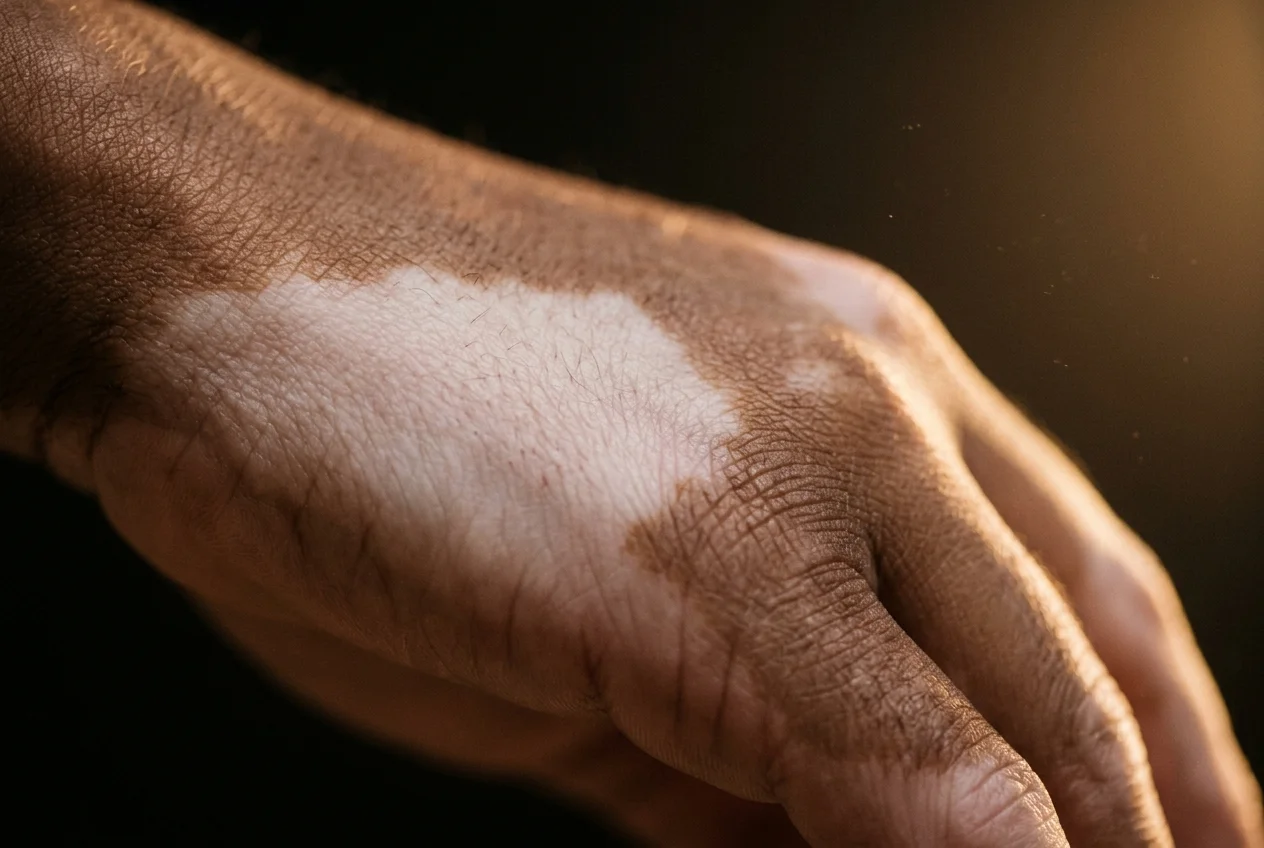
Vitiligo is a chronic disease in which white patches appear on the skin due to the loss of melanocytes, the cells responsible for producing melanin, the pigment that gives colour to the skin, the hair and part of the eyes.
It can affect people of any age, sex or skin colour. Although it is more evident in people with dark skin, it can appear in any skin type.
Vitiligo is not contagious, is not caused by an infection and does not represent a risk to life. However, it can have a significant emotional impact and affect self-esteem.
Why does it appear?
This is one of the most frequent questions in consultation. The answer is that there is no single cause.
We now know that vitiligo is a disease of autoimmune origin. This means that, for reasons that are still not completely known, the immune system mistakenly attacks the melanocytes and causes them to disappear.
Several factors can play a role:
- Genetic predisposition.
- Associated autoimmune diseases, especially of the thyroid.
- Significant physical or emotional stress.
- Repeated trauma to the skin (Koebner phenomenon).
- Intense sunburn.
Why does it appear suddenly?
In many patients there is no clear trigger. The patches can appear spontaneously and evolve slowly or in flare-ups.
It is important to know that vitiligo does not appear because of poor diet, lack of vitamins or poor hygiene.
What are the symptoms?
The main symptom is the appearance of well-defined white patches. They can be located anywhere on the body, although they are more common on:
- The face.
- Around the eyes.
- The mouth.
- The hands.
- The fingers.
- The elbows.
- The knees.
- The armpits.
- The genitals.
In some people the following can also appear:
- Whitening of the hair or beard.
- White eyelashes or eyebrows.
- Depigmentation of the body hair in the affected areas.
The patches do not usually cause pain, itching or scaling. The course is highly variable. Some remain stable for years, while others slowly increase in size or new lesions appear. Vitiligo is not contagious.
How is it diagnosed?
Diagnosis is usually made through clinical examination.
The doctor can use a Wood's lamp, a special light that helps to better delimit the depigmented areas, especially in light skin.
In some patients blood tests may be requested to rule out associated autoimmune diseases, especially disorders of the thyroid gland.
A skin biopsy is usually not necessary.
What treatments are available?
One of the most common questions is: is there a treatment? The answer is yes.
There are currently treatments capable of slowing the progression of the disease and, in many patients, achieving partial or even very significant repigmentation.
The options depend on:
- The extent of the vitiligo.
- The location.
- The duration of the disease.
- The activity of the disease.
Treatments may include:
- Topical corticosteroids for controlled periods.
- Calcineurin inhibitors (such as tacrolimus), especially on the face and neck.
- Narrowband UVB ultraviolet-light phototherapy.
- New topical immunomodulatory treatments in selected patients.
- Specific surgical techniques in very particular and stable cases.
Why can treatment take several months?
Because the melanocytes need time to produce melanin again. Repigmentation is usually slow and gradual. For this reason it is important to continue the treatment according to the doctor's instructions and not to abandon it too early.
What can you do day to day?
Some measures help to protect the skin and improve the result of treatment:
- Apply SPF 50+ sunscreen every day on the depigmented areas.
- Avoid sunburn.
- Moisturise the skin regularly.
- Do not use harsh products on the patches.
- Avoid repeated trauma whenever possible.
- Maintain good adherence to treatment.
In some people corrective make-up or self-tanning products can help disguise the patches if they wish.
When should you seek prompt medical advice?
Seek medical assessment if:
- Numerous new patches appear in a short time.
- You observe rapid progression of the disease.
- The treatment stops being effective.
- Symptoms compatible with other autoimmune diseases appear.
- The emotional impact is significant and affects your quality of life.
Myths and facts
- Myth: Vitiligo is contagious. Fact: No. It cannot be transmitted through physical contact.
- Myth: White patches are a fungus. Fact: No. Vitiligo is not caused by an infection.
- Myth: Stress is the only cause. Fact: Stress can act as a trigger in some people, but does not explain the disease on its own.
- Myth: There is no treatment. Fact: We currently have effective treatments that can stabilise the disease and favour repigmentation in many patients.
- Myth: The sun cures vitiligo. Fact: Excessive exposure can cause burns on the depigmented areas. The phototherapy used in medicine is a completely different treatment and is carried out under medical supervision.
The key points to remember
- Vitiligo is an autoimmune disease that causes the loss of skin pigment.
- It is not contagious.
- It is not caused by an infection or by poor hygiene.
- There are treatments that can stabilise the disease and favour repigmentation.
- The response to treatment is usually slow and requires consistency.
- Daily sun protection is essential.
- It is advisable to rule out associated thyroid diseases in some patients.
- The emotional impact is also part of the disease and deserves medical attention.
Frequently asked questions
Is vitiligo hereditary?
There is a genetic predisposition, but most children of patients with vitiligo will never develop the disease.
Is it contagious?
No.
Can it disappear on its own?
In some cases some spontaneous repigmentation can be observed, although this is not usual.
Will the patches keep growing?
It depends on each patient. Some remain stable for years and others evolve slowly.
Can I sunbathe?
Yes, but always with adequate sun protection to avoid burns.
Does vitiligo increase the risk of skin cancer?
Not directly. However, the depigmented areas are more sensitive to sunburn.
Does diet have an influence?
No diet has been shown to cure vitiligo.
Does treatment work in all patients?
The answer is variable. Factors such as the location of the patches and the duration of the disease influence the result.
Can it affect the hair?
Yes. The hair or beard can turn white in the affected areas.
Will I be able to lead a normal life?
Yes. Vitiligo does not limit physical activity, work or life expectancy.
Need personalised guidance?
This guide is for information only and does not replace a medical consultation. For an assessment tailored to your case, you may request a consultation.
Request a consultationTopics