Post-inflammatory hyperpigmentation
Dark patches after inflammation
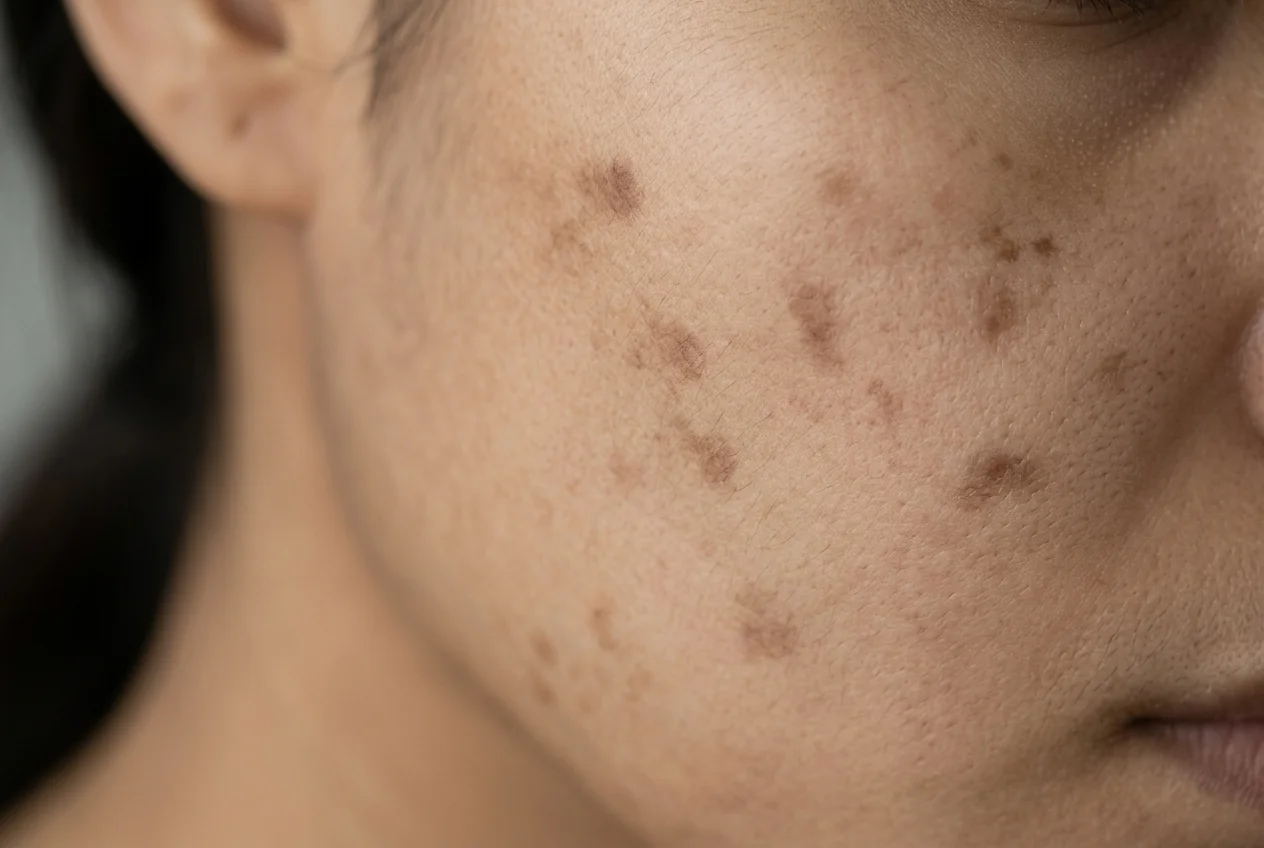
Post-inflammatory hyperpigmentation causes dark patches after an inflammatory process such as acne or eczema. Learn about its causes, how to prevent them and the most effective treatments to lighten them.
What is post-inflammatory hyperpigmentation?
Post-inflammatory hyperpigmentation (PIH) is the appearance of brown, greyish or black patches on the skin after inflammation or a skin lesion.
It is not a disease in itself, but a consequence of the skin's healing process.
It can appear after:
- Acne.
- Dermatitis.
- Eczema.
- Psoriasis.
- Insect bites.
- Burns.
- Wounds.
- Medical or aesthetic procedures.
- Hair removal or intense irritation.
It is especially common in people with medium, dark or very dark skin phototypes, although it can affect any skin type.
Post-inflammatory hyperpigmentation is not contagious and is not skin cancer.
Why does it appear?
This is the question patients ask most: «Why has this patch remained if the pimple or wound has already disappeared?»
The answer is simple. When the skin becomes inflamed, the melanocytes (the cells that produce skin pigment) respond by manufacturing a greater amount of melanin. That excess pigment remains in the skin even when the original lesion has already healed.
Why do some people develop patches and others don't? It depends on several factors: the natural colour of the skin, the intensity of the inflammation, the duration of the lesion, individual predisposition and sun exposure during healing.
Why do they get worse with the sun? Because solar radiation stimulates melanin production even more. Even short sun exposures can darken the patches and make them take much longer to disappear.
Why does scratching a pimple increase the risk? Because the greater the inflammation or trauma to the skin, the greater the pigment production. That is why we insist so much on not manipulating the lesions.
What are the symptoms?
Post-inflammatory hyperpigmentation produces:
- Brown patches.
- Greyish or bluish patches when the pigment is deeper.
- Darker colouring than normal skin.
- Absence of pain.
- Absence of itching in most cases.
The patches appear exactly where the previous lesion was. They can persist for weeks, months and sometimes more than a year. They do not cause raising or scaling.
How is it diagnosed?
Diagnosis is usually made through clinical examination. The doctor will ask: what lesion existed previously, when the patches appeared and whether there is frequent sun exposure.
Dermatoscopy can help confirm the diagnosis and differentiate it from other pigmentary alterations. In most cases no additional tests are necessary.
What treatments are available?
One of the most frequent questions is: «Will the patches disappear?» In most cases, yes, but they need time.
Treatment depends on the depth of the pigment, the time of evolution and the patient's phototype. The options include:
Photoprotection
It is the most important treatment. You should use sunscreen SPF 50+ every day and protection against visible light when indicated.
Depigmenting creams
Depending on each case, the following may be used: azelaic acid, hydroquinone, retinoids, vitamin C, kojic acid, niacinamide or topical tranexamic acid.
Chemical peels
In selected patients they help accelerate the elimination of the pigment.
Laser
It can be useful in some cases, but must be performed with caution, especially on dark skin, since inappropriate treatment can produce new patches.
Why does treatment take so long? Because melanin is eliminated slowly. The deeper the pigment, the more time the skin will need to lighten.
Why do new patches keep appearing? Because as long as inflammatory lesions continue to appear (for example, new acne breakouts), new areas of hyperpigmentation will continue to form. That is why it is so important to treat the original cause.
What can you do day to day?
To favour the disappearance of the patches, it is recommended to:
- Use sunscreen SPF 50+ every day.
- Do not manipulate pimples, scabs or wounds.
- Treat acne, dermatitis or other inflammatory diseases early.
- Correctly follow the prescribed depigmenting treatment.
- Avoid irritating home remedies.
- Be patient and consistent.
Consistency is usually the factor that most influences the success of the treatment.
When should you seek prompt medical advice?
Seek medical assessment if:
- The patches appear without a previous lesion having existed.
- They rapidly change in size, shape or colour.
- They have several colours or irregular borders.
- You are not sure that it is only hyperpigmentation.
- The patches significantly affect your emotional wellbeing.
Myths and facts
- Myth: The patches mean the wound is infected. Fact: No. They are a consequence of the inflammatory process and melanin production.
- Myth: If I sunbathe they will disappear sooner. Fact: Exactly the opposite happens. The sun tends to darken them and prolong their duration.
- Myth: If I rub the skin hard, the patches will disappear. Fact: Friction can increase inflammation and worsen the pigmentation.
- Myth: All patches are permanent. Fact: Most improve progressively, although some need medical treatment.
- Myth: They only appear after acne. Fact: Any inflammatory process of the skin can produce post-inflammatory hyperpigmentation.
The key points to remember
- Post-inflammatory hyperpigmentation appears after inflammation or a skin lesion.
- It is neither a disease nor skin cancer.
- The sun is the main factor that darkens and prolongs the patches.
- Treating the original disease is as important as treating the patches.
- Daily sun protection is essential.
- There are medical treatments that accelerate their disappearance.
- Improvement is usually progressive and requires patience.
Frequently asked questions
Will the patches disappear on their own?
In many people yes, although they can take months.
Can acne leave these patches?
Yes. It is one of the most common causes.
Are they scars?
No. Scars and hyperpigmentation are different problems, although they can coexist.
Is sunscreen really necessary?
Yes. It is one of the most important measures to prevent the patches from darkening.
Does make-up worsen the patches?
No. It can be used if it is suitable for your skin type.
Do dark skins have more risk?
Yes. Due to greater activity of the melanocytes.
Do peels help?
Yes, when they are correctly indicated and performed by professionals.
Can I prevent them?
Yes. By treating the disease that causes the inflammation early and avoiding manipulating the lesions.
Is laser always indicated?
No. It depends on the skin type and the depth of the pigment.
Can I lead a normal life?
Yes. With appropriate treatment and good sun protection, most patches improve significantly.
Need personalised guidance?
This guide is for information only and does not replace a medical consultation. For an assessment tailored to your case, you may request a consultation.
Request a consultation