Red hair: does pheomelanin hide an unsuspected protective role?
A Spanish study (PNAS Nexus, 2026) suggests pheomelanin could serve to eliminate excess cysteine — a metabolic function independent of pigmentation.

Doctor Florian A. Vallecillo Cabrera
Author
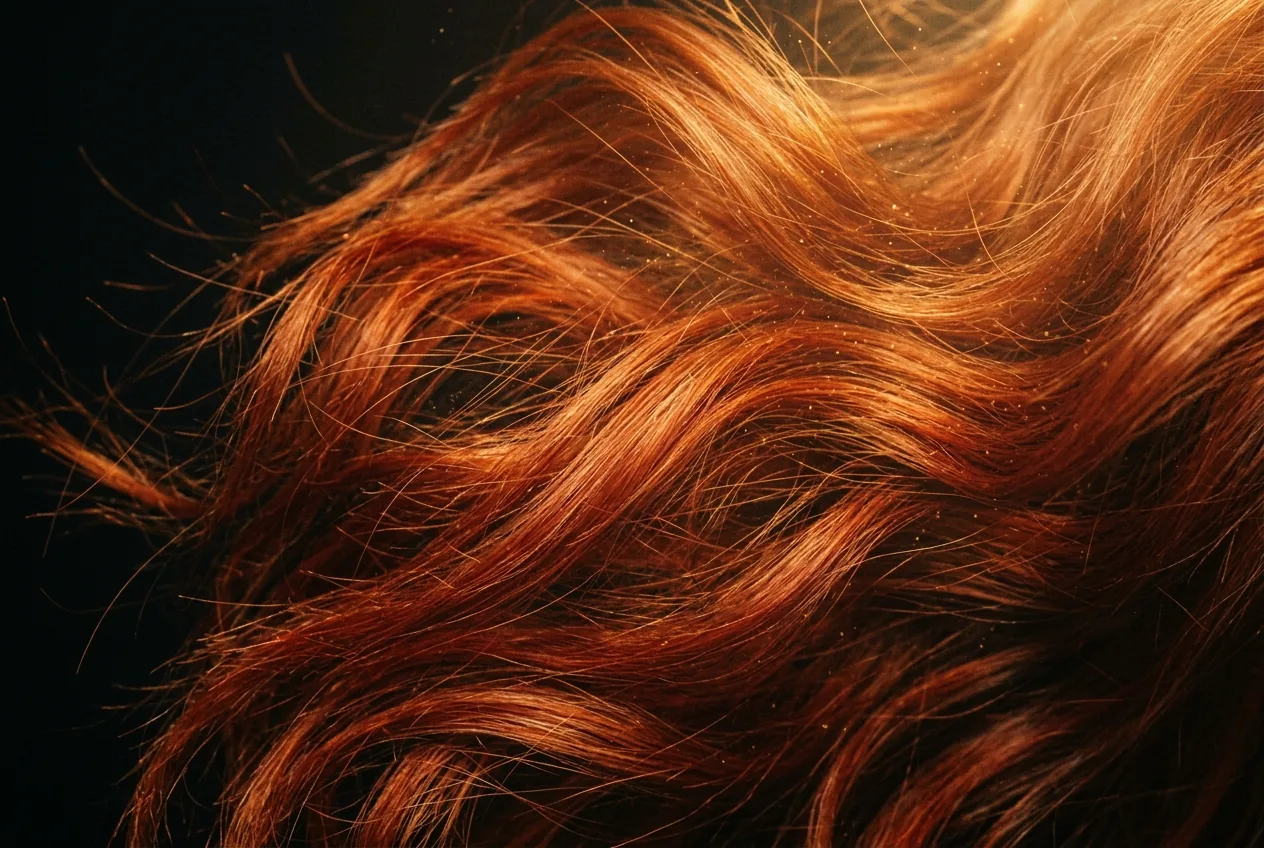
Why does red hair exist if its pigment, pheomelanin, offers less protection against UV and a higher skin-cancer risk? In an animal model, its production could serve to eliminate excess cysteine, an amino acid that is toxic when it accumulates. Pheomelanin could thus fulfil an ancient biological function, independent of pigmentation.
Why do redheads produce a different melanin?
Hair and skin colour depends mainly on two pigments.
Eumelanin
Eumelanin is a brown-to-black pigment. It absorbs ultraviolet rays efficiently and dissipates their energy as heat, thereby limiting damage to the DNA of skin cells. People with black or brown hair produce mostly this pigment.
Pheomelanin
Pheomelanin is a yellow-to-red pigment. It is particularly abundant in redheads and in many blond people. It absorbs UV less efficiently and has chemical properties different from those of eumelanin. For a long time it was studied mainly for its unfavourable effects on photoprotection.
Why do redheads have a higher melanoma risk?
Several mechanisms are involved. The first is simple: fair skin containing little eumelanin protects less effectively against UV rays. But that is not the whole story.
Over the past fifteen years, several studies have shown that certain variants of the MC1R gene, responsible for red pigmentation, also increase melanoma risk independently of sun exposure. In other words, two people receiving the same amount of UV do not necessarily have the same risk depending on their genetic background. The exact mechanisms are still debated and probably involve DNA repair, oxidative stress and cell signalling.
An evolutionary puzzle
If pheomelanin increases certain risks, why has it been preserved by evolution? This is the question the Spanish researchers asked. In evolutionary biology, an unfavourable trait usually disappears over generations unless it also provides a compensating advantage. The persistence of pheomelanin in many species therefore suggests it may fulfil a still-unknown function.
Was the study carried out in humans?
No. The researchers used an animal model: the zebra finch (Taeniopygia guttata), a small bird whose orange male plumage is rich in pheomelanin. This model makes it possible to study pigmentation mechanisms experimentally, which would be impossible in humans. It is therefore essential not to extrapolate the results directly to human medicine.
Why are researchers interested in cysteine?
Cysteine is a sulphur-containing amino acid. It plays an essential role in:
- protein synthesis;
- the production of glutathione, the main cellular antioxidant;
- keratin manufacture;
- pheomelanin synthesis.
But when present in excess, cysteine can also promote chemical reactions generating oxidative stress and become toxic to certain cells. The body must therefore maintain a very precise balance.
The researchers' hypothesis
The researchers put forward an original idea. What if making pheomelanin also served to consume this excess cysteine? In other words, the red pigment would not only be a pigment. It could also represent a metabolic pathway to eliminate a potentially toxic compound.
How was the experiment performed?
The researchers fed the birds a cysteine-enriched diet. They then compared the males, naturally able to produce a lot of pheomelanin, with the females, which produce very little. The results showed that males developed more pheomelanin-rich feathers and had less oxidative damage than females.
The researchers then used an experimental molecule called ML349, capable of inhibiting pheomelanin synthesis. In males receiving this drug, oxidative-stress markers rose markedly. This observation reinforces the idea that pigment synthesis does indeed participate in eliminating excess cysteine.
What does this discovery really mean?
The study does not show that pheomelanin is "good" or "bad". It simply suggests it may fulfil two very different functions: the first pigmentary, the second metabolic. This dual function could explain why the pigment has been preserved over millions of years of evolution despite the risks it may entail in certain contexts.
Are the results applicable to humans?
Not yet. The authors themselves remain cautious. In humans, nothing currently proves that pheomelanin synthesis significantly eliminates excess cysteine. However, the biochemical pathways involved are highly conserved among vertebrates. The hypothesis therefore deserves to be studied.
What role does the MC1R gene play?
The MC1R gene acts as a true biological switch. When it works normally, it promotes eumelanin production. In many redheads, certain MC1R variants reduce this activity. Melanocytes then make more pheomelanin. These variants are very common in Northern European populations and account for much of natural red pigmentation.
A more nuanced view of pheomelanin
For a long time, pheomelanin was presented mainly as an "unfavourable" pigment. Current knowledge is more nuanced. It does contribute to lower photoprotection, but that does not mean it is biologically useless. Many molecules have both beneficial and harmful effects depending on the context. This study perfectly illustrates that complexity.
What could the medical consequences be?
In the short term, none. This discovery changes neither the photoprotection recommendations nor the care of redheads. However, it opens several avenues of research. Understanding why certain cells use pheomelanin could make it possible to:
- better understand melanocyte physiology;
- explore new metabolic pathways involved in melanoma;
- identify new therapeutic targets;
- better understand the evolution of human pigmentation.
Should redheads change their behaviour?
No. The recommendations remain the same. People with fair skin or red hair should continue to avoid sunburn, use appropriate photoprotection, monitor their moles and seek prompt advice for any suspicious lesion. This study in no way calls these recommendations into question.
What this study does not demonstrate
This study does not demonstrate that:
- pheomelanin protects redheads against the sun;
- it reduces melanoma risk;
- red hair is an advantage for human health;
- cysteine is toxic in all redheads;
- the results observed in the zebra finch are identical in humans.
It highlights a promising but still experimental biological mechanism.
The Valorian analysis
This publication is an excellent example of how evolutionary biology can challenge a received idea. For years, pheomelanin was considered almost exclusively through the lens of its drawbacks: less effective protection against ultraviolet light and an association with increased melanoma risk.
The researchers now propose a more subtle hypothesis: if this pigment has been preserved throughout evolution, it may be because it fulfils an essential metabolic function independent of hair colour. By using cysteine to make pheomelanin, the body could limit the accumulation of a potentially toxic compound.
This idea is appealing, but it remains to be demonstrated in humans. It changes nothing about current photoprotection recommendations for redheads, who remain a population at particular risk of skin cancers.
For Valorian, this study above all illustrates an important lesson: in biology, a single molecule can have several functions. What seems disadvantageous in one context may have been preserved because it brings a benefit in another. Understanding these evolutionary trade-offs is essential to better grasp human physiology and develop new therapeutic approaches.
Key points
- ◆In an animal model (zebra finch), pheomelanin synthesis could eliminate excess cysteine, which is potentially toxic.
- ◆Pheomelanin would therefore have a dual function: pigmentary AND metabolic, which would explain its preservation through evolution.
- ◆The study does NOT show that redheads are better protected from the sun: photoprotection recommendations remain unchanged.
- ◆Experimental results, not transferable to humans for now; the MC1R gene remains central to red pigmentation and melanoma risk.
Valorian level of evidence
- Scientific quality(3/5)
Experimentally sound and published in a peer-reviewed journal, but based exclusively on an animal model; conclusions regarding humans remain hypothetical.
- Current clinical application(1/5)
No change to medical recommendations is warranted at this stage.
- Future potential(4/5)
If confirmed in humans, this mechanism could renew our understanding of pigmentation, melanocyte metabolism and open new avenues in melanoma prevention.
References
- Galván I. et coll. Pheomelanin synthesis protects against cysteine toxicity by promoting its excretion into keratinized structures. PNAS Nexus. 2026.
- Slominski A. et coll. Biology of Melanin Pigmentation. Physiological Reviews.
- Dessinioti C., Stratigos A. The MC1R gene and melanoma risk. Journal of the European Academy of Dermatology and Venereology.
Frequently asked questions
Are redheads better protected from the sun?
No. The study does not demonstrate this. Redheads remain at increased risk of skin cancers and should maintain strict photoprotection.
Was the study done in humans?
No, in a bird (zebra finch). The biochemical pathways are conserved among vertebrates, but the hypothesis still needs to be demonstrated in humans.
Does this change medical recommendations?
No. No change is warranted: avoiding sunburn, appropriate photoprotection and mole monitoring remain essential.