Grey hair: a natural mechanism of protection against cancer?
A University of Tokyo study (Nature Cell Biology, 2025) reveals a senescence-coupled differentiation mechanism in melanocyte stem cells.
Doctor Florian A. Vallecillo Cabrera
Author
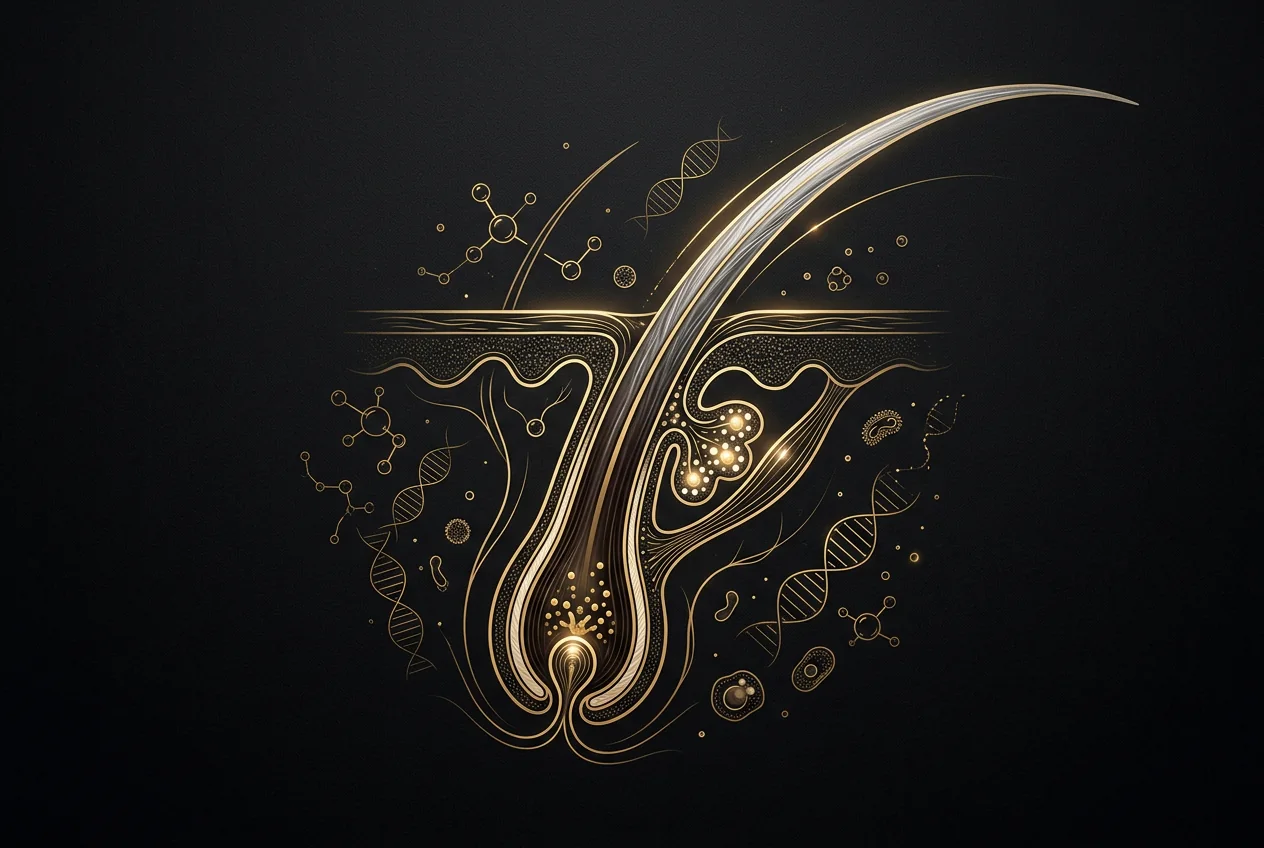
Long dismissed as a mere sign of age, grey hair may reflect a defence mechanism that eliminates stem cells with irreparably damaged DNA before they can progress towards melanoma. Grey hair is not protective in itself: it is the visible trace of that process.
Why does hair turn grey?
Hair colour depends on specialised cells called melanocytes, which produce melanin. These melanocytes are renewed throughout life by melanocyte stem cells (McSCs) located in the hair follicle. With every hair growth cycle, these stem cells generate new melanocytes responsible for pigmentation.
What happens when DNA is damaged?
Our cells are continuously exposed to insults: ultraviolet (UV) radiation, oxidative stress, pollution, inflammation and natural DNA replication errors. When damage is moderate, cells repair it. But when lesions become too severe, keeping those cells could favour the emergence of cancer.
A surprising protective strategy
Researchers found that melanocyte stem cells possess a particularly effective safety mechanism. When DNA damage becomes irreparable, these cells activate a process called senescence-coupled differentiation. In practice, they permanently stop being stem cells, differentiate and then disappear.
As a result, the stem cell reservoir shrinks, new melanocytes are no longer produced, and the hair regrows grey or white. This cellular sacrifice removes potentially dangerous cells before they can progress towards melanoma.
Does grey hair protect against cancer?
No. This is the most important point of the study. Grey hair is not protective in itself: it is merely the visible consequence of a biological protection mechanism. In other words: heavily damaged DNA → elimination of at-risk cells → loss of pigmentation → appearance of grey hair.
An important discovery
The researchers also identified the role of a molecule called KIT Ligand (KITL). When this pathway blocks senescence-coupled differentiation, some cells continue to survive despite major DNA damage. This persistence could favour tumour development under certain experimental conditions.
What are the implications for medicine?
This discovery improves our understanding of hair follicle ageing, stem cell biology, DNA repair mechanisms and the links between ageing and cancer. The authors also suggest that this type of mechanism could exist in other tissues of the body, opening important perspectives for ageing and oncology research.
What this study does not demonstrate
These results must be interpreted with caution. The study does not prove that people with grey hair develop fewer cancers, nor that greying directly protects against melanoma, nor that grey hair is a reliable marker of cancer risk. It is above all a study of fundamental biology, carried out mainly in experimental models, whose mechanisms will need to be confirmed and better characterised in humans.
The Valorian analysis
At Valorian, we consider this publication a major advance in understanding the links between ageing and protection against cancer. It perfectly illustrates a fundamental biological principle: the body sometimes prioritises safety over aesthetics. In this specific case, gradually losing hair pigmentation could be the price to pay for eliminating cells that have become potentially dangerous.
Although these findings have no immediate clinical application yet, they open promising perspectives for developing future strategies to protect stem cells, slow certain ageing mechanisms and better prevent skin cancers.
Key points
- ◆Greying may reflect a mechanism that removes stem cells with irreparably damaged DNA (senescence-coupled differentiation).
- ◆Grey hair is NOT protective in itself: it is the visible consequence of the process.
- ◆The KIT Ligand (KITL) pathway can allow damaged cells to survive and, in some models, favour melanoma.
- ◆Fundamental biology study (experimental models): no immediate clinical application.
Valorian level of evidence
- Scientific quality(5/5)
Published in Nature Cell Biology, one of the leading international journals in cell biology.
- Current clinical application(1/5)
- Future potential(5/5)
Our conclusion
a study of very high scientific quality that improves our understanding of the fundamental mechanisms of ageing and cancer prevention, but whose direct medical applications are yet to come.
References
- Mohri Y. et al. Antagonistic stem cell fates under stress govern decisions between hair greying and melanoma. Nature Cell Biology. 2025. University of Tokyo (Institute of Medical Science).
Frequently asked questions
Does grey hair protect against cancer?
No. It is not protective in itself; it reflects a mechanism that eliminates stem cells with damaged DNA.
What is senescence-coupled differentiation?
A process by which melanocyte stem cells permanently stop being stem cells, differentiate and disappear when their DNA is too damaged.
Does this study have an immediate medical application?
No. It is fundamental biology in experimental models; the mechanisms will need to be confirmed in humans.
Topics