Biologic treatments and hair loss: adverse effect, paradoxical immune reaction or consequence of the disease?
Anti-TNF, dupilumab, IL-17, IL-23… Hair loss under biologics exists, but covers very different mechanisms. The real question: which alopecia is it, and is the follicle threatened?

Doctor Florian A. Vallecillo Cabrera
Author
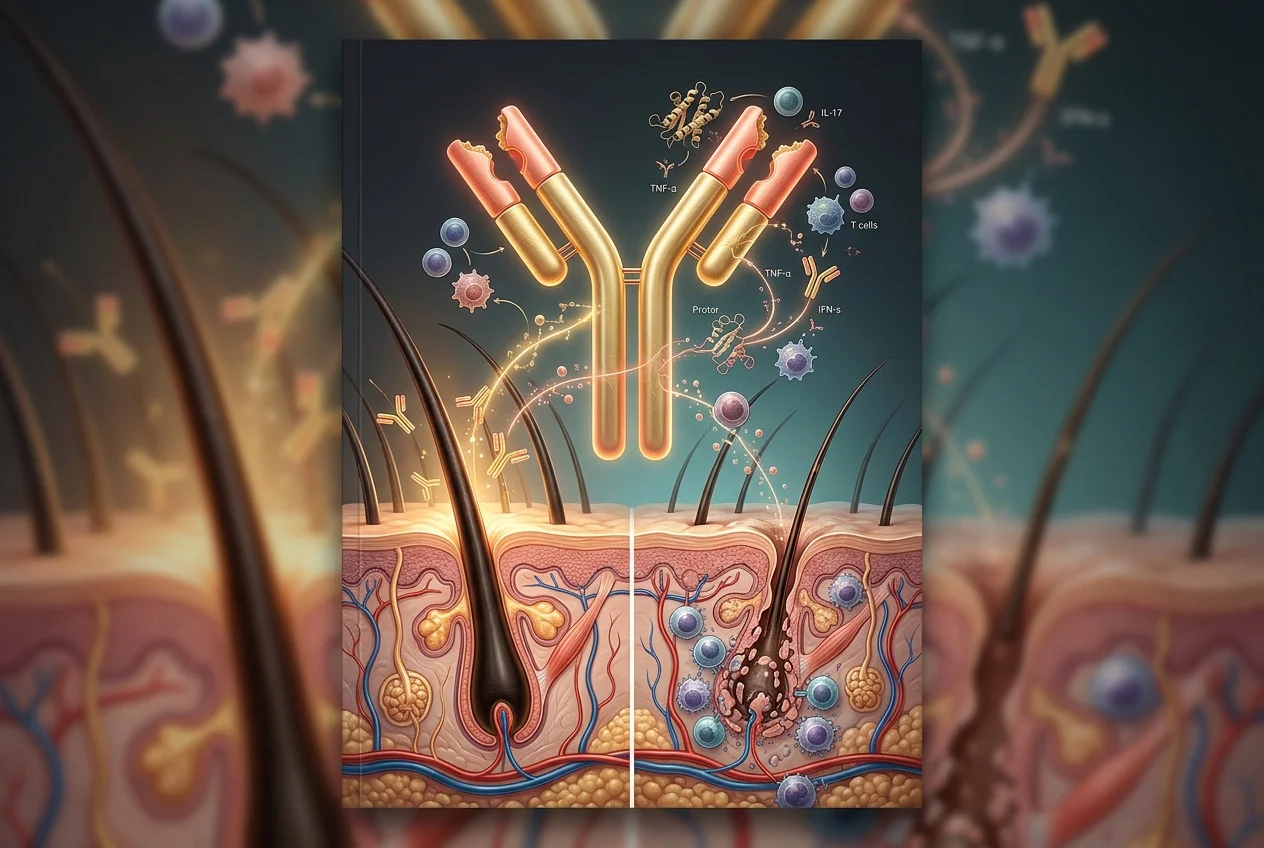
Hair loss under biologic treatment is real but rare and heterogeneous: telogen effluvium, paradoxical alopecia areata, inflammatory scalp psoriasis, infection or (rarely) scarring alopecia. The best-established signal concerns anti-TNF drugs (French pharmacovigilance: 52 cases, reporting odds ratio 3.0), rather a class effect. Dupilumab, on the contrary, can promote regrowth in some atopic patients. The right question is not 'should the biologic be stopped?' but 'which alopecia is it, is there another cause, and is the follicle threatened?'.
Summary
Biologic treatments have profoundly improved the management of psoriasis, rheumatoid arthritis, spondyloarthritis, inflammatory bowel disease, atopic dermatitis and many other immune-mediated diseases.
They are sometimes referred to in a simplified way as the "-mab drugs", because many are monoclonal antibodies: adalimumab, infliximab, golimumab, ustekinumab, secukinumab, guselkumab, dupilumab or omalizumab. This rule is not absolute, however: etanercept, for example, is a fusion protein and not a monoclonal antibody.
Since their use has broadened, some patients report hair loss appearing during treatment. The available data confirm that this phenomenon exists, particularly with TNF-α inhibitors. But it does not correspond to a single disease: it may be a diffuse telogen effluvium, an autoimmune alopecia areata, an inflammatory psoriasiform alopecia or, more rarely, potentially scarring follicular damage.
The causal link is sometimes probable, but rarely easy to demonstrate. The inflammatory disease itself, associated medications, nutritional deficiencies, an infection, weight loss or a pre-existing androgenetic alopecia may all contribute to the picture.
The clinical question is therefore not only whether "the biologic causes hair loss", but to determine which type of alopecia has appeared, why, and whether there is a risk of permanent loss.
What is a biologic treatment?
A biologic drug is produced from living systems and generally targets a very precise molecule of the immune system.
Unlike older immunosuppressants, which act relatively broadly, biologics neutralise a given cytokine, receptor or cell.
Among the main families used in dermatology, rheumatology, gastroenterology and allergology are:
- TNF-α inhibitors;
- interleukin-17 inhibitors;
- interleukin-12/23 inhibitors;
- selective interleukin-23 inhibitors;
- inhibitors of the IL-4 and IL-13 pathways;
- treatments directed against IgE;
- treatments targeting B lymphocytes or certain surface molecules.
These drugs are not interchangeable. They modify different immune pathways and therefore have neither the same benefits nor the same adverse effects.
Is hair loss a recognised effect of biologics?
Yes, but with several levels of evidence.
The best-established signal concerns TNF-α inhibitors. An analysis of the French pharmacovigilance database examined 282,590 adverse-event reports recorded between 2000 and 2012. Among 1,068 reports of alopecia, 52 had occurred under anti-TNF therapy: 18 with infliximab, 17 with adalimumab, 15 with etanercept and 2 with certolizumab. Exposure to anti-TNF drugs was three times more represented in alopecia reports than in other reports, with a reporting odds ratio of 3.0.
This analysis confirms a pharmacovigilance signal, but it does not give the real incidence. A spontaneous-reporting database knows neither the total number of exposed patients nor the number of unreported cases, and it is particularly sensitive to media attention around an adverse effect.
Recent literature nevertheless continues to describe cases of paradoxical alopecia areata under biologic therapies, especially anti-TNF drugs. A series published in 2025 reports seven patients with inflammatory diseases who developed alopecia areata during their treatment, underlining the current lack of a consensus therapeutic strategy.
The most accurate conclusion is therefore the following: hair loss under biologics is a real phenomenon, but rare, heterogeneous and still imperfectly quantified.
Not all cases of hair loss under biologics are the same
The word "alopecia" describes hair loss, but not its mechanism. In a patient treated with a biologic, several diagnoses are possible.
1. Diffuse telogen effluvium
Telogen effluvium is a diffuse, generally non-scarring shedding.
A large number of follicles prematurely pass from the growth phase to the resting phase. The shedding becomes visible several weeks or months after the triggering factor.
It can be promoted by:
- an inflammatory flare;
- an infection;
- a hospitalisation or a procedure;
- weight loss;
- a marked reduction in food intake;
- iron deficiency;
- a thyroid disorder;
- major physiological stress;
- the introduction or modification of a drug.
In this situation, the biologic may play a role, but it is not necessarily the only cause. In patients with inflammatory diseases, several factors are often combined.
Telogen effluvium typically manifests as an increase in hairs found in the shower, on the pillow or when combing. The scalp usually remains normal, without a clear patch or significant inflammation.
2. Paradoxical alopecia areata
Alopecia areata is an autoimmune disease in which the immune system temporarily attacks follicles in the growth phase.
It classically produces:
- round or oval patches;
- normal-appearing skin;
- exclamation-mark hairs;
- black or yellow dots on trichoscopy;
- sometimes involvement of the eyebrows, eyelashes or nails.
In some situations, the shedding may be diffuse and resemble an effluvium.
Alopecia areata occurring under anti-TNF therapy is described as a paradoxical reaction: a drug that reduces autoimmune inflammation may, in a minority of patients, promote another immune manifestation. Cases of total or universal alopecia have been reported, particularly with adalimumab.
A 2026 publication describes a 55-year-old woman with rheumatoid arthritis who developed progressive alopecia areata under golimumab and leflunomide, while the arthritis remained controlled. The shedding progressed despite intralesional corticosteroid injections, then improved after switching to upadacitinib. This is a case report, which suggests a temporal association without being able, on its own, to prove causality.
3. Psoriasiform alopecia or paradoxical scalp psoriasis
Anti-TNF drugs can paradoxically trigger psoriasis in a person treated for another disease, or modify the presentation of pre-existing psoriasis.
When the scalp is affected, one may observe:
- red plaques;
- thick scales;
- crusts;
- itching;
- tenderness or pain;
- patchy or diffuse shedding;
- sometimes pustules or a superinfection.
Paradoxical psoriasis is not a simple "drug allergy". It probably results from an imbalance in the cytokine network, in particular between the TNF pathway and type I interferons. An updated review published in 2024 emphasises that these psoriasiform eruptions can occur with anti-TNF drugs, but also, more rarely, with other targeted treatments.
This form is particularly important to recognise, because intense and prolonged scalp inflammation can lead to severe shedding and, exceptionally, lasting follicular damage.
4. Inflammatory or scarring alopecia
Scarring alopecias progressively destroy the follicle and can cause irreversible loss.
They are much rarer in this context, but they must be sought in the presence of:
- pain or burning;
- pustules;
- persistent crusts;
- disappearance of follicular openings;
- perifollicular redness;
- localised shedding that progresses rapidly.
A biopsy may be necessary if the diagnosis remains uncertain.
It should also be remembered that some biologics and JAK inhibitors are being studied as treatments for certain scarring alopecias. The relationship between immunotherapy and the follicle is therefore not one-directional: the same pathway can be beneficial in one disease and unfavourable in another.
Why can an anti-inflammatory drug trigger an inflammatory disease?
This is one of the paradoxes of modern immunology.
A cytokine never works alone. The immune system forms a network in which each pathway regulates the others. Blocking one cytokine can reduce a disease while unintentionally releasing the brake exerted on another pathway.
Under anti-TNF therapy
TNF-α is involved in the inflammatory response, but also in the regulation of certain interferon-producing cells.
When TNF is neutralised, a relatively excessive production of type I interferons may appear in some patients. This change is one of the mechanisms proposed to explain paradoxical psoriasis.
In alopecia areata, the follicle loses its "immune privilege": cytotoxic lymphocytes and cytokines, in particular interferon gamma, target the hair bulb. Recent work describes several immunological profiles of alopecia areata, some dominated by IFN-γ, others with an IL-17 or mixed Th1/Th17 component.
Blocking a single pathway can thus modify the overall balance without suppressing all autoimmune reactions.
A susceptibility specific to the patient
Paradoxical reactions seem more plausible in patients who accumulate several immune diseases or an atopic, psoriatic or autoimmune background.
They do not mean that the treatment is "toxic" for everyone. Rather, they reveal an interaction between:
- the pharmacological target;
- the patient's immune make-up;
- the disease being treated;
- associated treatments;
- still poorly defined environmental factors.
Which biologics are most involved?
TNF-α inhibitors: the most solid signal
This family includes in particular: adalimumab; infliximab; golimumab; certolizumab pegol; etanercept.
They are used in rheumatoid arthritis, spondyloarthritis, psoriasis, psoriatic arthritis and inflammatory bowel disease.
The forms described include:
- alopecia areata;
- universal alopecia;
- paradoxical scalp psoriasis;
- psoriasiform alopecia;
- diffuse non-scarring shedding.
The French pharmacovigilance database suggested a class effect rather than a problem limited to a single molecule. However, a reliable percentage of affected patients cannot be given at present.
Anti-IL-17
Secukinumab and ixekizumab block interleukin-17, a central pathway of psoriasis.
They often considerably improve scalp psoriasis and can promote regrowth when the shedding was linked to psoriatic inflammation.
But isolated cases of non-scarring alopecia are also reported with secukinumab. The level of evidence rests mainly on clinical observations, without an epidemiological signal as solid as for anti-TNF drugs.
Anti-IL-12/23 and anti-IL-23
Ustekinumab targets interleukins 12 and 23. Guselkumab, risankizumab and tildrakizumab more selectively target IL-23.
These treatments are generally very effective on psoriasis, including on the scalp. A randomised trial published in JAMA Dermatology in 2025 confirmed the efficacy of guselkumab in moderate-to-severe scalp psoriasis across different phototypes.
Cases of alopecia areata or paradoxical shedding have nevertheless been described with some molecules, but the data remain scattered. Nothing currently allows one to assert a homogeneous hair-related adverse effect of the entire anti-IL-23 class.
Conversely, ustekinumab can be an option when a paradoxical skin reaction under anti-TNF therapy requires a class switch. In a 2026 cohort of patients with inflammatory bowel disease, 19 of the 20 patients who switched to ustekinumab because of a skin reaction under anti-TNF therapy achieved a complete or partial response. This study concerned all skin reactions and not exclusively alopecia.
Dupilumab: an effect in both directions
Dupilumab blocks the IL-4 and IL-13 pathways and treats atopic dermatitis in particular. Its relationship with hair is particularly complex.
A VigiBase analysis found 462 reports of hair disorders among 20,548 adverse-event reports associated with dupilumab. The majority concerned hair loss, while a few reports mentioned increased growth. These figures represent a proportion among pharmacovigilance reports, not among all treated patients. They should therefore not be interpreted as an incidence of 2.2%.
At the same time, dupilumab can improve some cases of alopecia areata, particularly in patients with an atopic background. A randomised trial accompanied by biological analyses of the scalp observed a decrease in Th2 markers and an increase in hair keratins under treatment, with more marked results in atopic patients.
Thus, dupilumab can:
- promote regrowth in some patients;
- produce no hair effect in the majority;
- trigger or worsen shedding in a minority.
This apparent contradiction probably reflects the immunological heterogeneity of alopecia areata.
Omalizumab and other anti-allergic biologics
Omalizumab targets IgE and is used in particular in chronic urticaria and allergic asthma.
Cases of effluvium and alopecia areata have been reported. A systematic review specifically devoted to hair loss under omalizumab was published in 2026, confirming that the signal is now the subject of structured evaluation, even if the data remain much less abundant than for anti-TNF drugs.
The VigiBase analysis of Th2-axis biologics also found a pharmacovigilance association between omalizumab and hair loss.
Rituximab and other monoclonal antibodies
Rituximab targets B lymphocytes and is used in certain rheumatological, haematological and autoimmune diseases.
Hair loss can occur in complex contexts, but it is often difficult to attribute to rituximab alone, particularly when it is combined with chemotherapy, corticosteroids or other immunosuppressants.
It is therefore misleading to group all drugs ending in "-mab" as if they shared the same hair-related risk.
Is the biologic always responsible?
No. In a patient treated for an inflammatory disease, several competing causes must be sought.
The disease itself
Scalp psoriasis can cause shedding linked to inflammation, scratching and alteration of the hair cycle. Experimental work implicates in particular the IL-33/ST2 axis in the follicular alterations associated with psoriasis, but these data remain partly preclinical.
Rheumatoid arthritis, inflammatory bowel disease and autoimmune diseases can also promote an effluvium through systemic inflammation, fatigue, malnutrition or anaemia.
Associated treatments
Very often, the biologic is not prescribed alone. Associated drugs may include: methotrexate; leflunomide; sulfasalazine; retinoids; anticoagulants; beta-blockers; antithyroid drugs; antidepressants; hormonal treatments.
Methotrexate and leflunomide can cause diffuse shedding. In the case of alopecia areata under golimumab published in 2026, the patient was also taking leflunomide, which prevents the event from being formally attributed to a single molecule.
A deficiency or malnutrition
Inflammatory bowel disease, restrictive diets, nausea, reduced intake and certain surgeries can cause: iron deficiency; vitamin B12 or folate deficiency; zinc deficiency; hypoproteinaemia; vitamin D deficiency.
A deficiency can worsen shedding triggered by another cause.
A revealed androgenetic alopecia
An effluvium can suddenly make visible a previously discreet androgenetic alopecia. After the effluvium resolves, the density then does not completely return to its previous level, because the follicular miniaturisation was already present.
An infection
Biologics can modify the risk of infection. An acute infection can cause an effluvium a few months later.
On the scalp, a folliculitis, a dermatophyte infection or a bacterial superinfection can also mimic paradoxical psoriasis. A 2026 publication even proposes that some lesions attributed to paradoxical psoriasis under anti-TNF therapy are in fact linked to an infection or colonisation by Staphylococcus aureus. This hypothesis is based on a clinical series and must be confirmed, but it recalls the importance of examining and, if necessary, sampling the lesions.
Does the time to onset make it possible to recognise the cause?
The time can guide, but it is not diagnostic. A reaction can occur:
- a few weeks after introduction;
- several months later;
- after a dose increase;
- after a switch of biosimilar or class;
- sometimes after several years of good tolerance.
A telogen effluvium often manifests with a delay of two to four months relative to the triggering factor. Alopecia areata or a psoriasiform reaction can appear earlier or later.
A consistent chronological relationship strengthens the drug hypothesis, but does not prove it. The most convincing arguments are:
- onset after introduction;
- absence of another plausible cause;
- improvement after withdrawal;
- recurrence upon re-introduction.
However, the deliberate re-introduction of a potentially responsible drug is rarely desirable when an alternative exists.
How to examine a patient losing hair under a biologic?
The evaluation must be methodical.
The history
One must specify: the exact name of the biologic; the disease treated; the date of the first injection; recent changes of dose or molecule; concomitant treatments; the date of onset of shedding; its sudden or progressive nature; the existence of patches; itching, scales, pain or pustules; a recent infection, procedure or weight loss; personal and family history of alopecia; possible involvement of the eyebrows, eyelashes or nails.
The clinical examination
It looks for: a diffuse decrease in density; well-defined patches; miniaturisation; scaling; erythema; crusts; perifollicular inflammation; disappearance of follicular openings.
The pull test can objectify active shedding, but it is not enough to determine the cause.
Trichoscopy
Trichoscopy makes it possible to quickly orient towards: an effluvium; alopecia areata; androgenetic alopecia; scalp psoriasis; scarring alopecia; an infection.
In alopecia areata, it can show yellow dots, black dots, broken hairs and exclamation-mark hairs. In androgenetic alopecia, it shows a variability in hair diameter and miniaturisation. In a scarring form, the disappearance of follicular openings is a warning sign.
The biopsy
A scalp biopsy is useful when: the inflammation is significant; a scarring alopecia is suspected; the diagnosis between alopecia areata and psoriasis remains uncertain; the shedding progresses despite appropriate management.
What laboratory work-up should be carried out?
The work-up must be personalised. It may include:
- complete blood count;
- ferritin;
- iron, transferrin and saturation coefficient;
- TSH;
- vitamin B12;
- folates;
- vitamin D;
- zinc in case of nutritional risk;
- albumin or protein assessment;
- inflammatory markers according to the disease;
- liver or kidney assessment according to the treatments.
Tests should not be multiplied automatically, but rather the factors likely to sustain the shedding should be sought.
Should the biologic treatment be stopped?
Not systematically. An abrupt stop can cause a severe relapse of the treated disease. The decision must be made with the prescribing specialist.
The treatment can sometimes be continued
Continuation can be considered when: the shedding is moderate; it is non-scarring; the inflammatory disease is very well controlled; there is no severe scalp inflammation; a correctable cause has been identified; the patient accepts close monitoring.
A change of treatment must be discussed
It becomes more relevant when: the shedding is rapid or major; the alopecia areata progresses; the eyebrows or eyelashes are affected; a total or universal alopecia appears; the scalp is very inflammatory; scarring damage is suspected; quality of life is severely impaired; the drug is no longer indispensable or can be replaced.
The change may consist of switching: to another molecule of the same class; to another biologic class; sometimes to a non-biologic targeted treatment, depending on the disease.
There is no universal rule, and the series published in 2025 insists precisely on the need for individualised management.
How to treat the shedding?
The treatment depends on the diagnosis.
In case of telogen effluvium
Management relies on: correcting the triggering factor; correcting a deficiency; a sufficient protein intake; controlling the inflammatory disease; observing regrowth over several months.
Minoxidil can sometimes be discussed when an androgenetic alopecia is associated or when recovery is incomplete.
In case of alopecia areata
Depending on the extent, options may include: topical corticosteroids; intralesional injections; systemic treatments in extensive forms; JAK inhibitors in certain authorised or specialised indications.
JAK inhibitors have transformed the management of severe alopecia areata, but they are not monoclonal antibodies and have their own safety profile. The long-term data for ritlecitinib over about five years are reassuring in trials, while confirming the need for monitoring of infections and rare events.
The 2026 case showing improvement after switching from golimumab to upadacitinib is interesting, but does not constitute a general recommendation.
In case of psoriasiform alopecia
Management may combine: topical corticosteroids; keratolytic treatments; antifungal treatments if a seborrhoeic dermatitis coexists; a search for infection; reassessment of the biologic; a class switch in severe forms.
In case of scarring alopecia
The priority objective is to stop the inflammation in order to preserve the follicles that are still alive. Rapid dermatological management is essential.
Can shedding be prevented before starting a biologic?
There is no validated drug-based prevention. A reasonable approach nevertheless consists of:
- documenting the initial hair density in at-risk patients;
- looking for a pre-existing androgenetic alopecia;
- checking the history of alopecia areata or severe scalp psoriasis;
- correcting an iron or nutritional deficiency;
- informing the patient of the warning signs;
- photographing the scalp when the initial situation is already complex.
This approach mainly makes it possible to recognise a real change more quickly.
Are biosimilars more responsible?
To date, there is no solid evidence showing that biosimilars cause more alopecia than the reference biologic products.
Shedding occurring after a product switch must be assessed seriously, but timing alone does not allow a difference in toxicity to be concluded. One must also take into account:
- the natural course of the disease;
- a simultaneous change of dose;
- other medications;
- a recent infection or stress;
- a possible nocebo effect.
Is the shedding reversible?
Most often, yes, when it is: a telogen effluvium; a non-scarring alopecia areata; a psoriasiform alopecia treated early. But regrowth may require several months.
The prognosis is less favourable when there is: prolonged inflammation; scarring damage; a significant associated androgenetic alopecia; a total or universal alopecia areata; recurrent episodes.
Telling the patient that "the follicles are intact" without having established the type of alopecia would therefore be too assertive.
What the studies do not demonstrate
The current data do not demonstrate that:
- all biologic treatments cause hair loss;
- all "-mab" drugs have the same profile;
- shedding occurring under treatment is necessarily caused by it;
- the majority of patients on anti-TNF drugs will lose their hair;
- all cases of shedding are temporary;
- immediate discontinuation of treatment is always necessary;
- switching biologics automatically guarantees regrowth;
- food supplements can prevent these alopecias on their own.
Most of the publications devoted to this subject are based on case reports, small series and pharmacovigilance databases. They identify a signal, but do not always make it possible to calculate a precise absolute risk.
Practical implications for patients
Significant shedding under a biologic should be neither trivialised nor dramatised. The right steps are:
- identifying the exact molecule and the associated treatments;
- examining the scalp;
- distinguishing diffuse shedding, alopecia areata, psoriasis and scarring form;
- looking for a deficiency or an intercurrent factor;
- documenting the course with photographs and trichoscopy;
- discussing the approach with the prescribing physician;
- not stopping a biologic treatment on one's own.
A prompt consultation is particularly indicated in the presence of:
- patches that are spreading;
- a loss of the eyebrows or eyelashes;
- thick scales or pustules;
- pain or a burning sensation;
- a disappearance of follicular openings;
- very sudden shedding;
- a significant impairment of quality of life.
The Valorian analysis
Hair loss under biologic treatment is probably under-recognised. It is often considered secondary to the initial inflammatory disease, whereas it can become one of the main reasons for dissatisfaction and treatment discontinuation.
The mistake, however, would be to consider all these cases of shedding as a single adverse effect. Under the same term "alopecia" are hidden very different mechanisms: effluvium linked to metabolic stress, paradoxical autoimmune alopecia areata, inflammatory scalp psoriasis, infection, revealed androgenetic alopecia or, much more rarely, scarring disease.
The scientific signal is today most convincing for TNF-α inhibitors. The French pharmacovigilance analysis, the clinical series and the repeated observations support a class effect, without making it possible to establish its frequency precisely. For the other biologics, the data are much more fragmentary and sometimes contradictory.
Dupilumab perfectly illustrates this complexity: it can promote regrowth of alopecia areata in some atopic patients and be associated with shedding in others. This observation shows that hair diseases are not determined by a single cytokine, but by individual immunological profiles.
In practice, the most important question is therefore not: "should the biologic be stopped?", but: which alopecia is it, is there another cause, and is the follicle threatened?
Diffuse shedding without inflammation is not managed like a rapidly progressive alopecia areata. Alopecia areata is not managed like pustular scalp psoriasis. And a scarring alopecia does not allow one to wait several months before acting.
Ideal management relies on a collaboration between the dermatologist or the physician specialised in hair and the specialist who prescribes the biologic. This coordination makes it possible to preserve both the control of the inflammatory disease and hair health.
Key points
- ◆Hair loss under biologics is real but rare and heterogeneous: under the word 'alopecia' are hidden telogen effluvium, paradoxical alopecia areata, inflammatory scalp psoriasis, infection or (rarely) scarring alopecia.
- ◆The best-established signal concerns TNF-α inhibitors (French pharmacovigilance: 52 cases, reporting odds ratio 3.0), rather a class effect; the real incidence remains unknown.
- ◆An anti-inflammatory drug can trigger a paradoxical reaction (alopecia areata, scalp psoriasis) by modifying the balance of the cytokine network (e.g. TNF ↔ type I interferons).
- ◆The biologic is not always responsible: inflammatory disease, associated treatments (methotrexate, leflunomide…), deficiencies, infection or revealed androgenetic alopecia must be sought.
- ◆The right question is not 'should the biologic be stopped?' but 'which alopecia is it, is there another cause, and is the follicle threatened?' — never stop a biologic treatment on your own.
Valorian level of evidence
- Existence of a signal under anti-TNF therapy(4/5)
The signal is supported by pharmacovigilance analyses, case series and numerous reproducible observations. It nevertheless remains difficult to precisely measure the incidence and the individual risk.
- Existence of a signal for all biologics(2/5)
Cases are reported with several classes, but the data are too heterogeneous to conclude a general effect of all biologics.
- Certainty about direct causality(2/5)
The chronology is often suggestive, but the inflammatory diseases, associated treatments, deficiencies and intercurrent events are important confounding factors.
- Clinical usefulness of the information(5/5)
Recognising the type of alopecia early can avoid an unjustified discontinuation of the treatment, allow a reversible cause to be corrected and prevent possible permanent follicular damage.
- Research potential(5/5)
Advances in trichoscopy, transcriptomics and follicular immunology should make it possible to better identify patients likely to develop a paradoxical reaction and to tailor the treatment to their immunological profile.
References
- Béné J, Moulis G, Auffret M, et al. Alopecia induced by tumour necrosis factor-alpha antagonists: description of 52 cases and disproportionality analysis in a nationwide pharmacovigilance database. Rheumatology (Oxford). 2014;53:1465-1469.
- Gerlero P, Doche I, Rivitti-Machado MC. Paradoxical Alopecia Areata during Biologic Therapies: A Case Series and Long-Term Follow-Up. Skin Appendage Disord. 2025.
- Maronese CA, Valenti M, Moltrasio C, et al. Paradoxical Psoriasis: An Updated Review of Clinical Features, Pathogenesis, and Treatment Options. J Invest Dermatol. 2024;144:2364-2376.
- Nkala MB, Niakosari F. Progressive alopecia areata during TNF-α inhibition with subsequent improvement following JAK1 inhibition. J Dermatolog Treat. 2026.
- Park S, Park SH, Byun YJ, Choi SA. Hair disorders associated with dupilumab based on VigiBase. PLOS One. 2022;17:e0270906.
- Renert-Yuval Y, Pavel AB, Del Duca E, et al. Scalp biomarkers during dupilumab treatment support Th2 pathway pathogenicity in alopecia areata. Allergy. 2023;78:1047-1059.
- Tirelli LL, Alfaro A, Citera G, Echeverría CM. Nonscarring Alopecia Secondary to Secukinumab. Actas Dermosifiliogr. 2022;113:1011-1013.
- Bai JQA, Chu N, Geng RSQ, Sibbald C. Hair Loss Following Omalizumab Therapy: A Systematic Review. J Cutan Med Surg. 2026.
- Heidari K, Shojaei S, Azari Matin A, Agrawal DK. Hair follicles as immune targets: cytokine crosstalk and precision pathways in alopecia areata. Expert Rev Clin Immunol. 2026.
- Fujimoto K, Hosomi S, Kobayashi Y, et al. Efficacy of Ustekinumab on Skin Reactions Induced by TNF-α Inhibitors in Inflammatory Bowel Disease. Inflamm Intest Dis. 2026;11:260-269.
Frequently asked questions
Do all '-mab' drugs cause hair loss?
No. They are very different molecules targeting distinct immune pathways. The most solid signal concerns anti-TNF drugs; for the other biologics, the data are fragmentary and sometimes contradictory (dupilumab can even promote regrowth in some atopic patients).
Should I stop the biologic immediately if my hair is falling out?
Not systematically. An abrupt stop can cause a severe relapse of the treated disease. The decision must be made with the prescribing physician, after determining the type of alopecia and looking for another cause. Never stop on your own.
Is the shedding reversible?
Most often yes (telogen effluvium, non-scarring alopecia areata, early-treated psoriasiform alopecia), but regrowth may take several months. The prognosis is worse in case of prolonged inflammation, scarring damage or total/universal alopecia areata.
How do I know if it is really the drug?
The most convincing arguments are: onset after introduction, absence of another plausible cause, improvement after withdrawal and recurrence upon re-introduction. The chronology guides but does not prove; disease, associated treatments and deficiencies are important confounding factors.