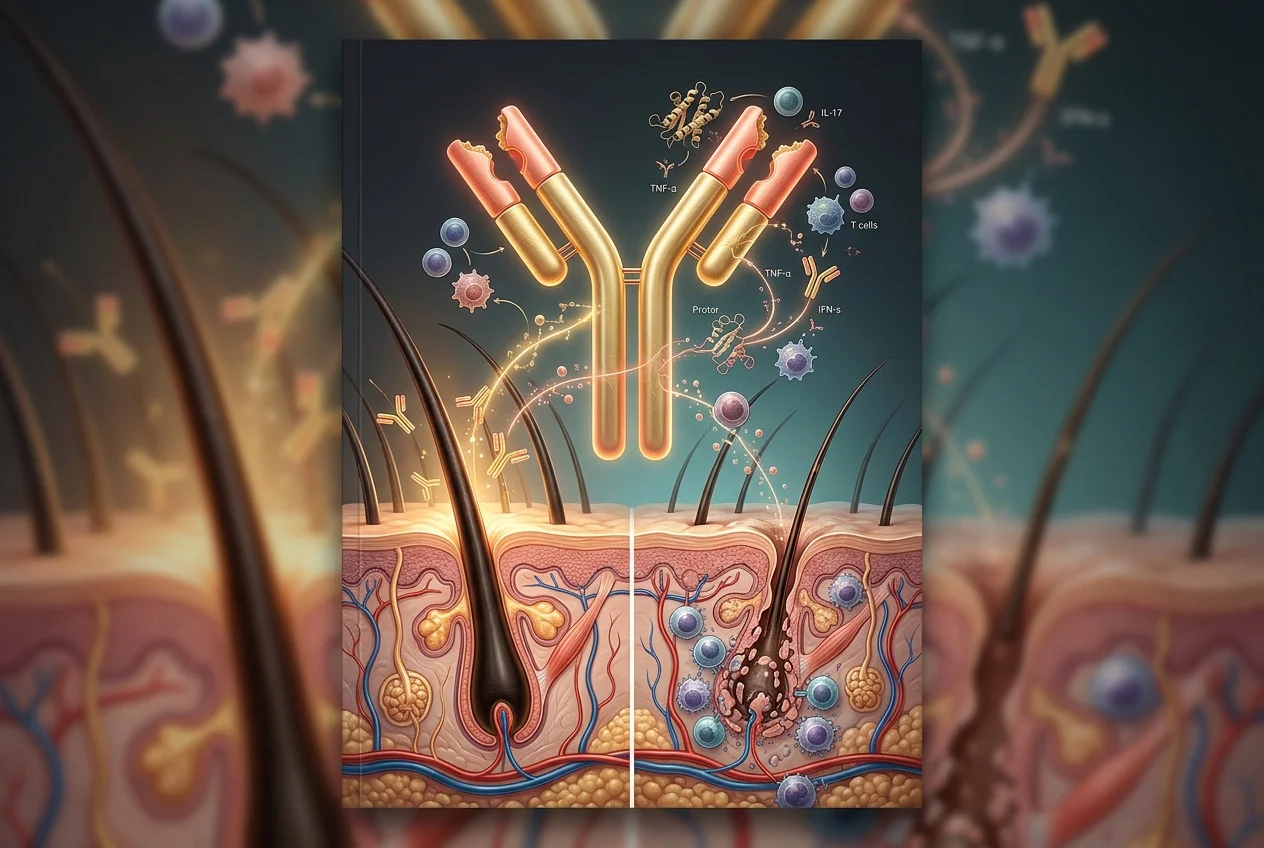
GLP-1 drugs and hair loss: a real side effect or a consequence of weight loss?
A large BMJ study associates GLP-1 agonists (semaglutide, tirzepatide) with an increased risk of alopecia, probably linked to telogen effluvium induced by rapid weight loss.

Doctor Florian A. Vallecillo Cabrera
Author

A large BMJ cohort study shows an increased risk of alopecia in patients treated with GLP-1 agonists (semaglutide, tirzepatide) compared with other antidiabetics (+37% vs SGLT-2, +68% vs DPP-4). The absolute risk remains low and the most likely mechanism is telogen effluvium related to rapid weight loss. The hair loss is generally reversible; stopping treatment is rarely necessary.
Summary
For several years, some patients treated with GLP-1 receptor agonists – in particular semaglutide (Ozempic®, Wegovy®) or tirzepatide (Mounjaro®, Zepbound®) – have reported hair loss, sometimes significant, after starting treatment.
Long considered anecdotal, this observation is now reinforced by a large study published in The BMJ, showing a statistically significant increase in the risk of alopecia compared with other diabetes treatments.
Should we therefore conclude that GLP-1 drugs directly cause hair loss?
The answer is more nuanced. Current scientific data suggest that the phenomenon is real, but probably multifactorial. In many cases, rapid weight loss, nutritional changes and metabolic stress appear to play a role at least as important as the drug itself.
GLP-1 agonists: a therapeutic revolution
GLP-1 receptor agonists have profoundly transformed the management of type 2 diabetes and then of obesity.
They act by reproducing the action of a natural gut hormone, GLP-1 (Glucagon-Like Peptide-1), which:
- stimulates insulin secretion when blood glucose rises;
- decreases glucagon secretion;
- slows gastric emptying;
- increases the feeling of satiety;
- spontaneously reduces food intake.
Tirzepatide also acts on the GIP receptor, partly explaining its superior efficacy on weight loss.
Beyond weight loss, these treatments reduce cardiovascular risk in some patients, improve glycaemic control and decrease several metabolic complications.
Why are we now talking about hair loss?
From the earliest clinical trials, some participants reported hair loss. Initially, this observation was considered rare and difficult to interpret.
Was it linked to:
- the drug?
- the weight loss?
- the dietary changes?
- or simply chance?
The recent BMJ publication adds a further element by showing that patients treated with GLP-1 develop more alopecia than those receiving other antidiabetic treatments.
What does the BMJ study really show?
The researchers analysed several thousand patients with type 2 diabetes. GLP-1 users were compared with patients treated with:
- SGLT-2 inhibitors;
- DPP-4 inhibitors.
After adjusting for the main confounding factors, they observed:
- a risk of alopecia about 37% higher compared with SGLT-2 inhibitors;
- a 68% higher risk compared with DPP-4 inhibitors.
These figures may seem impressive. However, they must be interpreted with caution.
Relative risk versus absolute risk
One of the most common pitfalls in medicine is to confuse relative risk and absolute risk.
In this study, the absolute risk remains low. In practice, this represents only a few additional cases of alopecia per thousand patients followed for one year.
In other words: the increase is real statistically, but the effect remains uncommon at the individual level.
This distinction is essential to avoid an exaggerated interpretation of the results.
What type of hair loss is observed?
The reported cases correspond essentially to non-scarring alopecia. This means that:
- the hair follicle remains alive;
- regrowth is generally possible;
- the hair loss is potentially reversible.
No increase in scarring alopecia, which permanently destroys the follicle, has been observed.
Telogen effluvium: the most likely hypothesis
For most specialists, the preferred mechanism is that of telogen effluvium.
Normally, each hair follicle alternates between:
- a growth phase (anagen);
- a transition phase (catagen);
- a resting phase (telogen).
When significant stress occurs, a large number of follicles simultaneously enter the telogen phase. Two to four months later, a diffuse and sometimes striking shedding appears.
This phenomenon is well known after:
- surgery;
- childbirth;
- a severe infection;
- a high fever;
- bariatric surgery;
- a very restrictive diet.
The rapid weight loss induced by GLP-1 could trigger exactly the same mechanism.
Why can weight loss promote hair loss?
Hair growth is extremely costly in terms of energy. During a significant caloric deficit, the body prioritises vital organs. Hair growth becomes secondary.
Several factors can be involved simultaneously:
- reduced protein intake;
- iron deficiency;
- zinc deficiency;
- vitamin D deficiency;
- vitamin B12 deficiency;
- reduced energy reserves;
- physiological stress related to weight loss.
It is therefore likely that the observed hair loss results from a combination of mechanisms rather than a single pharmacological effect.
Is there a direct effect of GLP-1 on the hair follicle?
To date, no definitive evidence allows us to answer yes.
GLP-1 receptors are expressed in several tissues. It is therefore theoretically possible that these drugs modify certain mechanisms involved in the hair follicle cycle.
However, the experimental data remain insufficient. The authors themselves consider that direct causality has not been demonstrated.
Are all molecules involved?
The signal mainly concerns:
- semaglutide;
- tirzepatide.
This could simply reflect their superior efficacy on weight loss. The faster the weight loss, the more the risk of telogen effluvium appears to increase.
It is therefore difficult to distinguish the effect of the drug from that of weight loss.
Who seems to be most at risk?
Available observations suggest a greater risk:
- in women;
- in cases of significant weight loss;
- in patients with early androgenetic alopecia;
- in people with insufficient protein intake.
However, these factors still need to be confirmed by prospective studies.
How to evaluate hair loss under GLP-1?
A dermatological consultation is often useful. The history will look for:
- the start date of treatment;
- the speed of weight loss;
- dietary habits;
- family history of alopecia;
- other medications;
- recent stress or illness.
Depending on the context, a biological work-up may include:
- full blood count;
- ferritin;
- iron studies;
- TSH;
- vitamin D;
- vitamin B12;
- folate;
- zinc;
- albumin or total protein.
The aim is to identify a possible correctable cause.
Should treatment be stopped?
In most cases, no.
In many patients, the metabolic and cardiovascular benefits of GLP-1 agonists far outweigh the risk of temporary hair loss.
Any decision to stop must be individualised. Appropriate dermatological management can often limit the aesthetic impact.
Can this hair loss be prevented?
Even though no strategy is validated, several measures seem reasonable:
- ensuring sufficient protein intake;
- avoiding excessive caloric restriction;
- screening for and correcting nutritional deficiencies;
- paying particular attention to patients with known androgenetic alopecia;
- consulting promptly in case of significant hair loss.
What this study does not demonstrate
This study does not demonstrate that:
- GLP-1 agonists destroy hair follicles;
- all patients will develop hair loss;
- the loss is permanent;
- treatment must be systematically interrupted;
- the drug is the only cause of the alopecia.
It shows a statistical association but does not allow a direct causal link to be established.
The Valorian analysis
This study provides a further signal in a field where clinical observations had been multiplying for several years. GLP-1 agonists do appear to be associated with a slight increase in the risk of alopecia, but the magnitude of this risk remains low in absolute terms.
The most likely mechanism remains telogen effluvium induced by rapid weight loss and the accompanying metabolic adaptations. Direct toxicity to the hair follicle is not excluded, but it is currently not demonstrated.
The real clinical message is therefore not to pit the considerable benefits of these treatments against a generally reversible adverse effect, but to anticipate this possibility. Clear patient information, appropriate nutritional support and early screening for deficiencies can help limit this effect and maintain adherence to treatment.
This approach illustrates a common reality in medicine: a very effective treatment may be accompanied by modest side effects that are nonetheless important for quality of life. Recognising them without dramatising them allows for more balanced and personalised care.
Key points
- ◆The BMJ shows a 37% higher risk of alopecia vs SGLT-2 and 68% higher vs DPP-4 in patients on GLP-1, but the absolute risk remains low (a few cases per 1000 patient-years).
- ◆The observed hair loss is non-scarring alopecia, and therefore generally reversible.
- ◆The most likely mechanism is telogen effluvium induced by rapid weight loss and metabolic stress.
- ◆No direct toxic effect of GLP-1 on the hair follicle has been demonstrated: the study shows an association, not causality.
- ◆Stopping treatment is rarely justified: sufficient protein intake, screening for deficiencies (iron, zinc, vitamin D, B12) and follow-up help limit the impact.
Valorian level of evidence
- Quality of evidence(4/5)
The data now rest on a large cohort study published in The BMJ, supplemented by clinical trials, pharmacovigilance analyses and several literature reviews. The signal is consistent, but the evidence remains essentially observational.
- Clinical applicability(4/5)
The results are directly useful in practice to inform patients, recognise telogen effluvium and avoid unjustified treatment interruptions.
- Level of certainty about causality(2/5)
The association is well established, but the direct responsibility of GLP-1 agonists is not demonstrated. Mechanisms involving rapid weight loss, nutritional changes and metabolic stress remain the most plausible explanations.
- Potential future impact(4/5)
Future prospective studies with dermatological assessment and trichological follow-up will probably help to better distinguish the effect of the drug from that of weight loss and to identify the patients most at risk.
References
- BMJ (2026). Association of GLP-1 receptor agonists with alopecia in adults with type 2 diabetes: population-based cohort study.
- Revue (2026). Hair loss associated with GLP-1 receptor agonists: mechanisms, clinical evidence and management.
- American Academy of Dermatology (AAD).
- European Academy of Dermatology and Venereology (EADV).
Frequently asked questions
Do GLP-1 drugs (Ozempic, Wegovy, Mounjaro) cause hair loss?
A statistical association exists, but there is no proof of direct causality. The hair loss is most often telogen effluvium related to rapid weight loss and is generally reversible.
Is this hair loss permanent?
No. It is non-scarring alopecia: the follicle remains alive and regrowth is generally possible once the metabolic situation has stabilised.
Should treatment be stopped if hair loss occurs?
In most cases, no. The metabolic and cardiovascular benefits often outweigh the risk of temporary hair loss. Any decision must be individualised with the physician.
How can hair loss under GLP-1 be limited?
Ensure sufficient protein intake, avoid excessive caloric restriction, screen for and correct deficiencies (iron, zinc, vitamin D, B12) and consult promptly in case of significant hair loss.