
In vivo gene therapy: teaching the body to manufacture its own CAR-T cells against autoimmune diseases
Chinese researchers manage to 'reboot' the immune system using a viral vector that generates CAR-T cells inside the body itself, with promising results in 16 patients (including multiple sclerosis).

Doctor Florian A. Vallecillo Cabrera
Author
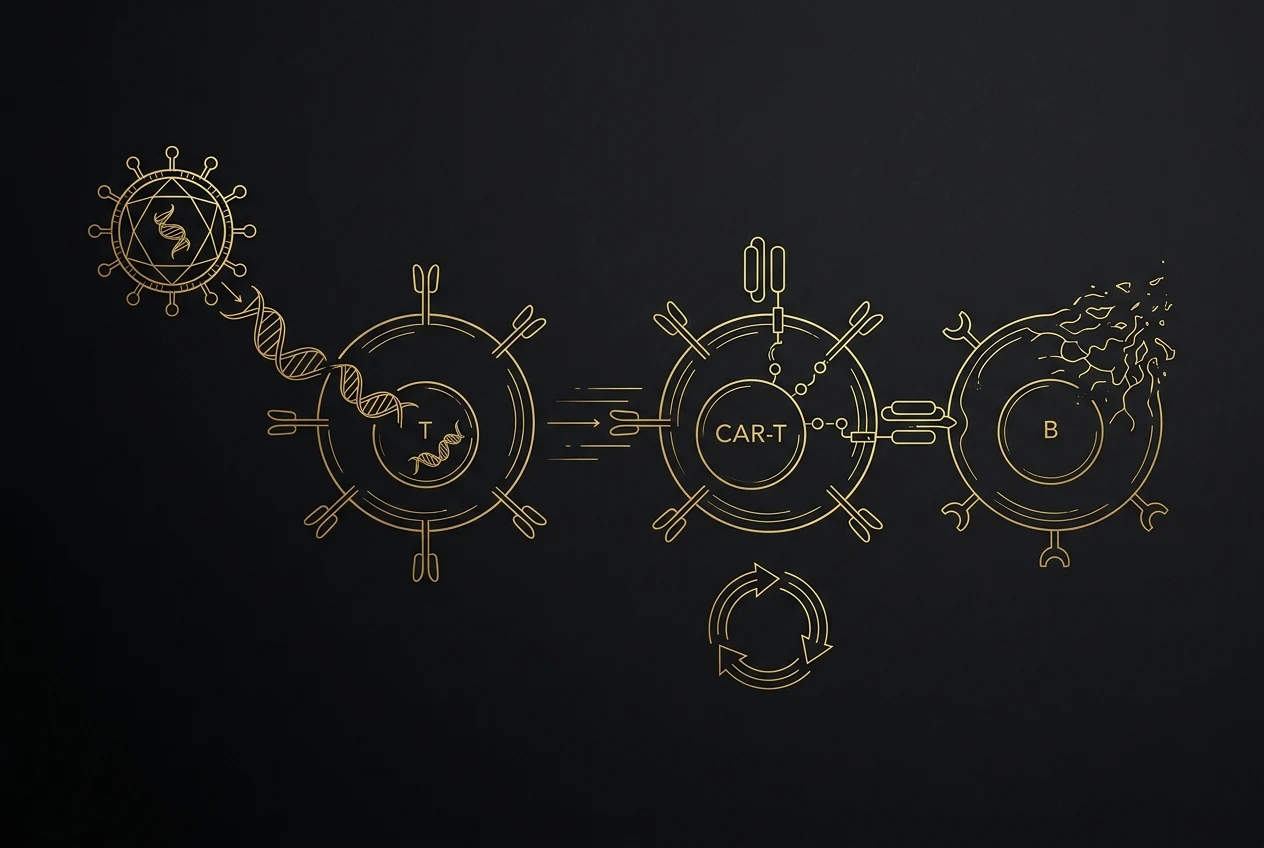
A study published in the New England Journal of Medicine describes a way to produce CAR-T cells directly inside the body, without manufacturing them in the laboratory. The goal: to reprogram the immune system so that it stops attacking the body's own tissues. We analyse what this first proof-of-concept shows — and what it does not.
Why this news matters
Can the body be taught to fight autoimmune diseases on its own? A team from Wuhan University of Science and Technology (China) has just taken a striking step in that direction. Their work, presented on 2 September 2026 in the New England Journal of Medicine, describes a technique that combines two cutting-edge technologies — CAR-T cells and gene therapy — to enable the body itself to produce the cells it needs to 'reboot' its immune system.
Autoimmune diseases arise when the immune system, which should protect us, mistakes its target and attacks the body's healthy cells. In many of these conditions, white blood cells called B lymphocytes produce antibodies directed against our own tissues. The idea here is to eliminate those 'misprogrammed' B lymphocytes so that the body replaces them with new ones that no longer attack the organism.
The essentials in one sentence
Instead of manufacturing CAR-T cells in the laboratory — a slow and expensive process — this technique uses a virus to 'teach' the body to produce them internally (in vivo), which could make these treatments far more accessible.
What CAR-T cells are and why they are so difficult to manufacture
CAR-T cell therapy involves extracting T lymphocytes (immune cells) from the patient and genetically modifying them in the laboratory so that they recognise and destroy a specific target: tumour cells or, in the case of autoimmune diseases, harmful B lymphocytes. This technology has already demonstrated its efficacy against certain cancers and, more recently, in some severe autoimmune diseases.
The problem is that manufacturing these cells is complex and very costly: the cells must be extracted, modified outside the body (ex vivo), multiplied, and then re-infused — all within highly specialised facilities. This complexity enormously limits access to these treatments.
The innovation: letting the body manufacture its own CAR-T cells
The approach taken by the Chinese researchers bypasses that entire laboratory process. Using a virus as a 'messenger', they introduce genetic instructions directly into the patient's T lymphocytes, inside the body. Those instructions teach the cells to recognise the protein CD19, which is present on the surface of B lymphocytes. The result is that the modified T lymphocytes destroy the B lymphocytes.
In other words: instead of bringing in ready-made CAR-T cells from outside, the body itself is turned into the 'factory'. If this strategy is confirmed, it could democratise therapies that today are reserved for very few centres.
Results in 16 patients: precision and control
The team tested their method in 16 patients with various autoimmune diseases, seven of them with multiple sclerosis. After a single intravenous infusion of the virus, the participants' bodies began mass-producing these new CAR-T cells.
Two findings stand out for their safety implications. First, the system was highly precise: 99% of the genetically modified cells were T lymphocytes — that is, precisely the cells intended to be modified. Second, the gene therapy does not appear to have caused dangerous mutations — the DNA fragments carried by the virus did not insert into sensitive regions of the genome — and the viruses were eliminated rapidly by the body without triggering an excessive immune reaction.
An immune system 'reboot'
The proliferation of CAR-T cells caused rapid depletion of B lymphocytes. Within two months, these had been completely replaced by new B lymphocytes that were no longer programmed to attack the body. It is, in a sense, like reinstalling the operating system of a corrupted computer.
This immune 'reboot' rapidly improved patients' condition. Six months after treatment, those with multiple sclerosis showed better cognitive and motor function and felt less fatigued. A more detailed clinical analysis also revealed reduced neuronal damage (multiple sclerosis damages the myelin sheath surrounding axons) and reduced activation of microglia, the immune cells of the brain.
Level of evidence
★★☆☆☆ — This is an initial study in a very small number of patients (16), with no comparison group and short follow-up. The results are promising, but preliminary.
Safety: manageable side effects
None of the patients experienced lasting serious side effects from the treatment. The most frequent event — observed in 11 of the 16 patients — was an inflammatory response between one and three weeks after the viral infusion, but it was temporary and lasted no more than two weeks.
The authors conclude that generating CAR-T cells in vivo with a viral vector is associated with 'manageable' side effects and could be effective for treating neurological autoimmune diseases. They also highlight its principal advantage: by avoiding the complex production of these cells outside the body, this technique has the potential to make CAR-T therapy a more accessible and adaptable intervention.
Why caution remains essential
The results should be kept in proper perspective. This is an initial study, with very few patients, no control group, and only a few months of follow-up. We do not yet know how long the benefit lasts, nor what the long-term safety profile is of introducing genetic instructions via a virus. The authors themselves note that larger and longer studies will be needed to properly evaluate the efficacy and safety of this strategy.
In medicine, a promising announcement is not equivalent to an available treatment. Between a first proof of concept and routine clinical practice there almost always lies several years of rigorous trials.
Clínica Valorian's analysis
What makes this work fascinating is not only the clinical result, but the shift in strategy: rather than manufacturing complex cells in the laboratory, the body is taught to manufacture them itself. If confirmed, that idea could transform access to therapies currently limited by their cost and complexity — and not only in oncology, but also in autoimmune diseases affecting millions of people.
At the same time, we maintain the caution that rigour demands: 16 patients is a very small number, and gene therapy raises legitimate questions about long-term safety. We will follow the upcoming trials closely. What is today a hopeful proof of concept will need to demonstrate, with more patients and longer follow-up, that it is also safe and durable.
Valorian Assessment
- Conceptual innovation (in vivo CAR-T): ★★★★★
- Short-term precision and safety: ★★★★☆
- Strength of evidence (study size and design): ★★☆☆☆
- Current clinical applicability: ★★☆☆☆
Overall rating: ★★★☆☆ — Very promising conceptual advance; awaiting confirmation in larger, long-term studies.
Key points
- ◆Researchers from Wuhan University (China) have enabled the body to manufacture its own CAR-T cells in vivo via a viral vector, rather than producing them in the laboratory (published in the New England Journal of Medicine, 2 September 2026).
- ◆The genetic instructions teach T lymphocytes to recognise the protein CD19 and destroy the 'misprogrammed' B lymphocytes responsible for the autoimmune attack.
- ◆Tested in 16 patients (7 with multiple sclerosis); after a single infusion, 99% of the modified cells were T lymphocytes and the viruses were cleared without an excessive reaction.
- ◆By 2 months, the B lymphocytes had been replaced by new ones no longer programmed to attack the body: a genuine 'reboot' of the immune system.
- ◆At 6 months, patients with multiple sclerosis showed improved cognitive and motor function, less fatigue, and reduced neuronal damage.
- ◆Caution: small study, no control group, and short follow-up. Promising, but larger and longer trials are needed before any routine use.
References
- Generation of CAR T cells in vivo with a viral vector in patients with autoimmune disease. New England Journal of Medicine. 2026 (correspondence).DOI: 10.1056/NEJMc2603114
- Müller F, Taubmann J, Bucci L, et al. CD19 CAR T-Cell Therapy in Autoimmune Disease — A Case Series with Follow-up. New England Journal of Medicine. 2024.
- Mackensen A, Müller F, Mougiakakos D, et al. Anti-CD19 CAR T cell therapy for refractory systemic lupus erythematosus. Nature Medicine. 2022.
- Schett G, Mackensen A, Mougiakakos D. CAR T-cell therapy in autoimmune diseases. The Lancet. 2023.
Frequently asked questions
Is this therapy already available to patients?
No. This is an initial study in 16 individuals. Before it can be used routinely, larger trials are needed — with comparison groups and longer follow-up — to confirm its efficacy and safety.
How does it differ from 'classic' CAR-T cells?
Classic CAR-T cells are manufactured in the laboratory from the patient's own cells, a complex and costly process. Here, a viral vector 'teaches' the body to produce those cells within the organism itself (in vivo), which could make the treatment far more accessible.
Does it work for all autoimmune diseases?
The study included several autoimmune diseases, primarily multiple sclerosis. The approach is promising, but cannot yet be generalised: each disease requires its own confirmation in specific studies.
Is the technique dangerous?
In this study there were no lasting serious side effects; the most frequent event was a transient inflammatory response (in 11 of 16 patients) that lasted no more than two weeks. Even so, the long-term safety of gene therapy must still be confirmed.
Clínica Valorian
Living with an autoimmune disease or an allergy?
Science moves fast, but every case is unique. If you have questions about your situation, a personalised medical assessment is always the best starting point.
Request a consultation