Bitter taste receptors: a new research avenue against food allergies
Bitter taste receptors (TAS2R), studied in frogs, could take part in triggering food allergies and become future therapeutic targets.

Doctor Florian A. Vallecillo Cabrera
Author
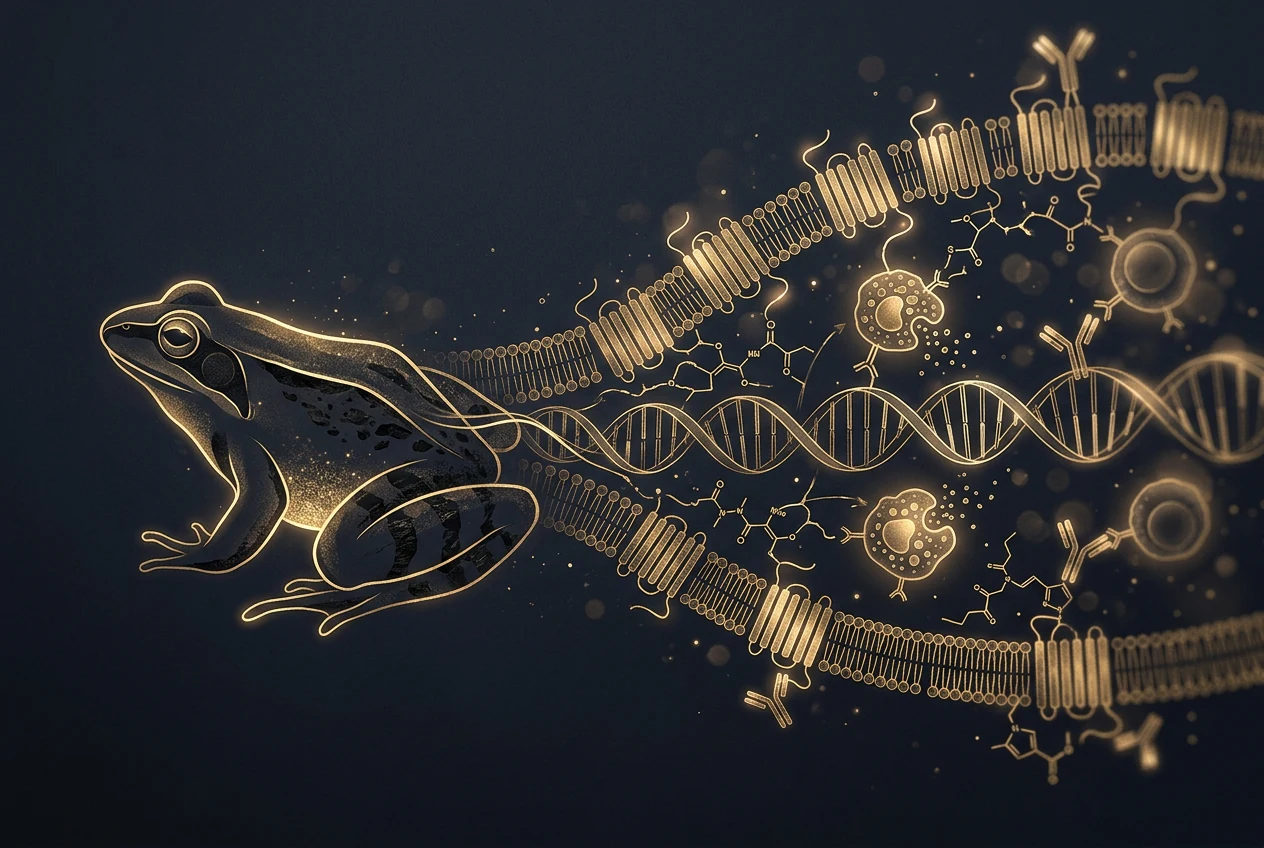
An American team (Northeastern University, PLOS Genetics) is exploring bitter taste receptors (TAS2R) as an avenue to understand food allergies. Studied in frogs (up to 250 receptors versus ~25 in humans), they could take part in food detection and immune activation. A promising fundamental-research advance, but without immediate clinical application.
Summary
Food allergies today affect hundreds of millions of people worldwide, and their frequency continues to rise.
An American team looked at an unexpected biological mechanism: bitter taste receptors, called TAS2R.
By studying certain species of frogs, which have up to ten times more receptors of this type than humans, the researchers hope to better understand how our body detects certain food compounds and triggers, in some cases, an excessive immune response.
This discovery is not a treatment, but it opens a promising new avenue of research.
What is a food allergy?
A food allergy is an abnormal reaction of the immune system against a normally harmless protein. After ingesting the food, the body mistakenly identifies this protein as a danger and triggers an immune response.
The symptoms can be highly variable:
- itching;
- hives;
- swelling of the lips or throat;
- abdominal pain;
- diarrhoea;
- vomiting;
- breathing difficulties;
- in the most severe cases, anaphylactic shock.
According to the World Health Organization, about 220 million people are affected worldwide.
What are TAS2R receptors?
TAS2R are the receptors responsible for the perception of bitterness. They allow our body to recognise potentially toxic substances.
In humans, there are about 25 types of TAS2R receptors. They are mainly present:
- on the tongue;
- in the intestine;
- in certain immune cells;
- in the liver;
- in the airways;
- and in other tissues.
Their role therefore goes far beyond taste.
Why are frogs of interest to researchers?
Some species of frogs live in environments where they are exposed to a very large number of natural toxins. During their evolution, they developed an exceptional number of TAS2R receptors.
The wood frog (Lithobates sylvaticus) has nearly 250, about ten times more than humans. This extraordinary diversity constitutes an ideal model for understanding how these receptors work.
What is the link with food allergies?
Researchers believe that TAS2R could be involved in the first stages of detecting certain food substances. When a potentially dangerous compound is detected, these receptors can participate in the activation of various defence mechanisms:
- nausea;
- vomiting;
- diarrhoea;
- local activation of certain immune cells.
In allergic people, this response could be inappropriate or exaggerated. Scientists are therefore seeking to determine whether certain TAS2R take part in triggering this reaction.
Why is this important?
Today, treatments for food allergies remain essentially preventive. They are based on:
- avoiding the responsible food;
- treating allergic reactions;
- or, in some cases, oral immunotherapy (desensitisation).
These approaches often make it possible to raise the tolerance threshold, but they generally do not cure the allergy permanently. A better understanding of biological mechanisms could lead to far more targeted treatments.
Could TAS2R receptors become a therapeutic target?
That is the researchers' hypothesis. If certain receptors do indeed take part in activating the allergic response, it would theoretically become possible to:
- block their activation;
- modulate their functioning;
- or develop treatments adapted to the precise type of allergen.
However, we are still at the stage of fundamental research.
Will this discovery soon make it possible to cure allergies?
Not yet. The study does not show that a treatment is available. It identifies a new biological avenue that will have to be confirmed by extensive research in humans.
The development of new drugs then requires several years of clinical trials before possible use in practice.
Current treatments
Today, management is mainly based on:
- precise identification of allergens;
- allergy tests;
- food avoidance;
- carrying an adrenaline auto-injector in at-risk patients;
- oral immunotherapy in certain indications.
These treatments often improve quality of life but do not always allow a definitive cure.
What this study does not demonstrate
It is important to remain cautious. This study does not show that:
- frogs will soon make it possible to cure allergies;
- TAS2R receptors are responsible for all food allergies;
- a drug is close to being marketed;
- the results observed in amphibians are directly transferable to humans.
This is an important advance in fundamental research, but the clinical applications still remain hypothetical.
The Valorian analysis
This study perfectly illustrates how biomedical research progresses. Major therapeutic advances often arise from observations made in other animal species. Here, frogs serve as a biological model to better understand a family of receptors still largely unknown in humans.
The major interest of this work is to remind us that taste receptors do not serve only to perceive flavours. They also take part in complex surveillance functions of the body, interacting with the digestive system and the immune system.
At Valorian, we consider this study to be a promising but still very early research avenue. If TAS2R do turn out to be involved in triggering food allergies, they could become new therapeutic targets in the years to come. In the meantime, prevention, specialised diagnosis and currently validated treatments remain the pillars of management.
Key points
- ◆Food allergies affect ~220 million people (WHO) and their frequency is rising.
- ◆Bitter taste receptors TAS2R are not only for taste: they are present in the intestine, immune cells, liver and airways.
- ◆The wood frog has ~250 TAS2R receptors (≈10× humans), offering an ideal study model.
- ◆Hypothesis: certain TAS2R could take part in triggering an excessive immune response to foods.
- ◆Fundamental research: no immediate therapeutic application; current treatments remain avoidance, adrenaline and oral immunotherapy.
Valorian level of evidence
- Scientific quality(4/5)
Fundamental research study published in PLOS Genetics, providing solid data on the biology of TAS2R receptors, but without clinical demonstration in humans.
- Current clinical application(2/5)
No immediate therapeutic application. The results mainly improve our understanding of the potential mechanisms involved in food allergies.
- Future potential(5/5)
TAS2R receptors could constitute a new target for developing more specific treatments for food allergies, subject to confirmation by clinical studies in humans.
References
- Étude publiée dans PLOS Genetics par les chercheurs de la Northeastern University (États-Unis).
- Travaux dirigés notamment par le Pr Jing-Ke Weng, portant sur l'évolution et le rôle des récepteurs de l'amertume (TAS2R) chez les amphibiens et leurs implications potentielles dans les allergies alimentaires.
Frequently asked questions
Will frogs make it possible to cure allergies?
No. This is a biological model of fundamental research. No treatment currently results from it; years of studies in humans and clinical trials would be needed.
What are TAS2R receptors?
They are the bitter taste receptors (~25 types in humans). They recognise potentially toxic substances and are present far beyond the tongue: intestine, immune cells, liver and airways.
How are food allergies treated today?
Through allergen identification, allergy tests, food avoidance, an adrenaline auto-injector in at-risk patients and, in some cases, oral immunotherapy (desensitisation).
Does this discovery change current management?
No, not yet. It is a promising but early avenue. Prevention, specialised diagnosis and validated treatments remain the pillars of management.
Clínica Valorian
Living with an autoimmune disease or an allergy?
Science moves fast, but every case is unique. If you have questions about your situation, a personalised medical assessment is always the best starting point.
Request a consultationTopics