
Antifungal resistance: terbinafine, azoles and emerging dermatophytes
Some fungi increasingly resist terbinafine and azoles. Trichophyton indotineae, Candida auris: what science says and how to limit resistance.

Doctor Florian A. Vallecillo Cabrera
Author
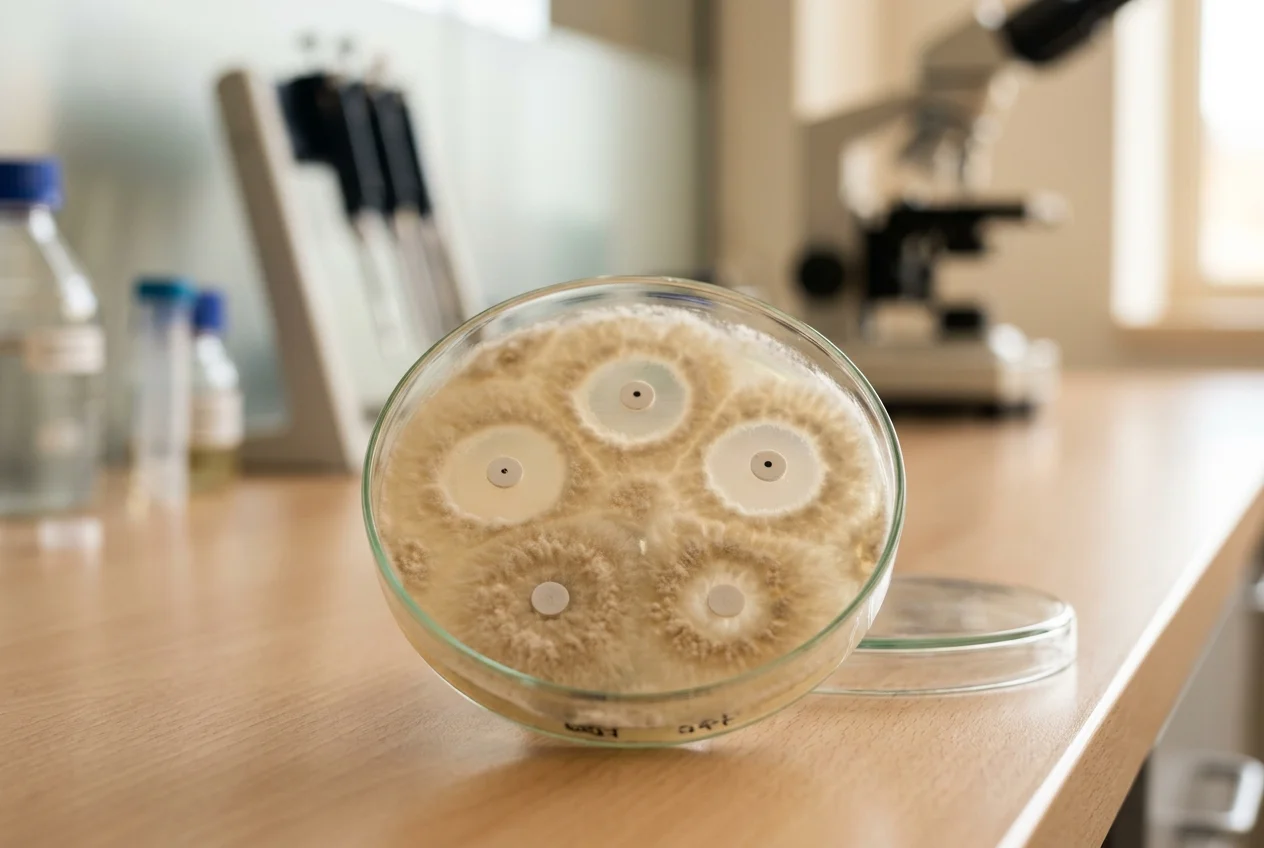
Antifungal resistance is progressing: terbinafine (SQLE mutations) and azoles are losing effectiveness, and emerging dermatophytes such as Trichophyton indotineae cause extensive infections. A public-health challenge recognised by the WHO. The vast majority of fungal infections remain curable: diagnostic confirmation and appropriate use of antifungals are essential.
Summary
Fungal infections (mycoses) are common and, in the vast majority of cases, easy to treat. But over the past few years, specialists have observed a worrying phenomenon: some fungi are becoming resistant to antifungals — the medicines meant to eliminate them.
This resistance affects both the dermatophytes responsible for "ringworm" of the skin and nails and certain yeasts. It makes treatments longer, harder and sometimes ineffective.
Understanding why it appears also shows how to limit it — and the patient's role is essential.
What is antifungal resistance?
Resistance is when a fungus keeps growing despite a normally effective antifungal treatment. The medicine can no longer destroy it or stop its growth.
This phenomenon is well known for bacteria (antibiotic resistance). It is more recent, but rapidly expanding, for fungi. In 2022, the World Health Organization published a first list of "priority fungi" to raise the alarm about this public-health threat.
Terbinafine: resistance in dermatophytes
Terbinafine is the first-line treatment for most skin and nail infections caused by dermatophytes. However, resistant strains are now being described.
This resistance is linked to mutations in the gene of squalene epoxidase (SQLE), the enzyme terbinafine is meant to block. When this enzyme is modified, the medicine loses its effectiveness. In practice, ringworm or an onychomycosis may fail to heal despite a well-conducted treatment.
Trichophyton indotineae: an emerging dermatophyte
One fungus is drawing particular attention: Trichophyton indotineae. First described in South Asia, it has spread to many countries. It causes very extensive, inflammatory and recurrent infections, often resistant to terbinafine.
Its emergence has been favoured by the massive, uncontrolled use of creams combining a corticosteroid and an antifungal, available without prescription in some regions.
Azoles and Candida auris: a broader threat
Resistance is not limited to dermatophytes. Azoles (such as itraconazole or fluconazole), widely used against yeasts, also see their effectiveness decline in some situations.
The most emblematic case is Candida auris, a multidrug-resistant yeast responsible for serious infections in hospitals. It illustrates how antifungal resistance has become a global issue, well beyond simple skin infections.
Why is resistance increasing?
Several factors combine:
- excessive or inappropriate use of antifungals;
- creams combining a corticosteroid and an antifungal, which mask the infection and favour relapses;
- treatments stopped too early, which let the most resistant fungi survive;
- self-medication and unconfirmed diagnoses;
- the globalisation of trade, which facilitates the spread of resistant strains.
What are the consequences for patients?
A resistant infection heals more slowly, sometimes requires longer treatments at higher doses, or the use of other molecules. For nails, this can mean several extra months of treatment.
This is why, faced with an infection that does not respond, it is useful to confirm the diagnosis (sample, culture or even molecular analysis) and to precisely identify the fungus involved.
How can resistance be limited?
The patient plays a central role:
- do not self-medicate with antifungals or "corticosteroid + antifungal" creams;
- follow the treatment for the whole prescribed duration, even if the lesions appear healed;
- have the diagnosis confirmed in case of doubt or failure;
- respect hygiene measures to avoid reinfections.
On the medical side, a reasoned use of antifungals and microbiological confirmation in difficult cases are essential.
The Valorian analysis
Antifungal resistance is still little known to the public, even though it is progressing rapidly. It should not be a source of excessive worry: the vast majority of fungal infections remain perfectly curable. But it recalls a simple, fundamental rule — an antifungal is not a harmless product.
At Clínica Valorian, we favour an evidence-based approach: confirming the diagnosis before treating complex cases, avoiding unnecessary corticosteroid-antifungal combinations, and supporting the patient until the end of treatment. This is the best way to preserve the effectiveness of these medicines for the future.
Valorian level of evidence
Quality of evidence: ★★★★☆ (4/5) — Dermatophyte resistance and the emergence of T. indotineae are documented by numerous publications and reference bodies (WHO, CDC).
Clinical applicability: ★★★★☆ (4/5) — The practical consequences (diagnostic confirmation, appropriate use) are directly useful day to day.
Scale of the phenomenon: ★★★☆☆ (3/5) — Resistance is progressing but, for now, remains a minority in most common infections.
Public-health stakes: ★★★★★ (5/5) — The WHO now classifies several fungi among priority pathogens: preserving the effectiveness of antifungals is a major goal.
Key points
- ◆Antifungal resistance is increasing and affects both dermatophytes (skin, nails) and some yeasts.
- ◆Terbinafine, the first-line treatment, can fail when the fungus carries SQLE mutations.
- ◆Trichophyton indotineae, an emerging dermatophyte, causes extensive, resistant infections.
- ◆Corticosteroid-antifungal creams and treatments stopped too early promote resistance.
- ◆The vast majority of fungal infections remain curable: diagnostic confirmation and appropriate use of antifungals are essential.
References
- World Health Organization (WHO). Fungal Priority Pathogens List. 2022.
- Centers for Disease Control and Prevention (CDC). Trichophyton indotineae: an emerging antifungal-resistant dermatophyte.
- Centers for Disease Control and Prevention (CDC). Candida auris.
- Gupta AK et al. Terbinafine resistance in dermatophytes and squalene epoxidase (SQLE) gene mutations.
- Verma SB et al. The emergence of recalcitrant dermatophytosis. British Journal of Dermatology.
- European Academy of Dermatology and Venereology (EADV). Statements on dermatophyte resistance.
- Fisher MC et al. Tackling the emerging threat of antifungal resistance. Nature Reviews Microbiology.
Frequently asked questions
My fungal infection is not healing — is it necessarily resistance?
Not necessarily. A poorly followed treatment, a reinfection, a wrong diagnosis or an insufficient duration are more frequent. In case of doubt, a sample can confirm the fungus and its sensitivity.
Are 'corticosteroid + antifungal' creams dangerous?
Used wrongly and for a long time, they mask the infection, favour relapses and contribute to the emergence of resistant strains. They should only be used on prescription and for a specific indication.
What to do if terbinafine does not work?
The doctor can confirm the diagnosis by culture or molecular analysis, then change the antifungal (for example an azole), adjust the dose or extend the treatment.
Can resistance be avoided?
Largely yes: do not self-medicate, complete the prescribed treatment, confirm the diagnosis in difficult cases and respect hygiene to avoid reinfections.