
Stress-related hair loss: scalp TGF-β/BMP pathways and the emerging role of topical nutraceutical-peptide combinations
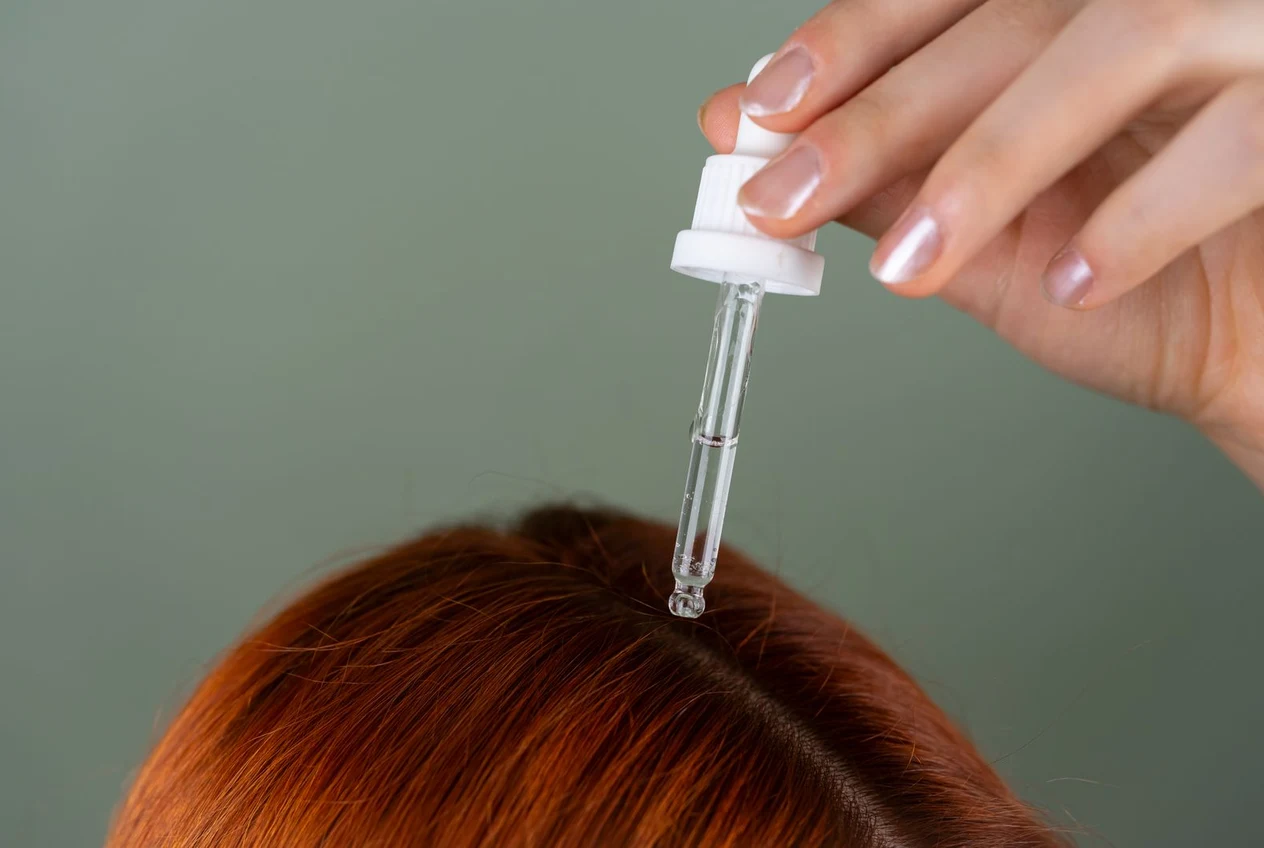
Hair shedding blamed on stress often fits telogen effluvium, but it frequently overlaps with androgenetic alopecia, alopecia areata, systemic illness, weight change, or medication effects. New data on a topical EGCG-biotin-Pal-GHK combination support a mechanistic scalp TGF-β/BMP hypothesis, but they do not replace careful diagnosis or treatments supported by stronger clinical evidence [1-8].
Introduction
Stress-related hair loss is commonly described in practice as increased diffuse shedding, often consistent with telogen effluvium. In real-world care, however, stress is rarely the only factor. It may trigger a temporary shed, unmask or worsen pre-existing androgenetic alopecia, coincide with alopecia areata, or overlap with systemic illness, weight change, and medication exposures. Assuming that all shedding is “from stress” can therefore delay the correct diagnosis and a more appropriate treatment plan [2,6,7,8].
Recent mechanistic interest has shifted toward the scalp microenvironment. A 2026 study evaluated a topical composition containing epigallocatechin gallate (EGCG), biotin, and the peptide Pal-GHK, proposing that it may modulate TGF-β and BMP pathways in the scalp in stress-induced alopecia [1]. The hypothesis is biologically appealing, but it should be interpreted cautiously: a mechanistic or early-stage finding does not automatically translate into robust, generalizable clinical benefit across heterogeneous patients with hair loss [1].
How stress may affect the hair follicle cycle
Hair follicles cycle through growth (anagen), regression (catagen), and resting/shedding (telogen). Clinically, significant physical or emotional stress can push a larger proportion of follicles prematurely into telogen. The resulting increase in shedding is usually noticed weeks to months after the trigger, which is the classic pattern of telogen effluvium. That pattern, however, can coexist with underlying androgenetic alopecia or early alopecia areata, which changes both clinical interpretation and treatment expectations [2,6,8].
The recent EGCG-biotin-Pal-GHK paper matters because it suggests that stress-related alopecia may involve identifiable signaling changes in the scalp, not only a nonspecific systemic stress response [1]. Broadly, TGF-β has been linked to inhibitory growth signaling and catagen transition, whereas bone morphogenetic proteins (BMPs) help regulate the follicular stem-cell niche and the balance between quiescence and activation. For that reason, modulating these pathways is a plausible biological strategy, although convincing clinical proof is still needed [1].
What the TGF-β/BMP topical evidence does and does not show
The main contribution of the 2026 study is that it connects stress-associated hair loss with molecular alterations in the scalp microenvironment and explores a topical combination designed around those pathways [1]. That is useful because it moves the discussion beyond vague stress explanations toward measurable biology. Even so, clinically important questions remain: which patients benefit, how large the effect is, how durable it is, what the best comparator should be, and what safety looks like in routine care [1].
In other words, a topical nutraceutical-peptide formulation may be promising, but it should not be presented as a universal substitute for better-established therapies or for diagnostic work-up. In androgenetic alopecia, for example, the underlying problem is not simply stress. A 24-month retrospective comparative study in female pattern hair loss evaluated spironolactone versus bicalutamide, underscoring that many patients who report “stress hair loss” actually have or develop pattern loss that requires its own management strategy [2].
Differential diagnosis: not every shed is caused by stress
When shedding is diffuse, it is easy to connect it to a difficult emotional period. That shortcut can be misleading. Androgenetic alopecia may become more noticeable after a telogen effluvium, so patients may interpret the event as stress-related even though progressive miniaturization was already present [2]. Alopecia areata may also present in patchy or diffuse ways, and its interpretation increasingly requires attention to immune biology and genetic context [6,8].
Recent literature has also discussed hair loss in relation to glucagon-like peptide-1 receptor agonist therapy, where possible confounders include rapid weight loss, metabolic comorbidity, and temporal association rather than straightforward causation [7]. This matters in practice because patients may attribute shedding solely to stress while multiple triggers are actually operating at the same time.
Clinical assessment and the role of trichoscopy
Assessment should start with a careful history: onset, duration, pattern, recent illness, surgery, childbirth, weight loss, medications, family history, and symptoms suggestive of inflammation or autoimmunity. Scalp and hair-shaft examination remain essential. Trichoscopy can help distinguish telogen effluvium, androgenetic alopecia, and other disorders, but it also requires awareness of normal variation so that common features are not overcalled as pathology [4]. A 2026 study described normal trichoscopic features and hair-shaft parameters in healthy women of African descent, highlighting that “normal” is not identical across populations and that interpretation without context can be misleading [4].
Management: realistic expectations and stepwise care
If the presentation is consistent with trigger-related telogen effluvium, management usually focuses on identifying and correcting the cause, optimizing general health, and monitoring for recovery over time. When androgenetic alopecia is also present, treatment decisions change and may include condition-specific medical therapy; in women, recent data compare systemic options such as spironolactone and bicalutamide in selected settings [2]. If alopecia areata is suspected, evaluation and treatment should be framed around an immune-mediated disease, an area in which therapeutic strategies continue to evolve, including questions about switching JAK inhibitors in some contexts [6].
Within that broader framework, topical agents aimed at TGF-β/BMP signaling, such as EGCG-biotin-Pal-GHK, are best viewed as an emerging and interesting adjunct rather than an established standard for all patients [1]. Safety matters as well: when hair restoration procedures or other invasive interventions are considered, a 2026 safety review emphasizes patient selection, complication prevention, and realistic counseling [3]. For some patients, medical cranial prostheses are also part of practical and psychosocial care, although access and coverage vary widely across health systems [5].
What this means for patients
The key message is twofold. First, stress can contribute to hair shedding, especially as telogen effluvium, but it often does not explain the full picture [2,6,7,8]. Second, research on the scalp microenvironment and TGF-β/BMP pathways opens an interesting avenue for more targeted topical approaches [1]. Even so, the priority remains accurate diagnosis, identification of coexisting factors, and selection of treatment that matches both the cause and the strength of available evidence.
References
[1] . EGCG-Biotin-Pal-GHK Composition Modulates TGF-β and BMP Pathways in Scalp Microenvironment for Treating Stress-Induced Alopecia. European journal of pharmacology (2026). https://pubmed.ncbi.nlm.nih.gov/42575238/ [2] . Spironolactone versus Bicalutamide for Female Pattern Hair Loss: A 24-Month Unicenter Retrospective Comparative Study of Effectiveness and Safety. Dermatology and therapy (2026). https://pubmed.ncbi.nlm.nih.gov/42565959/ [3] . Safety Considerations in Hair Restoration Procedures: A Comprehensive Review. The Journal of craniofacial surgery (2026). https://pubmed.ncbi.nlm.nih.gov/42594307/ [4] . Normal trichoscopic features and hair shaft parameters in healthy women of African descent. Journal of the American Academy of Dermatology (2026). https://pubmed.ncbi.nlm.nih.gov/42586273/ [5] Anaeme A, Lu J, Mann C. Global landscape of cranial prosthesis policies for medical hair loss: a narrative review. Frontiers in public health (2026). https://pubmed.ncbi.nlm.nih.gov/42529207/ [6] . Are the Benefits of JAK Inhibitor Switching in Alopecia Areata Independent of Cumulative Treatment Exposure? Journal of the American Academy of Dermatology (2026). https://pubmed.ncbi.nlm.nih.gov/42562101/ [7] . Response to Jean et al's "Alopecia after glucagon-like peptide-1 agonist therapy: A TriNetX Database active comparator retrospective cohort study". Journal of the American Academy of Dermatology (2026). https://pubmed.ncbi.nlm.nih.gov/42637046/ [8] . Genetic context shapes interpretation of AIRE and Notch4 in alopecia areata. JID innovations : skin science from molecules to population health (2026). https://pubmed.ncbi.nlm.nih.gov/42633099/
References
- EGCG-Biotin-Pal-GHK Composition Modulates TGF-β and BMP Pathways in Scalp Microenvironment for Treating Stress-Induced Alopecia.Source
- Spironolactone versus Bicalutamide for Female Pattern Hair Loss: A 24-Month Unicenter Retrospective Comparative Study of Effectiveness and Safety.Source
- Safety Considerations in Hair Restoration Procedures: A Comprehensive Review.Source
- Normal trichoscopic features and hair shaft parameters in healthy women of African descent.Source
- Global landscape of cranial prosthesis policies for medical hair loss: a narrative review.Source
- Are the Benefits of JAK Inhibitor Switching in Alopecia Areata Independent of Cumulative Treatment Exposure?Source
- Response to Jean et al's "Alopecia after glucagon-like peptide-1 agonist therapy: A TriNetX Database active comparator retrospective cohort study".Source
- Genetic context shapes interpretation of AIRE and Notch4 in alopecia areata.Source