Helicobacter pylori: the bacterium behind most ulcers… and sometimes stomach cancer
Present in half of humanity, this bacterium causes chronic inflammation of the stomach. Accurate diagnosis and eradication in most cases: today's challenges are antibiotic resistance and targeted screening.

Doctor Florian A. Vallecillo Cabrera
Author
Helicobacter pylori is the most common chronic bacterium in humans (≈ 15–20 % in France, > 60 % in some regions of the world). Often asymptomatic, it causes chronic gastritis that can lead to a gastric ulcer (70 %), a duodenal ulcer (> 90 %) or, more rarely, stomach cancer (classified a definite carcinogen by the IARC). Diagnosis by urea breath test or stool antigen; PCR on biopsies to guide antibiotics. Treatment: PPI + antibiotics (± bismuth) for 14 days, with mandatory eradication check. Key issues: antibiotic resistance and targeted screening. Sources: Maastricht VI, HAS, IARC.
Summary
Present in roughly half of the world's population, Helicobacter pylori is the most common chronic bacterium in humans. In France, its prevalence is now estimated at around 15–20 %, compared with more than 60 % in some countries of Asia, Africa or Latin America.
Most infected people have no symptoms. Yet this bacterium causes chronic inflammation of the stomach that can, after several decades, promote the development of a gastric ulcer, a duodenal ulcer or, more rarely, stomach cancer.
Since the revolutionary discovery of its role in ulcers, rewarded with the Nobel Prize in Medicine in 2005, knowledge has advanced considerably. Today it is possible to diagnose the bacterium with great accuracy and to eradicate it in the majority of cases. Current challenges mainly concern antibiotic resistance, improving targeted screening and personalising treatment.
A discovery that transformed gastroenterology
For decades, ulcers were attributed to stress, spicy food, tobacco or an anxious personality.
This view was completely overturned in the 1980s when two Australian researchers, Barry Marshall and Robin Warren, identified a bacterium living in the human stomach. At the time, the idea seemed impossible: gastric acidity was thought to prevent any bacterial survival.
To convince the scientific community, Barry Marshall went so far as to ingest the bacterium himself to demonstrate that it caused acute gastritis. Their discovery earned them the Nobel Prize in Physiology or Medicine in 2005, permanently transforming the management of gastric ulcers.
How can a bacterium survive in stomach acid?
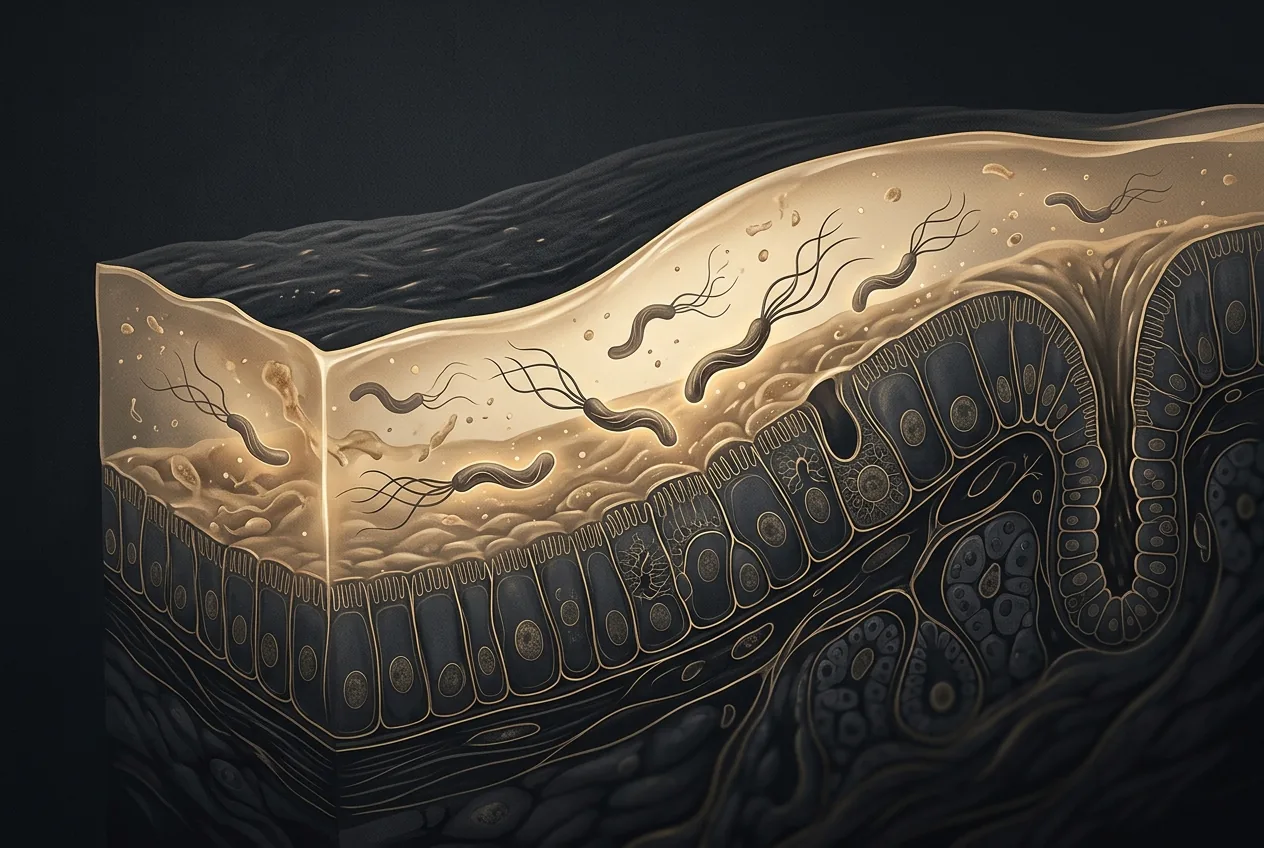
The stomach has an extremely acidic pH, often below 2. Helicobacter pylori survives there thanks to several remarkable adaptations.
A helical shape
Its spiral shape allows it to move easily through the protective mucus covering the gastric mucosa.
Flagella
It has several flagella that act like microscopic propellers and facilitate its movement.
Urease
Its main weapon is an enzyme called urease. This enzyme converts the urea present in the stomach into ammonia, creating a less acidic micro-environment around the bacterium that allows it to survive.
A strong ability to adhere
Thanks to various adhesion proteins, the bacterium anchors firmly to gastric cells and partly escapes the movements of the stomach.
How is it transmitted?
Infection mainly occurs during childhood. Transmission is essentially intrafamilial, oral-oral and sometimes oro-faecal depending on sanitary conditions.
The main factors favouring contamination are:
- family overcrowding;
- low socio-economic status;
- limited access to drinking water;
- insufficient hygiene.
In Western Europe, prevalence is gradually decreasing thanks to improved living conditions.
What does Helicobacter pylori really cause?
The course is highly variable. In about 80 % of infected people, the bacterium causes chronic gastritis without symptoms. In other patients, this inflammation can progress gradually.
Gastric ulcer
About 70 % of gastric ulcers are linked to Helicobacter pylori.
Duodenal ulcer
More than 90 % of duodenal ulcers are associated with this bacterium.
Gastric cancer
The individual risk remains low: about 1 % of infected people will develop a gastric adenocarcinoma. However, because of the very large number of infected people worldwide, Helicobacter pylori remains the leading preventable factor for gastric cancer. In 1994, the International Agency for Research on Cancer (IARC) classified it as a definite carcinogen (Group 1).
Why do some people develop cancer while others remain asymptomatic?
Cancer results from several factors.
The characteristics of the bacterium
Some strains are much more aggressive. The CagA and VacA proteins in particular increase inflammatory and carcinogenic potential.
Genetic background
Some people have a more intense inflammatory response.
The environment
Risk increases in particular with tobacco, a very salty diet, processed meats and low consumption of fruit and vegetables.
The microbiome
Recent research shows that the other bacteria present in the stomach probably also take part in the process of carcinogenesis.
What are the symptoms?
Most infections are completely asymptomatic. When symptoms exist, they are non-specific:
- epigastric pain;
- a burning sensation;
- digestive heaviness;
- bloating;
- nausea.
On their own, these symptoms do not allow the bacterium to be diagnosed.
How is the infection diagnosed?
The urea breath test
It is today the reference for diagnosing infection and checking cure after treatment. The patient drinks a solution containing urea labelled with carbon-13. If the bacterium is present, its urease breaks down this urea and the labelled carbon is found in the exhaled air. The test is very sensitive and completely non-invasive.
Stool antigen testing
This method is also very reliable. It can replace the breath test when the latter is not available.
Gastric endoscopy
It is indicated in particular after age 45–50 depending on the clinical context, in the presence of alarm signs, unexplained anaemia, weight loss, persistent vomiting or a suspected ulcer. It allows biopsies to be taken.
New PCR tests are changing management
One of the major recent advances is the use of PCR on gastric biopsies. This technique makes it possible to identify the bacterium and to immediately detect certain antibiotic-resistance mutations. Treatment can thus be adapted from the outset, without needlessly using an antibiotic to which the strain is resistant. This personalised approach is increasingly recommended in specialised centres.
Why is treatment becoming more difficult?
The main problem is the worldwide rise in resistance. Resistance to clarithromycin now exceeds 20 % in France and 30 % in some regions of Europe. The old triple therapies therefore achieve poorer results than in the past.
What is the treatment today?
Treatment generally combines a proton pump inhibitor (PPI), two or three antibiotics, and sometimes bismuth depending on the protocol. It usually lasts 14 days. Adherence is essential: even a few missed doses can promote treatment failure.
Why must efficacy always be checked?
Unlike many other infections, finishing the antibiotics is not enough: it is necessary to verify that the bacterium has really disappeared. The check is carried out at least four weeks after the end of the antibiotics and after temporarily stopping PPIs. The breath test is generally preferred. Yet several studies show that this check is still insufficiently performed.
Are PPIs dangerous?
Proton pump inhibitors are extremely effective. They remain essential in several situations: ulcers, gastro-oesophageal reflux, prevention of ulcers under NSAIDs in at-risk patients.
However, they are sometimes continued unnecessarily for years. Observational studies have suggested associations with digestive infections, fractures, vitamin B12 deficiency, hypomagnesaemia or kidney disease. Nevertheless, the causal links remain debated for several of these associations. Current recommendations stress above all a simple principle: prescribe PPIs when they are indicated and stop them when they are no longer needed, rather than maintaining them without reassessment.
Should the whole population be screened?
Not today in France. French recommendations favour targeted screening, in particular:
- in case of ulcer;
- before prolonged NSAID treatment in certain patients;
- in first-degree relatives of a patient with gastric cancer;
- in case of MALT lymphoma;
- in certain unexplained iron-deficiency anaemias or vitamin B12 deficiencies;
- during certain digestive endoscopies.
Conversely, countries such as Japan or South Korea, where the risk of gastric cancer is much higher, have developed broader screening strategies.
Is a vaccine conceivable?
Many teams have been working on a vaccine for several decades. Despite several promising trials, no vaccine is currently available in clinical practice. The bacterium's ability to escape the immune system makes this development particularly complex.
What this article does not demonstrate
Current data do not allow us to state that:
- every infected person will develop an ulcer;
- all patients should be screened;
- all treatments are effective without a check;
- PPIs are dangerous when correctly prescribed;
- antibiotics can be stopped as soon as symptoms disappear;
- diet alone can eradicate Helicobacter pylori.
The Valorian analysis
Helicobacter pylori perfectly illustrates how a scientific discovery can transform an entire medical specialty. Within a few decades, a disease long attributed to stress has become a chronic infection whose mechanisms are now well understood.
The challenge is no longer so much knowing how to treat the bacterium as treating the right patient, with the right antibiotics, and systematically verifying that eradication has succeeded. The rise in resistance gradually requires abandoning "blind" treatments in favour of a more personalised medicine based on identifying bacterial resistance.
At Valorian, we also consider that this infection is a reminder of an essential principle: cancer prevention often begins several decades before it appears. Identifying and treating Helicobacter pylori in at-risk people is today one of the few strategies able to directly prevent part of gastric cancers. However, universal screening is not yet justified in France. Decisions must remain individualised, taking into account age, family history, symptoms, geographical origin and personal risk.
Key points
- ◆Helicobacter pylori infects about half of humanity and is usually asymptomatic, but causes chronic gastritis.
- ◆It is linked to ~70 % of gastric ulcers and > 90 % of duodenal ulcers; classified a definite carcinogen (IARC), it is the leading preventable factor for gastric cancer.
- ◆Reference diagnosis: urea breath test or stool antigen; PCR on biopsies detects resistance and personalises treatment.
- ◆14-day treatment (PPI + antibiotics ± bismuth) with a systematic eradication check ≥ 4 weeks later; antibiotic resistance (clarithromycin) complicates management.
- ◆No universal screening in France: targeted screening (ulcer, family history of gastric cancer, MALT lymphoma, etc.). No vaccine available to date.
Valorian level of evidence
- Scientific quality(5/5)
The mechanisms of Helicobacter pylori, its role in ulcers and gastric cancer, and the diagnostic and therapeutic strategies rest on several decades of studies and international recommendations (Maastricht VI, HAS, IARC).
- Current clinical application(5/5)
Diagnosis, treatment and eradication control are routine practices. The new PCR techniques for guiding antibiotic choice are an important step towards personalised management.
- Future potential(5/5)
The next developments will probably concern the wider use of molecular tests, the development of new acid inhibitors (P-CABs), more effective targeted screening strategies and, in the longer term, the possible development of a vaccine against Helicobacter pylori.
References
- Malfertheiner P. et coll. Management of Helicobacter pylori infection: Maastricht VI/Florence Consensus Report. Gut. 2022.
- Haute Autorité de Santé (HAS). Recommandations françaises sur la prise en charge d'Helicobacter pylori.
- Agence internationale de recherche sur le cancer (CIRC/IARC). Nature Medicine, 2024 — stratégies mondiales de dépistage et de prévention du cancer gastrique.
- Graham DY. et coll. Publications récentes sur l'antibiorésistance et les nouvelles stratégies thérapeutiques.
Frequently asked questions
Is Helicobacter pylori dangerous if I have no symptoms?
Most infected people have no symptoms and will never develop a complication. However, the bacterium causes chronic gastritis and, in a minority, an ulcer or (rarely, ~1 %) gastric cancer. The decision to screen and treat depends on the individual context.
How do you know you are infected?
The non-invasive reference methods are the carbon-13 urea breath test and stool antigen testing. Endoscopy with biopsies is performed in the presence of alarm signs or depending on age and context.
Is treatment effective?
Yes, in most cases, but the rise in resistance (particularly to clarithromycin) sometimes requires adapting the antibiotics. PCR on biopsies makes it possible to identify resistance and personalise treatment.
Why is a check needed after treatment?
Because finishing the antibiotics is not enough: real eradication of the bacterium must be verified, at least four weeks after the end of treatment and after temporarily stopping PPIs, usually with a breath test.
Should the whole family be screened?
Not systematically. In France, screening is targeted, particularly in first-degree relatives of a patient with gastric cancer and in other at-risk situations. The decision must be individualised.
Topics