Apelin: the exercise hormone that could revolutionise the treatment of sarcopenia?
This muscle-produced "exerkine" stimulates regeneration, mitochondria and metabolism. Promising in animals, it is not yet a treatment: exercise remains the reference.
Doctor Florian A. Vallecillo Cabrera
Author
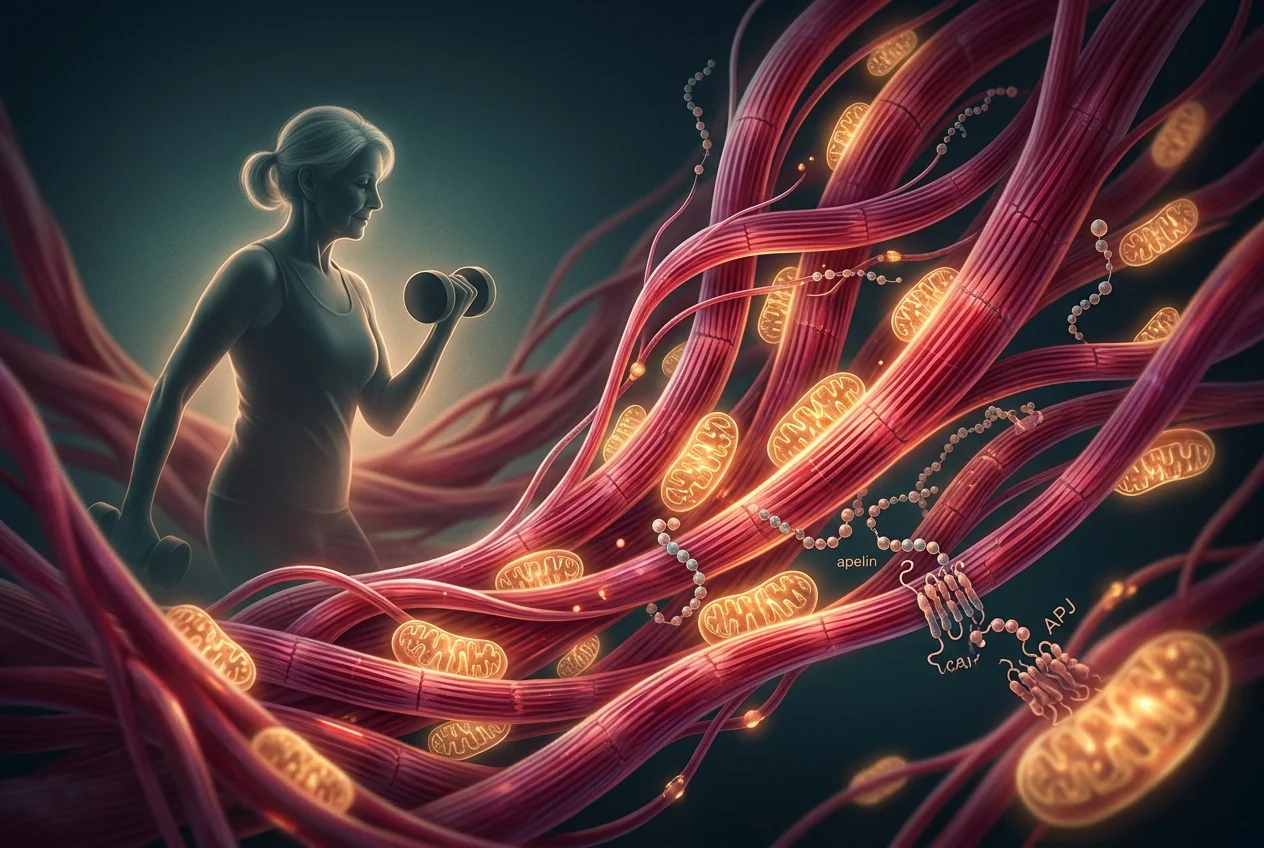
Apelin is an exerkine — a hormone produced by muscle during exercise — whose production declines with age. In animals, it stimulates satellite cells, improves mitochondrial function and metabolism, and restores muscle regeneration (Nature Medicine, 2018). No apelin-based treatment is available in clinical practice: analogues, APJ receptor agonists and microneedle patches (Pyr-Apelin-13) remain preclinical. The reference treatment for sarcopenia is still resistance exercise combined with adequate protein intake.
Summary
The progressive age-related loss of muscle mass, known as sarcopenia, is today one of the main causes of frailty, loss of autonomy and dependence in older people.
For a long time, the available treatments were limited to two pillars: physical exercise and a protein-rich diet.
In recent years, however, one molecule has been attracting researchers' attention: apelin.
This small hormone, naturally produced by muscles during physical activity, appears to play a major role in muscle regeneration, mitochondrial function, energy metabolism and the repair of muscle fibres.
Eight years after the first work was published in Nature Medicine, research has advanced considerably. Apelin now appears as one of the most promising avenues in regenerative muscle medicine. Nevertheless, no apelin-based treatment is yet available in clinical practice, and physical exercise remains the reference therapeutic strategy.
Sarcopenia: a genuine disease of ageing
For a long time, muscle loss was considered a "normal" consequence of ageing.
We now know that this is not the case.
Since 2016, sarcopenia has been recognised as a disease in its own right. The European diagnostic criteria (EWGSOP2) are based on three dimensions:
- a decrease in muscle strength;
- a reduction in muscle mass;
- a reduction in physical performance.
Muscle strength is now considered the best clinical marker of the disease.
From the age of 50, we lose on average 0.5 to 1% of muscle mass per year, but above all part of the functional quality of the muscle. After 70, this loss accelerates and increases the risk of falls, fractures, hospitalisations and loss of autonomy.
The muscle is much more than an engine
One of the major discoveries of the last twenty years is that muscle is also an endocrine organ.
When it contracts, it does not only produce force.
It secretes dozens of molecules called myokines that communicate with the brain, the liver, adipose tissue, the immune system and even the heart.
The main myokines include:
- irisin;
- interleukin-6 produced during exercise (to be distinguished from the IL-6 of chronic inflammation);
- myonectin;
- certain neurotrophic factors such as BDNF;
- and apelin.
These molecules partly explain why physical activity has a beneficial effect on health well beyond the muscle.
What is apelin?
Apelin is a small peptide discovered in the late 1990s.
It acts by binding to a specific receptor called APJ.
It is produced by several tissues:
- skeletal muscle;
- adipose tissue;
- the heart;
- endothelial cells;
- the brain.
Its production increases during physical exercise, which is why it is now classified among the exerkines, i.e. the molecules released in response to physical activity.
Why does apelin decline with age?
The work published in Toulouse and then confirmed by other teams has shown that ageing is accompanied by a progressive decrease in apelin production.
This decline appears to contribute to several phenomena:
- reduced capacity for muscle regeneration;
- mitochondrial impairment;
- decreased glucose uptake;
- reduced insulin sensitivity;
- reduced activity of the satellite cells responsible for muscle repair.
In some older people, even properly performed physical training leads to a much smaller increase in apelin than in young subjects, which could explain why not all seniors respond to exercise in the same way.
How does apelin act?
Research conducted since 2018 shows that apelin has several complementary effects.
It stimulates satellite cells
Satellite cells are the stem cells of the muscle.
They make it possible to repair damaged fibres and to produce new muscle fibres.
With age, their activity decreases.
Apelin appears to reactivate part of this regenerative capacity.
It improves mitochondrial function
Mitochondria are the power stations of our cells.
Ageing leads to a decrease in their efficiency.
Apelin promotes:
- energy production;
- mitochondrial respiration;
- the quality of the mitochondrial network.
These effects could help limit muscle fatigue.
It improves metabolism
Apelin increases:
- glucose uptake;
- insulin sensitivity;
- the use of fatty acids.
These properties also explain its potential interest in diabetes and obesity.
It reduces certain inflammatory pathways
Ageing is associated with low-grade chronic inflammation, called inflammaging.
This inflammation contributes to muscle wasting.
Apelin appears to modulate several inflammatory pathways involved in this process.
What did the landmark Nature Medicine study show?
The study published in 2018 is the first major experimental demonstration.
The researchers showed that:
- old mice produce much less apelin;
- administering apelin improves their muscle strength;
- muscle regeneration is restored;
- the mitochondria work better;
- physical capacities increase.
These results generated considerable enthusiasm because they suggested that part of muscle ageing could be corrected.
However, these were exclusively animal studies.
What have we learned since?
Since 2018, knowledge has advanced considerably.
Research confirms that apelin is involved in several fundamental mechanisms of muscle ageing. The most recent data also show that its role may differ between women and men. A review published in 2026 suggests that disturbances in apelin signalling linked to menopause could be particularly important in women, paving the way for more personalised therapeutic approaches.
In parallel, apelin is now being studied as a potential biomarker of sarcopenia, alongside other molecules such as myostatin, certain microRNAs and proteins involved in muscle metabolism.
Where does clinical research stand?
Despite the promising results obtained in animals, no apelin-based drug has yet been approved to treat sarcopenia.
Several strategies are, however, under development:
- more stable apelin analogues;
- APJ receptor agonists;
- sustained-release systems.
In 2026, a team showed in animal models that a microneedle patch delivering Pyr-Apelin-13 improved muscle mass, fibre structure and functional performance, illustrating the evolution of delivery approaches. These results, however, remain preclinical.
In addition, oral APJ receptor agonists are being developed in the field of obesity in order to preserve muscle mass during weight loss, but these data come mainly from preclinical research and early scientific communications.
Why is there still no treatment?
Because several major obstacles remain.
In particular, it is necessary to demonstrate:
- the safety of chronic treatment;
- the optimal dose;
- the necessary duration;
- its efficacy in humans;
- its clinical value compared with physical exercise.
Most molecules that are very promising in mice subsequently fail in clinical trials.
Caution therefore remains essential.
The reference treatment is still… exercise
To date, no molecule replaces physical activity.
International recommendations are still based on:
- resistance training (strength training) two to three times a week;
- a protein intake of 1 to 1.2 g/kg/day in healthy older people, and often more in the event of sarcopenia or disease;
- the correction of vitamin D deficiencies when they exist;
- regular physical activity including balance and endurance.
Apelin should therefore not be seen as a substitute for exercise, but as an avenue that could reproduce part of its benefits in the most frail individuals.
Other treatments under development
Apelin is not the only avenue being explored.
Researchers are also working on:
- myostatin inhibitors;
- bimagrumab;
- hormonal modulators;
- cell therapies;
- approaches targeting the mitochondria;
- drugs that stimulate satellite cells.
To date, none of these strategies has demonstrated sufficient efficacy to become a standard treatment.
What this study does not demonstrate
The current data do not demonstrate that:
- apelin reverses muscle ageing in humans;
- an apelin injection replaces strength training;
- a treatment is available in clinical practice;
- all patients with sarcopenia have an apelin deficiency;
- apelin improves the performance of young subjects or is a form of doping.
The most robust evidence still concerns animal models and translational research.
The Valorian analysis
The story of apelin perfectly illustrates how modern medicine evolves. What in 2018 was merely an experimental observation has become, in just a few years, a major field of research in gerontology and regenerative medicine. Recent work confirms that this exerkine is involved at the heart of the mechanisms of muscle ageing: fibre repair, mitochondrial function, energy metabolism and the dialogue between muscle and the other organs.
Nevertheless, it is essential to distinguish scientific hope from clinical application. Despite the progress made, no apelin-based treatment is currently available for patients, and the most innovative approaches – analogues, APJ receptor agonists or microneedle delivery systems – remain experimental.
The real lesson of this research may lie elsewhere: it reinforces the idea that the benefits of physical exercise are partly mediated by molecules produced by the muscle itself. Understanding this molecular language could eventually help the most frail older people who can no longer engage in sufficient physical activity.
In the meantime, the best "apelin-stimulating treatment" remains an appropriate physical activity programme, combined with protein-rich nutrition and a comprehensive management of frailty.
Key points
- ◆Sarcopenia has been recognised since 2016 as a disease in its own right (EWGSOP2 criteria: strength, mass, performance), with muscle strength being its best marker.
- ◆Apelin is an "exerkine": a hormone produced by muscle during exercise, whose production declines with age.
- ◆In animals, apelin stimulates satellite cells, improves mitochondrial function and metabolism, and restores muscle regeneration (Nature Medicine, 2018).
- ◆No apelin-based treatment is available in the clinic: analogues, APJ receptor agonists and microneedle patches delivering Pyr-Apelin-13 remain experimental (preclinical).
- ◆The reference treatment for sarcopenia remains resistance exercise + protein intake (1–1.2 g/kg/day, more in the event of disease) + correction of vitamin D.
Valorian level of evidence
- Quality of evidence(4/5)
The biological mechanisms of apelin are well documented in basic studies and numerous experimental models. Human data, however, remain limited.
- Current clinical applicability(2/5)
Apelin is not a treatment available in routine practice. The management of sarcopenia still relies on exercise, nutrition and the correction of risk factors.
- Future therapeutic potential(5/5)
Apelin is among the most promising candidates in regenerative muscle medicine. Recent developments in APJ receptor agonists, biomarkers and new delivery forms place it among the most exciting lines of research for the years to come.
References
- Vinel C. et al. The exerkine apelin reverses age-associated sarcopenia. Nature Medicine. 2018.
- Cruz-Jentoft AJ et al. EWGSOP2 European consensus on sarcopenia. Age and Ageing. 2019.
- Chen X. et al. Novel biomarkers for sarcopenia: a narrative review. Journal of Orthopaedic Surgery and Research. 2026.
- Menard R., Madelaine R. Hormonal dimorphism in sarcopenia disease. Aging. 2026.
- Kokotidou C. et al. Microneedle patch–based delivery of Pyr-Apelin-13 reverses functional and structural deficits in age-related sarcopenia. Scientific Reports. 2026.
Frequently asked questions
Can apelin replace strength training?
No. To date, no molecule replaces physical activity. Apelin is an avenue that could reproduce part of the benefits of exercise in the most frail people, but resistance training and adequate protein intake remain the reference treatment.
Is there an apelin-based drug for sarcopenia?
No. No treatment is approved. The strategies under development (more stable analogues, APJ receptor agonists, microneedle patches delivering Pyr-Apelin-13) are still at the preclinical or translational research stage.
Why does apelin production decline with age?
Ageing is accompanied by a progressive decline in apelin, associated with reduced muscle regeneration, mitochondrial impairment and reduced insulin sensitivity. In some seniors, exercise raises apelin less than in young people.
Is apelin a form of doping?
No. The data do not show that it improves the performance of young subjects. The most robust evidence concerns muscle regeneration in ageing models, mainly in animals.
Topics