Tick bites
How to remove them, symptoms and prevention

Tick bites are usually mild, but some can transmit diseases. Discover how to remove them correctly, what symptoms to monitor and when to consult the doctor for an appropriate assessment.
What are tick bites?
Ticks are parasitic arthropods that feed on the blood of animals and human beings. They attach to the skin by means of a specialised mouthpart and can remain attached for several hours or even several days before detaching.
Most bites only produce a small local reaction and evolve without complications. However, some ticks can transmit infectious diseases, so it is important to remove them correctly and monitor the evolution of the lesion.
Why do they appear?
Ticks usually live in forests, meadows, scrubland, rural areas and parks with tall vegetation. They can also be found on dogs, cats, horses, sheep, cows and wild animals.
When a person passes near vegetation, the tick can attach to the clothing or directly to the skin. The areas where they most frequently attach are the armpits, the groin, the scalp, behind the ears, the waist and the back of the knees.
What are the symptoms?
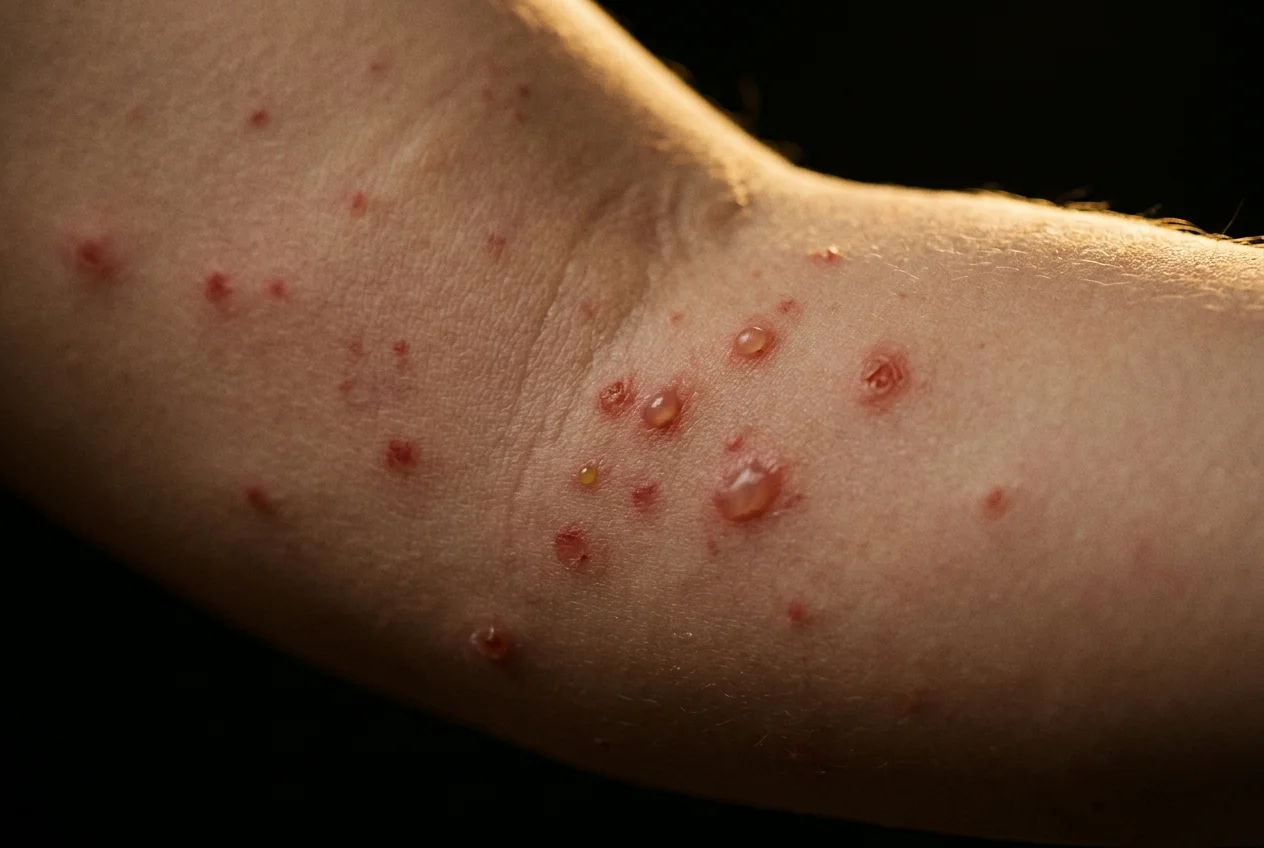
Most bites produce a small red papule, mild itching, discreet redness and local discomfort.
On many occasions the person discovers the tick before noticing symptoms. After removing it, a small lesion may persist for several days.
What diseases can they transmit?
Most bites do not transmit any disease. However, depending on the tick species and the geographical area, they can transmit infections such as Lyme disease, Mediterranean spotted fever, anaplasmosis, babesiosis, tick-borne encephalitis (in certain regions of Europe) and other less frequent infections.
It is important to remember that a tick bite does not mean that the person will develop a disease.
How is a tick removed correctly?
It must be removed as soon as possible. The correct way is to use fine-tipped tweezers, grasp the tick as close as possible to the skin, pull slowly upwards in a continuous manner and without abrupt twists, and then disinfect the area with an antiseptic.
You should not crush it, burn it or apply oil, alcohol, petroleum jelly, nail polish or other products before removing it, as these manoeuvres can favour the tick regurgitating its contents and increase the risk of transmission of microorganisms.
How is it diagnosed?
Usually the clinical examination is enough. If symptoms compatible with a tick-borne disease appear, the doctor will decide whether complementary tests are necessary, such as blood tests or other examinations.
It is not recommended to perform tests routinely after any bite if the person remains completely asymptomatic.
What treatments are available?
If there is only the bite. Generally only cleaning of the area, disinfection and observation during the following weeks are recommended.
Do I need antibiotics? In most cases, no. Preventive antibiotics are not indicated routinely after any tick bite. In very specific situations, according to the tick species, the time it has remained attached, the geographical area and the current medical recommendations, the health professional may assess a preventive treatment.
If a tick-borne disease is subsequently diagnosed, the treatment will depend on the specific infection.
What can you do day to day?
After removing the tick, monitor the area during the following weeks, keep the skin clean, avoid scratching the lesion and consult if new symptoms appear.
If you keep the tick, you can store it in a closed container to facilitate its identification if the doctor considers it useful, although it is not always necessary.
How to prevent bites?
When you go to the countryside or vegetated areas, wear long trousers, tuck the bottom of the trousers into the socks if you walk through tall vegetation, use authorised repellents, walk on clear trails, avoid sitting directly on tall grass, carefully check the whole body on returning and also examine children and pets.
The sooner an attached tick is removed, the lower the risk of transmission of some diseases.
When should you seek prompt medical advice?
You should see the doctor if, in the days or weeks after the bite, you have fever, intense headache, significant muscle pain, striking tiredness, a skin rash that increases in size (especially a ring-shaped lesion, or erythema migrans), progressive redness around the bite, discharge or signs of infection, or difficulty moving a limb or neurological alterations.
You should also consult if you cannot completely remove the tick.
Myths and facts
- Myth: All ticks transmit diseases. Fact: No. Most bites do not produce any infection.
- Myth: You have to put oil or alcohol before removing it. Fact: No. It must be removed directly with fine-tipped tweezers.
- Myth: If a tick bites me, I need antibiotics. Fact: Not in most cases. They are only indicated in specific situations.
- Myth: A small red mark means Lyme disease. Fact: No. A small local reaction is usual. Erythema migrans usually increases progressively in size over several days.
- Myth: Once the tick is removed I should no longer worry. Fact: It is advisable to monitor the appearance of symptoms during the following weeks.
The key points to remember
- Most tick bites do not transmit diseases.
- The tick must be removed as soon as possible with fine-tipped tweezers, without applying oil, alcohol or other products.
- After removing it, it is enough to clean the area and observe its evolution.
- Antibiotics are not indicated routinely after all bites.
- You should consult if fever, a rash that grows progressively or any other general symptom appears in the following weeks.
- Preventive measures and checking the body after outdoor activities are the best way to avoid complications.
Frequently asked questions
Do all ticks transmit Lyme disease?
No. Only certain species can transmit it and not all are infected.
How long must it remain attached to transmit an infection?
It depends on the disease and the tick species. In some infections the risk increases the longer it remains attached.
Can I remove it with my fingers?
It is not advisable. It is preferable to use fine-tipped tweezers.
Should I keep the tick?
It is not essential, although in some cases it can be useful if symptoms subsequently appear.
Can I shower afterwards?
Yes. There is no contraindication.
Does the bite always produce itching?
No. Many people do not present any discomfort.
Can the wound become infected?
Yes, although it is not frequent. You should monitor if pus, increased pain or progressive redness appears.
Should I have blood tests?
Not routinely if you have no symptoms.
Can pets bring ticks home?
Yes. It is important to maintain adequate antiparasitic protection in dogs and cats.
Does it have a good prognosis?
Yes. The vast majority of bites evolve favourably without complications.
Need personalised guidance?
This guide is for information only and does not replace a medical consultation. For an assessment tailored to your case, you may request a consultation.
Request a consultation