Actinic keratoses
Precancerous sun-related lesions
Actinic keratoses are precancerous lesions caused by accumulated sun damage. Learn how to identify them, which treatments exist and why it is important to treat them early.
What are actinic keratoses?
Actinic keratoses are precancerous skin lesions caused by the accumulated damage of ultraviolet (UV) radiation over the years.
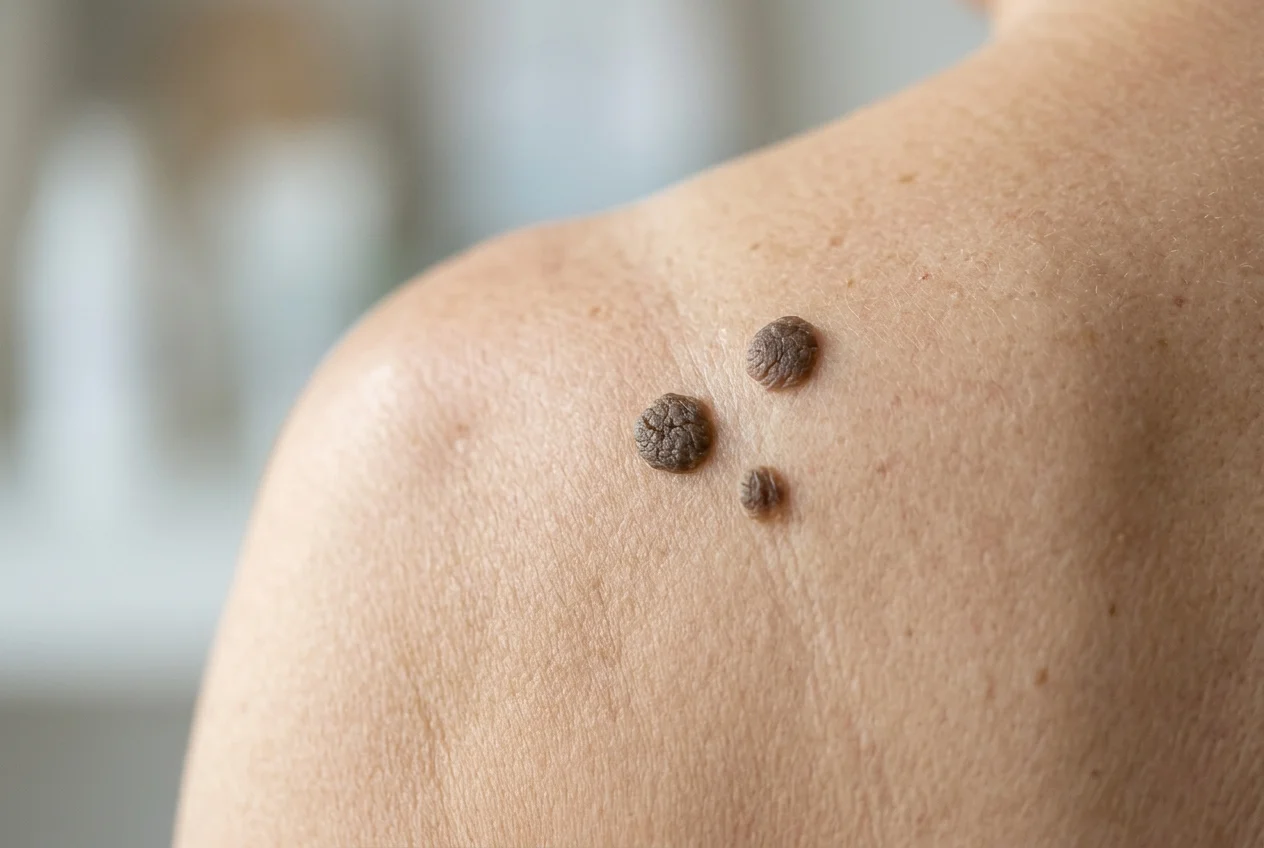
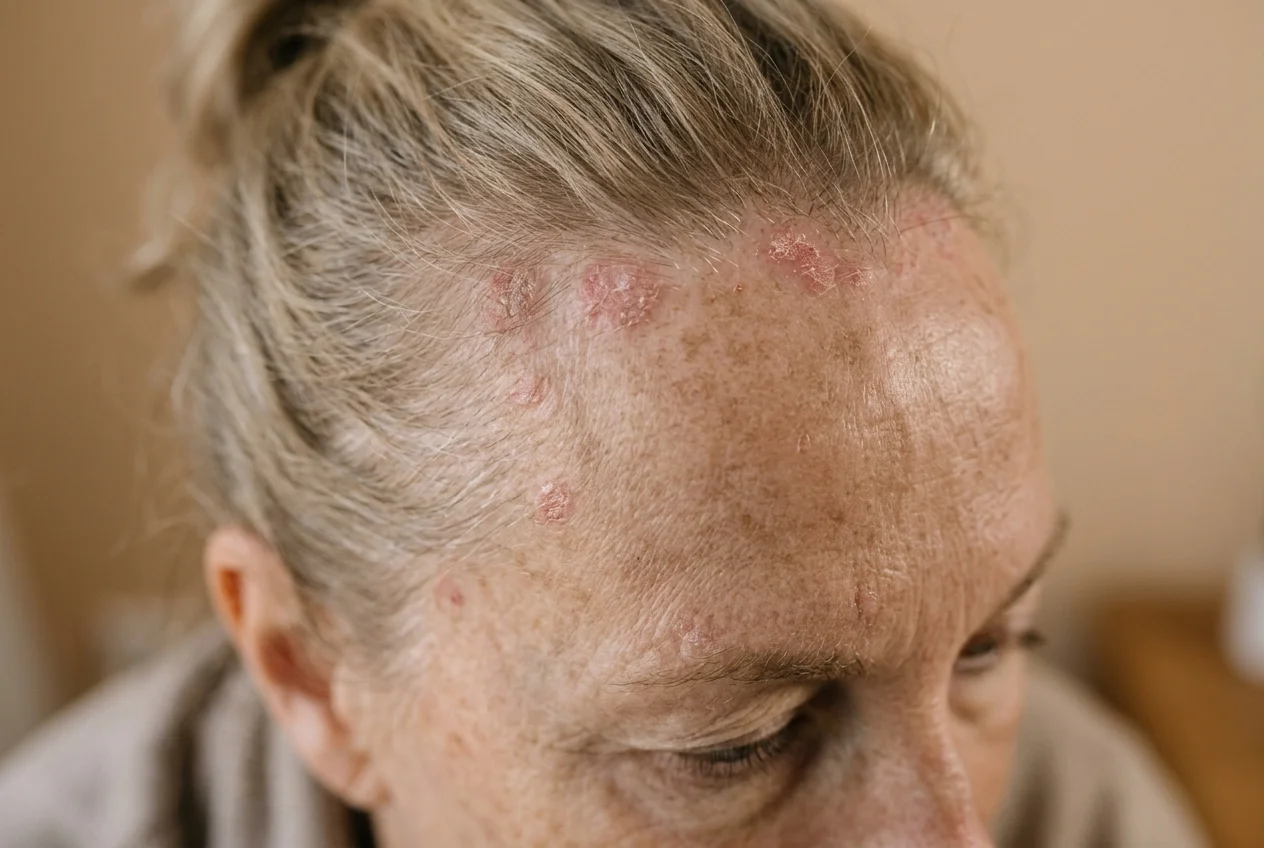
They present as small rough, dry or scaly areas that appear mainly on the most sun-exposed areas.
Although many people consider them simply «spots» or «crusts», actinic keratoses are important because a small proportion can evolve into a squamous cell carcinoma, a type of skin cancer. For this reason, they must be assessed and treated by a doctor.
The areas where they appear most frequently are: the face, the scalp (especially in people with baldness), the ears, the nose, the décolletage, the back of the hands and the forearms.
Why do they appear?
The main cause is sun damage accumulated over years. Each sun exposure produces small lesions in the DNA of the skin cells. Over time, these lesions accumulate and some cells begin to grow abnormally.
Why do they appear from a certain age? Because the damage produced by the sun is cumulative. They do not appear because of getting older, but because of the sum of many years of sun exposure.
Why do some people have many and others none? Several factors are involved: the skin type (fair-skinned people have a higher risk), accumulated sun exposure, repeated sunburns (especially in childhood), outdoor professions or activities, personal history of skin cancer and a weakened immune system.
Why do new lesions keep appearing? Because sun damage affects all exposed skin, even areas where there are not yet visible lesions. This is why we speak of the concept of «field of cancerisation», that is, skin damaged by the sun with a risk of developing new actinic keratoses.
What are the symptoms?
Many people notice the lesion with their fingers before seeing it in the mirror. Actinic keratoses usually present as:
- Plaques or spots rough to the touch.
- A rough or scaly surface.
- Pink, reddish, brown or skin-coloured colour.
- Crusts that appear and disappear.
- Persistent lesions.
In some cases they can cause itching, a burning sensation, mild pain when touched or occasional bleeding.
Their size usually varies between a few millimetres and one or two centimetres.
How is it diagnosed?
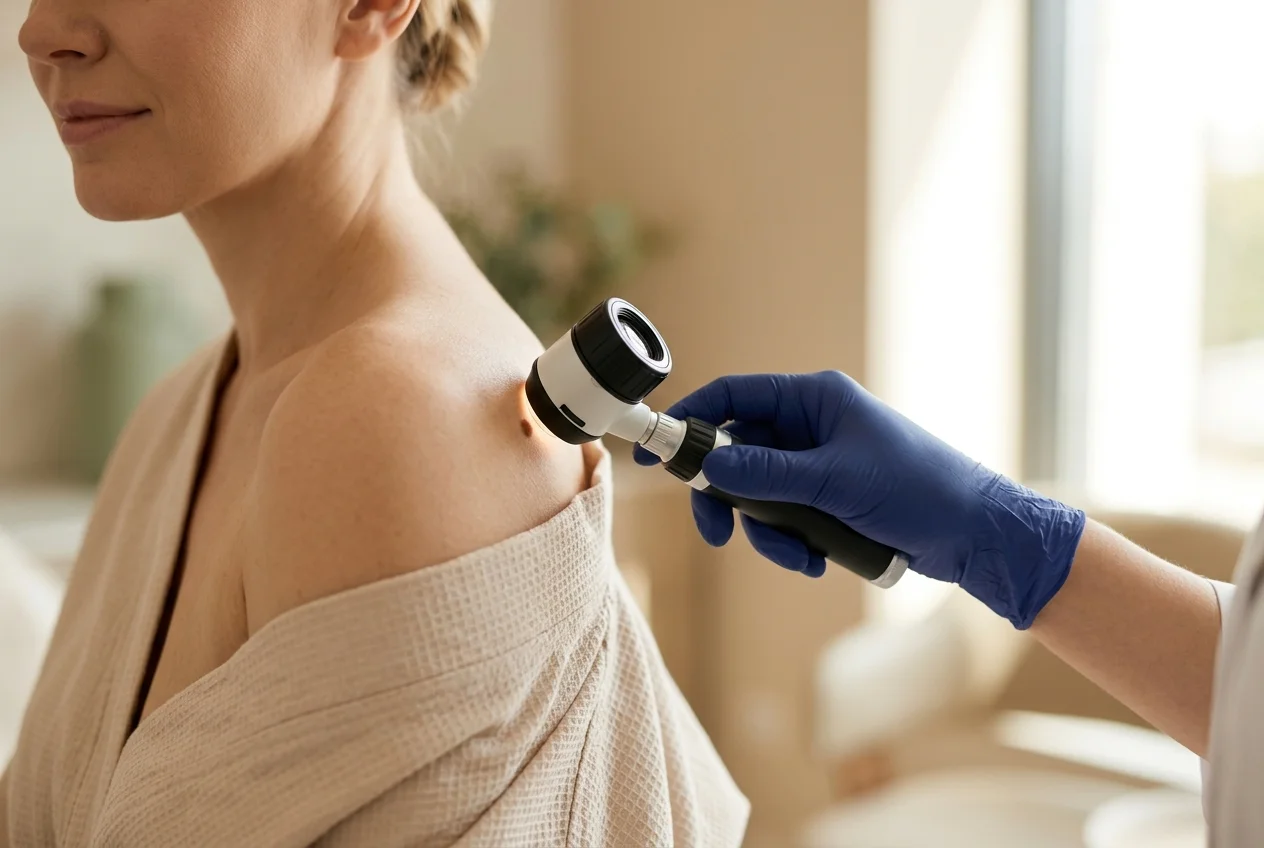
In most cases, diagnosis is made through clinical examination. The doctor will use a dermatoscope, which allows the characteristic structures of these lesions to be observed.
On some occasions, especially if there is a suspicion that the lesion has evolved into a squamous cell carcinoma, a biopsy may be necessary.
The rest of the skin will also be examined to detect other lesions related to sun damage.
What treatments are available?
One of the most frequent questions is: «Is it necessary to treat all actinic keratoses?» In most cases, yes. Although not all will evolve into cancer, we cannot currently predict which ones will.
Treatment will depend on the number of lesions, their location and the characteristics of each patient.
Cryotherapy
It consists of applying liquid nitrogen to destroy the lesion. It is one of the most used treatments when there are few actinic keratoses.
Topical treatments
When there are multiple lesions or a field of cancerisation, specific creams or gels prescribed by the doctor can be used. Among them are: 5-fluorouracil, imiquimod, diclofenac and tirbanibulin. These treatments eliminate both the visible lesions and other microscopic alterations.
Photodynamic therapy
It is a very effective technique for treating multiple actinic keratoses, especially on the face and scalp. It makes it possible to treat entire areas of damaged skin with excellent aesthetic results.
Other treatments
In some cases laser, curettage or surgical excision may be used if there is a suspicion of malignant transformation.
Why do they reappear? Because treatment removes the existing lesions, but does not erase the accumulated sun damage. This is why periodic check-ups and photoprotection are essential.
What can you do day to day?
In addition to medical treatment, it is recommended to:
- Use sunscreen SPF 50+ every day.
- Wear a hat when there is sun exposure.
- Avoid the sun during the central hours of the day.
- Do not pull off the crusts.
- Examine the skin periodically.
- Attend the check-ups indicated by your doctor.
These measures reduce the risk of developing new lesions.
When should you seek prompt medical advice?
Seek medical assessment if a lesion:
- Grows rapidly.
- Bleeds easily.
- Ulcerates.
- Causes persistent pain.
- Has a lump or hardening.
- Does not heal.
- Clearly changes in appearance.
These changes may indicate evolution into a squamous cell carcinoma and require early evaluation.
Myths and facts
- Myth: Actinic keratoses are just age spots. Fact: No. They are precancerous lesions related to accumulated sun damage.
- Myth: If they do not hurt, they do not need treatment. Fact: Many produce no symptoms and yet must be treated.
- Myth: They only appear in very old people. Fact: They can appear earlier in people with intense sun exposure.
- Myth: Removing them prevents them from coming back. Fact: Treatment removes the existing lesions, but new ones can appear if the skin continues to be exposed to the sun.
- Myth: Sunscreen is no longer useful once the lesions have appeared. Fact: Photoprotection remains essential to prevent new actinic keratoses and reduce additional sun damage.
The key points to remember
- Actinic keratoses are precancerous lesions caused by accumulated sun damage.
- Not all evolve into cancer, but they must be assessed and treated.
- They usually appear on the most sun-exposed areas.
- Cryotherapy, topical treatments and photodynamic therapy are very effective options.
- Daily sun protection and medical check-ups are essential.
- Any lesion that grows, bleeds or changes in appearance should be evaluated as soon as possible.
Frequently asked questions
Are actinic keratoses a cancer?
No. They are precancerous lesions with a risk of evolving into a squamous cell carcinoma.
Should they always be treated?
In most cases, yes.
Are they contagious?
No.
Can they disappear on their own?
Sometimes a lesion may disappear temporarily, but it usually reappears. Spontaneous cure should not be expected.
Does cryotherapy hurt?
It can produce a brief discomfort and a burning sensation for a few seconds.
Will I need several sessions?
It will depend on the number of lesions and the chosen treatment.
Can new lesions appear?
Yes. Accumulated sun damage favours the appearance of new actinic keratoses over time.
Should I check all my skin?
Yes. People with actinic keratoses have a higher risk of developing other types of skin cancer and should have periodic check-ups.
Does treatment leave a scar?
Generally not, although it depends on the type of treatment and each patient.
Can I prevent them?
Yes. Daily photoprotection from an early age significantly reduces the risk of developing them.
Need personalised guidance?
This guide is for information only and does not replace a medical consultation. For an assessment tailored to your case, you may request a consultation.
Request a consultationTopics