Cutaneous larva migrans
Creeping eruption: symptoms and treatment

Cutaneous larva migrans is a parasitic infection acquired by contact with contaminated sand or soil. Learn about its symptoms, the characteristic winding track, how it is diagnosed and the most effective antiparasitic treatments.
What is cutaneous larva migrans?
Cutaneous larva migrans, also known as creeping eruption, is a skin infection caused by the larvae of certain parasites, mainly hookworms of dogs and cats (Ancylostoma braziliense and Ancylostoma caninum).
The human being is an accidental host. The larvae penetrate the skin, but cannot complete their life cycle, so they remain moving superficially through the epidermis for weeks or even months.
The disease is frequent in tropical and subtropical regions, although it is increasingly diagnosed in travellers returning from beach areas of America, Africa, Asia or the Caribbean. Although it is usually very striking due to the appearance of the lesions, it is a benign disease and has effective treatment.
Why does it appear?
Infected dogs and cats eliminate parasite eggs through their faeces. In conditions of heat and humidity, these eggs evolve in the sand or the soil until they become larvae capable of penetrating human skin.
The infection usually occurs when walking barefoot on beaches, lying directly on the sand, being in contaminated gardens or handling contaminated humid soil. The larvae cross the superficial layer of the skin and begin to move slowly beneath it.
Where is it most frequent?
It is common on tropical beaches, coastal areas of the Caribbean, Central and South America, Southeast Asia, Africa and some regions of Oceania.
In Europe it is usually diagnosed in people who have recently returned from a trip.
What are the symptoms?
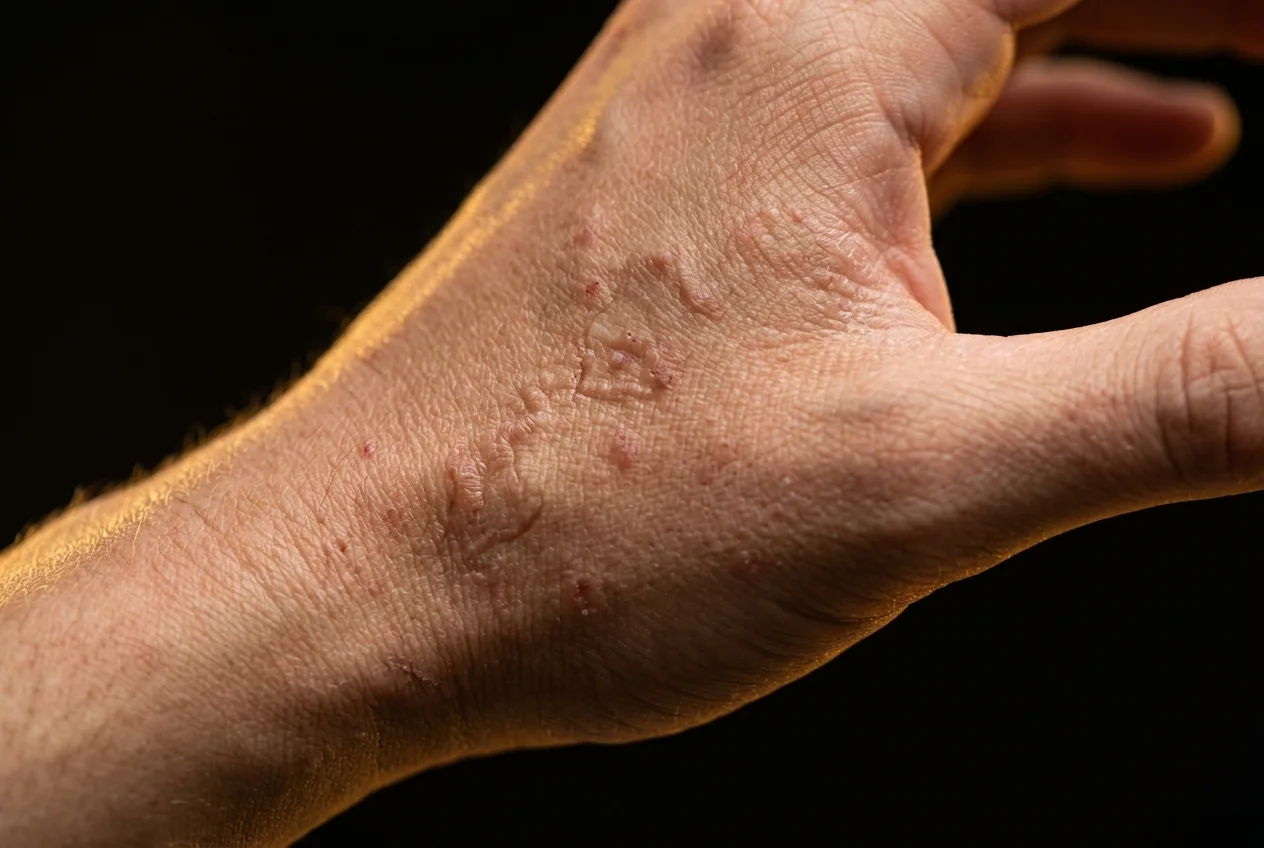
The main symptom is very intense itching, which usually worsens at night. The characteristic lesion consists of a reddish, raised, thin and very sinuous track that changes position every day. The larva usually advances between a few millimetres and several centimetres per day.
The most affected areas are the soles of the feet, the toes, the ankles, the legs, the buttocks and the thighs. It is frequent for the lesions to appear in the areas that have been in direct contact with the sand.
Is it dangerous?
In the vast majority of cases, no. The larvae remain confined to the skin and eventually die. They do not usually affect internal organs or produce serious complications.
The main discomfort is the intense itching and the risk of secondary bacterial infection from scratching.
How is it diagnosed?
The diagnosis is fundamentally clinical. The doctor suspects the disease when there is a typical serpiginous track, intense itching and a recent history of travel to tropical areas or contact with contaminated sand.
Complementary tests are generally not necessary. Skin biopsy is rarely useful, as the larva is usually found ahead of the visible lesion.
What treatments are available?
Although the disease can resolve spontaneously after several weeks or months, it is recommended to treat it, as the treatment accelerates healing and quickly relieves the itching.
Oral treatment. The most used medications are albendazole and ivermectin. Both have a high cure rate. The choice will depend on each patient and the medical assessment.
Topical treatment. In very limited lesions, topical thiabendazole can be used. However, it is currently used less frequently than oral treatments.
Itch treatment. In some patients oral antihistamines and topical corticosteroids for a few days if there is significant inflammation can be useful, always associated with antiparasitic treatment when indicated.
What can you do day to day?
While receiving treatment, avoid scratching, keep the skin clean, cut the nails to reduce the risk of infection, wear comfortable clothing that does not irritate the lesion and always complete the treatment indicated by your doctor.
The itching usually improves notably a few days after starting the treatment.
How can it be prevented?
To reduce the risk of infection it is recommended not to walk barefoot on beaches where dogs or cats circulate, use a towel or mat to lie on the sand, avoid direct contact with potentially contaminated soil, periodically deworm pets and favour the sanitary control of stray animals.
These measures are especially important during trips to tropical areas.
When should you seek prompt medical advice?
You should consult if the itching is very intense, if the lesion continues to advance, if pus or signs of infection appear, if you have fever, if the lesions are multiple or very extensive, or if you have recently returned from a trip and present a characteristic serpiginous lesion.
Myths and facts
- Myth: The larva can travel throughout the whole body. Fact: No. It usually remains limited to the superficial layer of the skin.
- Myth: It is a worm that lives forever inside the skin. Fact: No. In the human being it cannot complete its life cycle and ends up dying.
- Myth: You have to open the skin to remove the larva. Fact: No. Treatment with antiparasitics usually eliminates it without the need for surgical procedures.
- Myth: It only appears in people with poor hygiene. Fact: No. The infection is acquired by contact with contaminated sand or soil and can affect anyone.
- Myth: If the itching disappears, the infection has already disappeared. Fact: It is important to always complete the treatment prescribed by the doctor.
The key points to remember
- Cutaneous larva migrans is an infection produced by larvae of parasites of dogs and cats.
- It is acquired mainly by walking barefoot or lying on contaminated sand.
- It produces a reddish winding track that advances slowly and causes intense itching.
- The diagnosis is usually made through clinical examination and the history of travel or exposure.
- Ivermectin and albendazole are very effective treatments.
- The disease has an excellent prognosis and, with appropriate treatment, usually resolves without leaving sequelae.
Frequently asked questions
Is it contagious?
No. It is not transmitted from one person to another.
Can it affect internal organs?
No. Cutaneous larva migrans remains practically always limited to the skin.
How long does it take to heal?
With treatment it usually improves in a few days and resolves in a few weeks. Without treatment it can persist for weeks or even months.
Does it leave a scar?
Usually not, unless there is a secondary infection or very intense scratching.
Can I do sport?
Yes, as long as the lesion is not painful and is kept clean.
Can I bathe?
Yes. There is no contraindication, although it is advisable to maintain correct hygiene of the area.
Can it reappear?
Yes, if a new exposure to contaminated sand or soil occurs again.
Do I need blood tests?
Not usually. The diagnosis is generally clinical.
Can children suffer from it?
Yes. It is relatively frequent in children who play barefoot on contaminated beaches or parks.
Is there a cure?
Yes. The antiparasitic treatment is very effective and most patients recover completely without sequelae.
Need personalised guidance?
This guide is for information only and does not replace a medical consultation. For an assessment tailored to your case, you may request a consultation.
Request a consultation