Frontal fibrosing alopecia
Scarring alopecia: symptoms and treatment

Frontal fibrosing alopecia is a scarring alopecia that mainly affects women after the menopause. Discover its symptoms, how it is diagnosed and the treatments that can help to stop its progression.
What is frontal fibrosing alopecia?
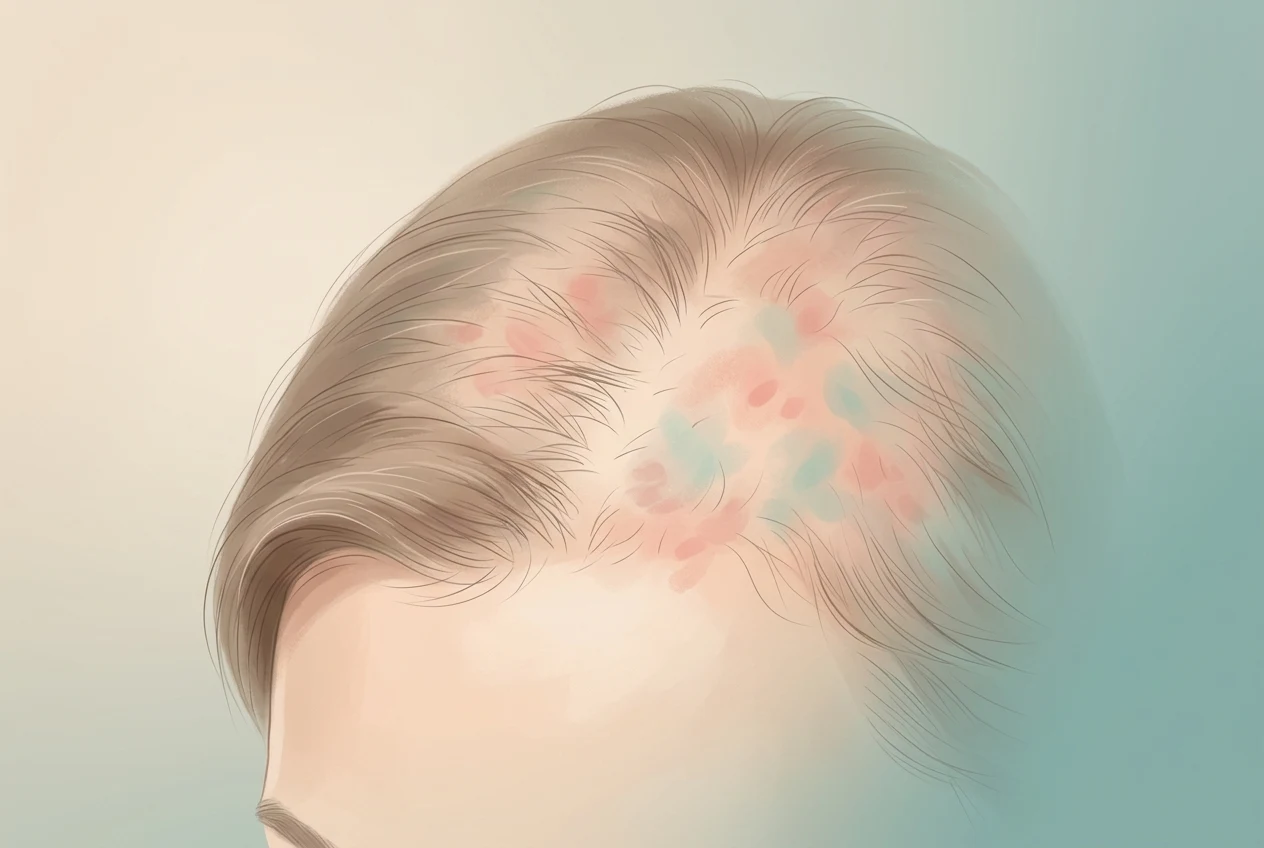
Frontal fibrosing alopecia (FFA) is a chronic scarring alopecia in which the immune system causes inflammation around the hair follicles, destroying them progressively and replacing them with scar tissue. As a consequence, the lost hair cannot grow back spontaneously, so the main objective of treatment is to stop or slow the progression of the disease as soon as possible.
The disease was first described in 1994 and its frequency has increased notably during the last decades. It mainly affects women after the menopause, women between 40 and 70 years of age and, less frequently, young men and women. It is currently considered a variant of lichen planopilaris.
Why does it appear?
The exact cause is still unknown. It is believed that several factors are involved: genetic predisposition, alterations of the immune system, hormonal factors and environmental factors not yet completely identified.
The main mechanism consists of an inflammatory reaction that progressively destroys the hair follicles. Currently there is no single demonstrated cause.
Is it an autoimmune disease?
It is considered an immune-mediated disease. The immune system partially loses tolerance towards the hair follicle and triggers a chronic inflammation that ends up destroying it.
It can be associated with other autoimmune diseases, especially autoimmune thyroiditis, vitiligo and other autoimmune diseases less frequently.
What are the symptoms?
The most characteristic sign is the progressive retraction of the frontal hairline. In addition, hair loss on the temples, a decrease in frontal density, loss of the eyebrows (very frequent), loss of body hair, itching, burning, a burning sensation and pain when touching the scalp can appear.
In some patients the disease barely produces symptoms.
What happens with the eyebrows?
The loss of the eyebrows is one of the most characteristic signs of the disease. In many patients it appears even before the loss of the hair of the scalp.
The partial or complete disappearance of the eyebrows can be a very important diagnostic clue.
How does it evolve?
The evolution is usually slow. Without treatment, the hairline can recede progressively over years. The speed of progression is very variable between patients.
In some cases the disease stabilises spontaneously, although it is not possible to predict when this will happen.
How is it diagnosed?
The diagnosis is based on the clinical history, the scalp examination and trichoscopy (hair dermatoscopy). Trichoscopy can show absence of follicular openings, perifollicular erythema, scales around the follicle, isolated follicles and signs of scarring.
In some cases it is advisable to perform a scalp biopsy to confirm the diagnosis. Tests may also be requested when associated diseases are suspected.
What treatments are available?
Treatment must be started as soon as possible to try to preserve the greatest number of follicles.
Corticosteroids. Topical corticosteroids, intralesional injections and oral corticosteroids for limited periods in selected cases can be used.
Calcineurin inhibitors. Topical medications such as tacrolimus and pimecrolimus can be used as complementary treatment.
Antimalarials. Hydroxychloroquine is one of the most used systemic treatments to control inflammation in selected patients. It requires medical follow-up and periodic ophthalmological controls.
5-alpha reductase inhibitors. Medications such as finasteride and dutasteride have been shown to be useful in slowing the progression in many patients, especially when there is an associated androgenetic alopecia.
Other systemic treatments. In selected patients doxycycline, low-dose isotretinoin, mycophenolate mofetil, methotrexate, ciclosporin and other immunomodulators can be used. The choice depends on the activity and severity of the disease.
Minoxidil. It can be used as a complementary treatment to improve the density of the hair that still preserves viable follicles. It does not act on the inflammation.
Can a hair transplant be performed?
Yes, but only when the disease remains completely stable for a prolonged period, usually of several years. Performing a transplant on an active disease considerably increases the risk of failure.
Stability must be confirmed through specialised assessment.
What can you do day to day?
Attend periodic reviews, do not stop the treatment without consulting, avoid traumatising the scalp, protect the frontal line from the sun, use photoprotection when there is sun exposure and monitor the evolution through periodic photographs.
When should you seek prompt medical advice?
You should consult if you observe that the frontal line recedes, if you begin to lose the eyebrows, if persistent itching or burning appears, if you notice redness of the scalp, if the treatment stops controlling the disease or if you observe a rapid progression of the hair loss.
Early diagnosis is fundamental to preserve the greatest possible number of follicles.
Myths and facts
- Myth: It is an alopecia the same as common baldness. Fact: No. Frontal fibrosing alopecia is a scarring and inflammatory alopecia.
- Myth: The hair will grow back when the inflammation disappears. Fact: Destroyed follicles cannot regenerate. The objective is to preserve those that still remain active.
- Myth: It is contagious. Fact: No. It cannot be transmitted between people.
- Myth: It only affects the hair. Fact: It can also affect the eyebrows and body hair.
- Myth: The transplant always solves the problem. Fact: It can only be considered when the disease has been completely stable for a long time.
The key points to remember
- Frontal fibrosing alopecia is a scarring alopecia of immune-mediated origin.
- It produces a progressive recession of the frontal hairline and, frequently, loss of the eyebrows.
- Destroyed follicles cannot regenerate, so early diagnosis is fundamental.
- Trichoscopy and, occasionally, biopsy make it possible to confirm the diagnosis.
- There are effective treatments to control the inflammation and slow the progression.
- Periodic follow-up by a doctor specialised in trichology is essential to preserve the remaining hair.
Frequently asked questions
Is there a cure?
Currently there is no definitive cure, but there are treatments capable of slowing or halting the progression in many patients.
Is it hereditary?
A genetic predisposition can exist, although most cases appear sporadically.
Will the lost hair grow back?
The hair lost in the scarred areas does not usually recover.
Can the eyebrows grow back?
It depends on the degree of follicular destruction and the moment the treatment is started.
Will I need treatment for a long time?
Yes. It usually requires prolonged follow-up to control the activity of the disease.
Can I dye my hair?
Generally yes, as long as the scalp does not present significant inflammation and the doctor considers it appropriate.
Is it frequent?
No. It is much less frequent than androgenetic alopecia, although its incidence has increased in recent years.
Can it coexist with other alopecias?
Yes. The association with androgenetic alopecia is relatively frequent.
Do I need a biopsy?
Not always, although in many cases it helps to confirm the diagnosis.
Does it have a good prognosis?
It depends on how quickly it is diagnosed. Early treatment makes it possible to preserve a greater number of follicles and limit the progression of the disease.
Need personalised guidance?
This guide is for information only and does not replace a medical consultation. For an assessment tailored to your case, you may request a consultation.
Request a consultationTopics