Subungual hematoma
Blood under the nail after a blow: causes and treatment
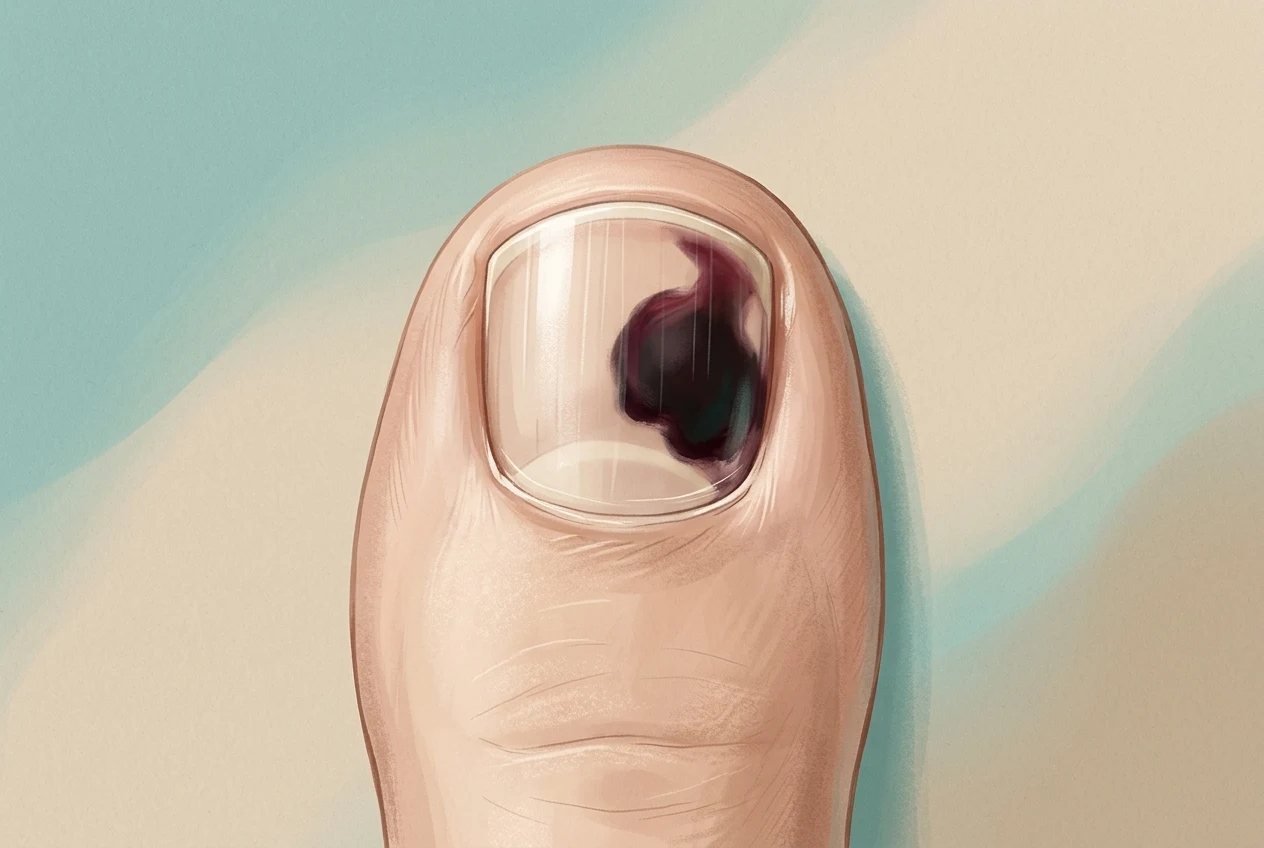
The subungual hematoma is an accumulation of blood under the nail after a trauma. Learn its symptoms, when it is necessary to drain it and how to differentiate it from other pigmented lesions such as subungual melanoma.
What is a subungual hematoma?
The subungual hematoma is an accumulation of blood under the nail, generally as a consequence of a trauma. The blood is trapped between the nail and the nail bed, producing a dark red, purple or black spot that can be accompanied by intense pain due to the increased pressure under the nail.
It can affect both the fingernails and the toenails, although it is especially frequent in athletes, runners, people who use footwear that is too tight and workers exposed to repeated blows. In most cases it is a benign lesion that resolves as the nail grows.
Why does it appear?
The most frequent cause is a trauma. Among the most usual situations are direct blows to the finger, the trapping of the finger in a door, the fall of heavy objects, impact sports, hiking or long-distance running, the use of shoes that are too small and repeated microtrauma.
Sometimes the patient does not remember a specific blow, especially when the hematoma is due to small repeated traumas.
What are the symptoms?
The symptoms depend on the size of the hematoma. Intense pain immediately after the blow, a pulsatile sensation, a red, purple or black spot under the nail, swelling of the finger, sensitivity when touching the nail and difficulty in walking if it affects a toe can appear. When the hematoma occupies a large part of the nail surface, the pain can be very intense during the first hours.
What happens with the nail?
Depending on the intensity of the trauma, different situations can occur: the hematoma disappears progressively with the growth of the nail, the nail detaches partially (onycholysis) or the nail can detach completely (spontaneous avulsion). If the nail matrix has not suffered important damage, the new nail usually grows normally.
How is the diagnosis made?
The diagnosis is usually clinical. The doctor will assess the history of trauma, the intensity of the pain, the size of the hematoma, the integrity of the nail and possible associated fractures or lesions.
Dermatoscopy. Dermatoscopy makes it possible to observe the characteristic pattern of the hematoma and differentiate it from other pigmented lesions.
Radiograph. It can be requested when a fracture of the distal phalanx is suspected after an important trauma.
Can it be confused with a melanoma?
Yes. Some old hematomas can resemble a melanonychia or even a subungual melanoma. There are some guiding differences: the hematoma usually appears after a trauma, the pigment moves towards the tip as the nail grows and the color usually changes progressively during reabsorption.
However, when there is any diagnostic doubt, especially if there is no traumatic history or the lesion does not migrate with the growth of the nail, a medical evaluation should be performed to rule out a subungual melanoma.
What treatments exist?
Treatment depends on the size of the hematoma and the intensity of the pain.
Small hematomas. When the pain is mild, it is generally only recommended to apply ice during the first hours, elevate the limb, take analgesics if necessary and wait for the nail to grow.
Drainage of the hematoma. If the pain is very intense and the hematoma is recent, the doctor can perform a nail trephination, which consists of making a small hole in the nail to evacuate the accumulated blood. This procedure relieves the pain quickly, is performed in a few minutes, usually does not require removing the nail and is more effective when performed during the first 24-48 hours after the trauma.
Important lesions. When there is an important rupture of the nail, a lesion of the matrix, open wounds or associated fractures, a specific surgical treatment may be necessary.
What can you do in your daily life?
Keep the nail clean, avoid new traumas, use wide footwear if it affects the foot, do not try to perforate the nail at home, protect the finger during sports practice and monitor the evolution of the color as the nail grows.
When should you consult the doctor or go to the emergency room?
You should consult if the pain is very intense, if the hematoma occupies a large part of the nail, if the nail is torn off or broken, if there is deformity of the finger, if you suspect a fracture, if pus or signs of infection appear, if the dark color does not advance towards the tip with the growth of the nail or if you do not remember any trauma.
Myths and facts
- Myth: Every black spot under the nail is a hematoma. Fact: No. Some pigmented lesions correspond to melanonychias or, in infrequent cases, to a subungual melanoma.
- Myth: The nail always has to be removed. Fact: Most hematomas do not require removing the nail.
- Myth: Perforating the nail at home is a good idea. Fact: No. It can cause infections and additional lesions if it is not performed with sterile material and by a professional.
- Myth: If the nail falls off, it will not grow back. Fact: If the nail matrix remains intact, the nail usually regenerates completely.
- Myth: The black color disappears in a few days. Fact: The spot disappears slowly as the nail grows.
The essential points to remember
- The subungual hematoma is an accumulation of blood under the nail, usually caused by a trauma.
- It produces a red, purple or black spot and can cause intense pain.
- Recent and very painful hematomas can be relieved through a drainage performed by a professional.
- Most disappear as the nail grows.
- It is important to differentiate a hematoma from other pigmented lesions, especially from subungual melanoma.
- If there is no clear traumatic history or the lesion does not evolve as expected, you should consult a specialized doctor.
Frequently asked questions
How long does it take to disappear?
It depends on the growth of the nail. On the hands it usually disappears in about 4 to 6 months, while on the feet it can take 12 to 18 months.
Does it always hurt?
No. Small hematomas can be practically painless.
Do I need antibiotics?
No, unless there is an infection.
Can I do sports?
Yes, although it is advisable to protect the finger and avoid painful activities until recovery.
Can the nail fall off?
Yes. In important traumas it can detach totally or partially.
What happens if the nail falls off?
A new nail will usually grow if the matrix has not been damaged.
Can it become infected?
Yes, although it is not frequent if the skin remains intact.
When should I worry about a melanoma?
When the pigmentation appears without a known trauma, does not move with the growth of the nail or presents atypical characteristics.
Can I paint my nail?
It is preferable to wait until the hematoma has stabilized and the diagnosis is clear.
Does it have a good prognosis?
Yes. Most subungual hematomas resolve completely without leaving permanent sequelae.
Need personalised guidance?
This guide is for information only and does not replace a medical consultation. For an assessment tailored to your case, you may request a consultation.
Request a consultationTopics