Mole self-examination: how to check your skin correctly
How to check your skin step by step
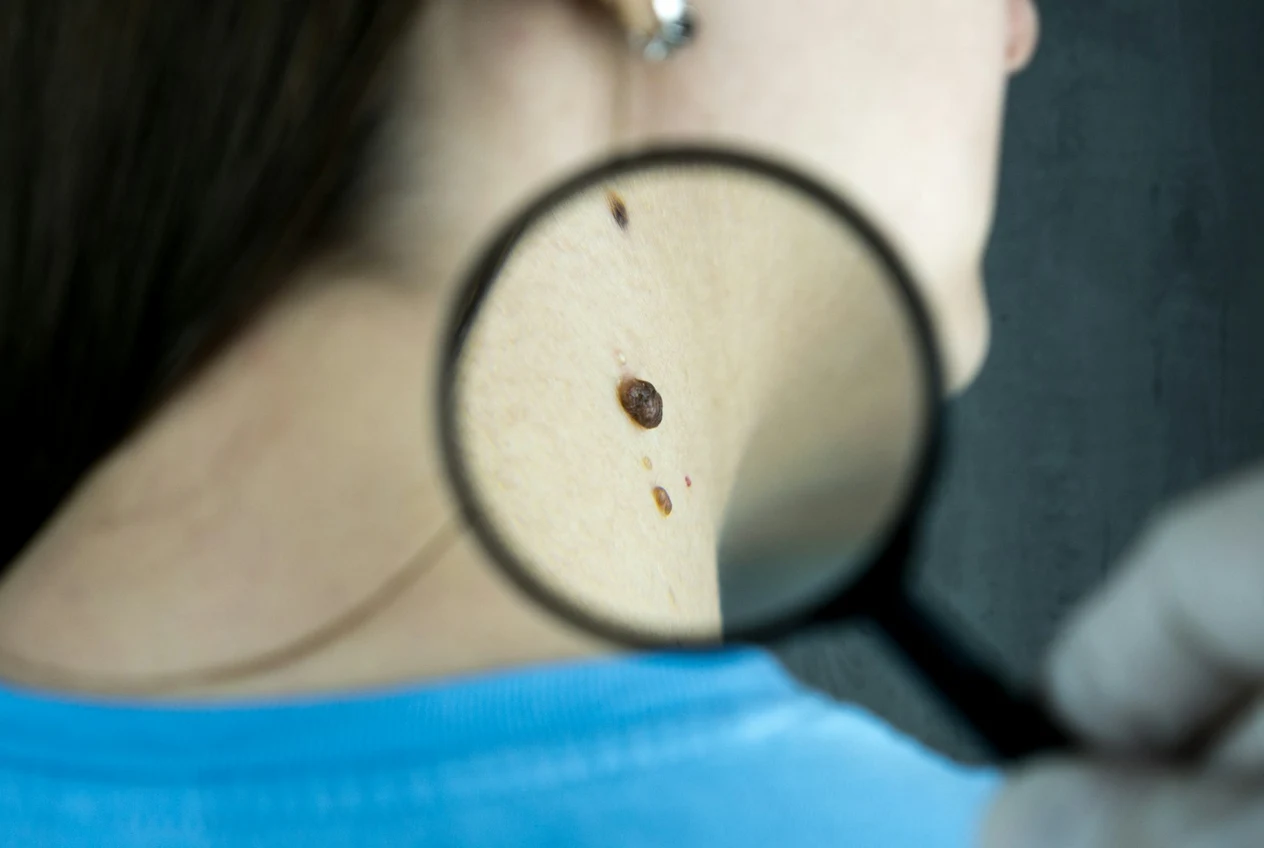
The monthly self-examination of the skin helps to detect suspicious changes in moles early. Knowing the ABCDE rule, the "ugly duckling" sign and consulting for any new or changing lesion are essential measures to prevent melanoma and other skin cancers.
Why is it important to check moles?
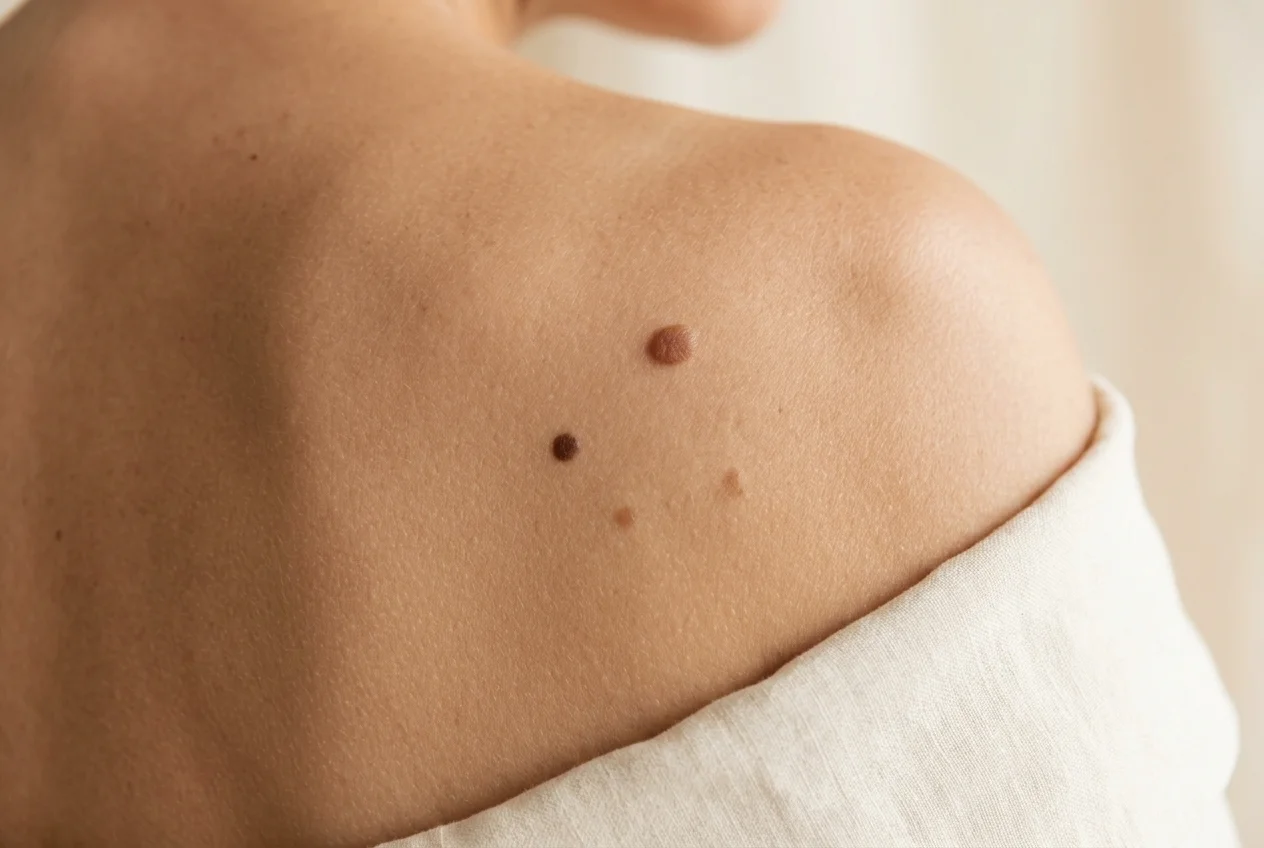
Most moles are completely benign and remain stable throughout life.
However, some skin cancers, especially melanoma, can develop on a pre-existing mole or appear on apparently normal skin.
For this reason, periodic self-examination of the skin is one of the most effective tools for detecting changes early.
Detecting a suspicious lesion in time can make a great difference to the prognosis.
How often should I check my skin?
In most people it is recommended to carry out a complete self-examination once a month.
It is not necessary to do it more frequently, since many changes are slow and could go unnoticed if the skin is observed every few days.
Regularity is more important than frequency.
Who should pay special attention?
Self-examination is advisable for the whole population, but it is especially important in people who have:
- Very fair skin.
- A large number of moles.
- Atypical moles.
- Personal or family history of melanoma.
- Repeated sunburns.
- Previous use of tanning beds.
- Immunosuppressive treatments.
- A history of skin cancer.
What do I need to perform a self-examination?
It only takes a few minutes and:
- A well-lit room.
- A large mirror.
- A hand mirror for difficult areas.
- In some cases, the help of another person to check the back or the scalp.
It can be useful to take periodic photographs to compare the evolution of certain lesions.
How to correctly check all your skin?
It is advisable to always follow the same order.
Face and scalp. Check the forehead, the nose, the ears, the lips and the neck. Use a comb or a hairdryer to part the hair and observe the scalp.
Trunk. Carefully observe the chest, the abdomen, the sides, the back and the lumbar region. Do not forget the armpits.
Arms and hands. Check the shoulders, the arms, the elbows, the forearms, the palms, the back of the hands, the fingers and the nails.
Legs and feet. Examine the thighs, the knees, the legs, the ankles, the soles of the feet, the spaces between the toes and the nails.
Areas that are often forgotten. Do not forget to check the scalp, the ears, the neck, the buttocks, the genital region, the soles of the feet, the palms of the hands and the nails. Some melanomas appear precisely in these locations.
What changes should attract attention?
Consult a doctor specialised in skin health if you observe:
- A new mole in adulthood.
- Changes in size.
- Changes in shape.
- Changes in colour.
- Spontaneous bleeding.
- Persistent crusts.
- Continuous itching.
- Pain.
- A lesion that does not heal.
The ABCDE rule
The ABCDE rule helps to recognise suspicious lesions.
- A — Asymmetry: one half of the mole is different from the other.
- B — Borders: the borders are irregular, jagged or poorly defined.
- C — Colour: there are several colours within the same lesion.
- D — Diameter: generally greater than 6 mm, although some melanomas are smaller.
- E — Evolution: it is the most important piece of information. A mole that changes always deserves a medical assessment.
The "ugly duckling" sign
Many people have numerous moles that are similar to one another.
A lesion that is clearly different from the rest (the "ugly duckling") deserves special attention, even if it does not meet all the ABCDE criteria.
Do all melanomas arise from a mole?
No.
An important part of melanomas appears directly on previously healthy skin.
For this reason, new lesions must also be monitored.
Should I have all my moles removed?
No.
The vast majority of moles are benign and do not need treatment.
They should only be removed when there is a clinical suspicion or a specific medical indication.
When should I visit the skin health specialist?
Request an assessment if you observe:
- A mole that changes.
- A new lesion of strange appearance.
- A wound that does not heal.
- Persistent bleeding.
- Rapid growth.
- Any lesion that raises doubts.
Never wait several months "to see what happens".
Dermatoscopy: a fundamental aid
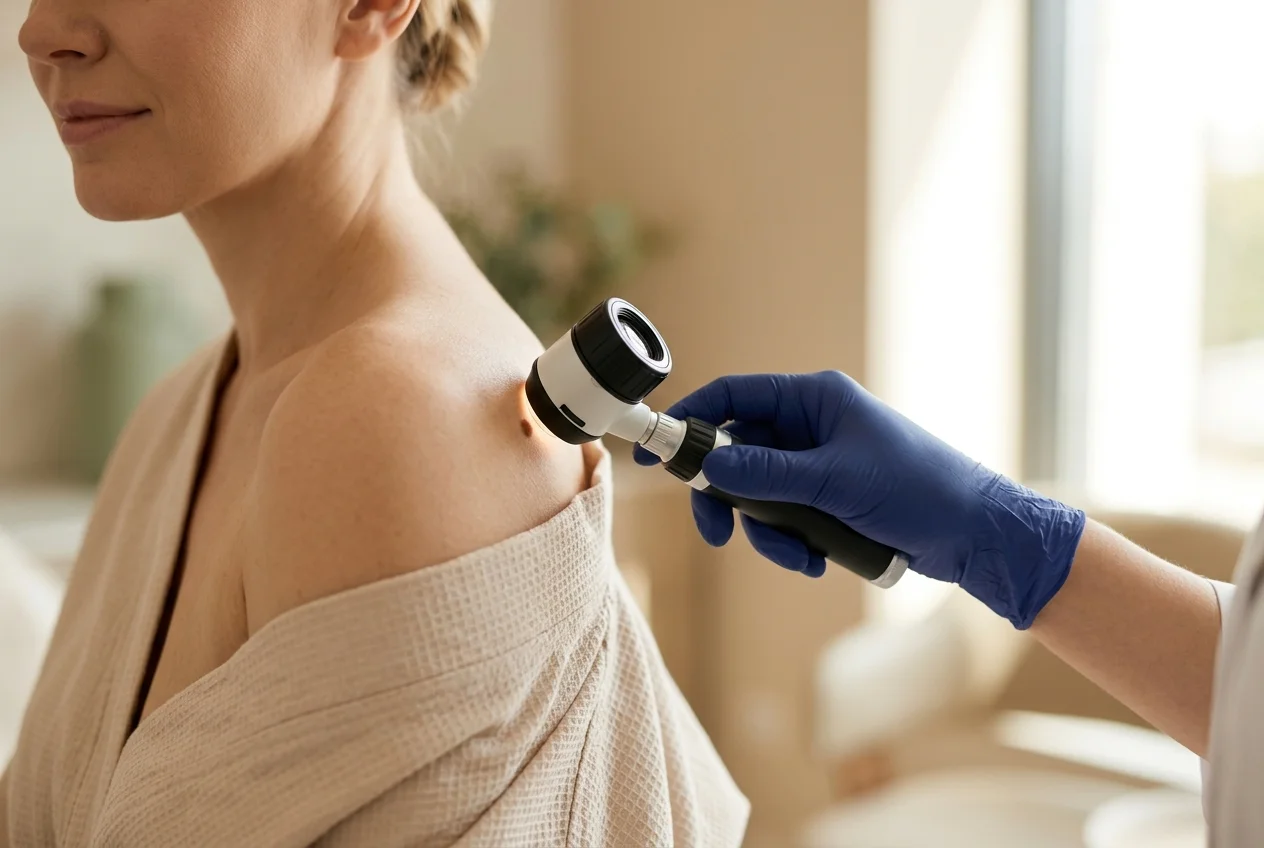
The doctor specialised in skin health can examine the moles by means of a dermatoscope, an instrument that allows the visualisation of structures invisible to the naked eye.
In patients with many moles, follow-up can also be carried out by digital dermatoscopy, comparing images obtained over time.
Myths and facts
- Myth: All large moles are dangerous. Fact: Many large moles are completely benign.
- Myth: If a mole does not hurt, nothing is wrong. Fact: Most early melanomas do not produce pain.
- Myth: All melanomas appear on a mole. Fact: Many appear on previously healthy skin.
- Myth: If a mole bleeds once, it is not important. Fact: Any lesion that bleeds spontaneously must be assessed.
- Myth: Removing a mole makes it turn into cancer. Fact: This is completely false. The removal of a suspicious mole is precisely what allows the diagnosis to be established and, in many cases, the disease to be cured.
The essential points to remember
- Check all your skin once a month, always following the same order.
- The evolution of a mole is the most important sign.
- The "ugly duckling" sign can help detect suspicious lesions.
- Many melanomas appear on previously healthy skin.
- Most moles are benign and do not need treatment.
- If you have any doubt, always consult a doctor specialised in skin health.
Frequently asked questions
How often should I check my moles?
Once a month is usually enough.
Should I take photographs?
Yes. They can be very useful for detecting changes over time.
Do all moles change?
No. Most remain stable for years.
What does the letter "E" of ABCDE mean?
Evolution. It is the most important criterion.
Can a melanoma appear on a foot?
Yes. It can also develop on the soles, the nails or the palms.
Should I also check the nails?
Yes. Some melanomas appear under the nail.
When should I consult?
For any change, any new suspicious lesion or any doubt.
Does dermatoscopy hurt?
No. It is a quick, completely painless and non-invasive examination.
Is a check-up advisable even if I notice no changes?
In people with risk factors, yes.
What is the best prevention?
Daily photoprotection, periodic self-examination and medical skin check-ups when indicated.
Need personalised guidance?
This guide is for information only and does not replace a medical consultation. For an assessment tailored to your case, you may request a consultation.
Request a consultationTopics